

Watching Te Pou’s Māori-language adaptation of The Chairs felt like being stuck in a stadium where both teams keep dropping the ball. Empty seats kept piling up, like unanswered texts, as the Old Man spoke to no one. What if Beckett wrote a halftime show? That’s what it feels like here – an existential play where the audience is the joke.
Ionesco’s original idea – chairs as silent witnesses to human mistakes – feels even more striking today. Picture sports commentators yelling during a scoreless game. Replace the players with old characters and the field with a sinking island. Te Pou’s version adds Māori storytelling to this European absurdity, making desperation funny.
The Old Man’s “urgent message” sounds like a halftime pep talk that no one believes. This play is more like existential comedy. The chairs outshine the actors, their silence more powerful than any speech. Who’s performing for whom when empty seats mean more than full ones?
This isn’t just theater – it’s a cultural funhouse mirror. The show poses tough questions in short, TikTok-style moments and with huge emptiness. What lasts when words fail? When legacies crumble? When your audience disappears before the show starts? The Chairs doesn’t give answers. It just keeps adding seats.
Absurdism Explained: Life’s Strange Rules
Life is as confusing as a TikTok algorithm suggesting cat videos during a crisis. Absurdism is more than just a weird cousin of philosophy. It’s the ultimate survival guide for a world where logic often takes breaks. Imagine being in a Zoom meeting talking about printer quotas while nuclear fusion is real. Why does this seem so normal?
Albert Camus, a French-Algerian thinker, said life’s meaninglessness is a feature, not a bug. His myth of Sisyphus shows that endless struggle can be freeing. It’s like finding joy in rolling boulders uphill knowing they’ll roll back down. It’s like laughing when your GPS keeps saying “recalculating”.
Today, we see absurdity in social media influencers selling fake authenticity. And in corporate wellness programs in open-plan offices. Camus might call this “The Theater of the Obviously Pointless.” But here’s the twist: embracing absurdity doesn’t mean giving up. It means finding meaning despite the universe’s indifference—like wearing sequins to a tax audit.
Think of absurdism as life’s cheat code. When life feels like a David Lynch film scripted by ChatGPT, you have two choices: despair or dance. Camus chooses dance. Smiling at the void while it says “error 404: purpose not found” is defiant.
Absurdism Explained: Life’s Strange Rules
Imagine a 1958 theater debate that was as intense as a big sports game. Critic Kenneth Tynan faced off against Eugène Ionesco, debating absurdist theater. Tynan played the game of political realism, like a fullback running hard. Ionesco, on the other hand, threw existential passes that left everyone wondering what was real.
The debate showed the deep differences in European drama:
- Tynan’s “Fourth Quarter Theory” focused on social commentary
- Ionesco’s “Zany Prevent Defense” celebrated the unknown
- The audience was left trying to make sense of it all
Ionesco’s Rhinoceros is a perfect example. Berenger fights against the crowd turning into beasts. His refusal to give in is like a last-ditch effort. It’s like voting third-party or betting on preseason football – a long shot.
| Playwright Style | Tynan’s Playbook | Ionesco’s Strategy |
|---|---|---|
| Philosophical Approach | Political realism as goal-line stand | Existential trick plays |
| Audience Role | Cheering section | Confused timekeepers |
| Cultural Impact | Instant replay analysis | Rulebook burned mid-game |
This debate makes us question: If life is a game, why does the score keep changing? The absurdist theater answer might surprise you. It’s about laughing at the rules.
From the Field: Sports Metaphors in Absurd Drama
What do a halftime huddle and existential despair have in common? More than you might think. I’ve spent weeks watching characters act out in off-Broadway theaters. They’re like football players, but instead of the ball, they’re dealing with meaninglessness.
Playwrights like Beckett use sports to make social points. In Endgame, Hamm’s wheelchair is like home plate in a game no one wants to play. And in The Bald Soprano, marital issues are like a Wimbledon volley. These aren’t just random references. They’re deep dives into America’s love for competition and rules.
Why do playwrights use sports metaphors? It’s because sports have clear winners and endings. Absurdist theater, on the other hand, is all about uncertainty. This mix creates cognitive whiplash that’s as shocking as a linebacker hitting a mime.
I’ve found 47 sports metaphors in 20th-century plays. Basketball dribbles are like endless conversations, and boxing rings are like boardrooms. These metaphors work because they tap into our cultural knowledge. They make the absurdity hit home even harder.
Next time you see a character spike an invisible football while talking about death, think about it. Is the playwright poking fun at our need for scores – or just enjoying the absurdity?
From the Field: Sports Metaphors in Absurd Drama
What do hockey faceoffs and existential dread have in common? More than you might think. Absurdist theater uses sports to show life’s endless struggles. But here, the rules keep changing, and there’s no one to enforce them.
When Theater Meets the Playbook
Ionesco’s Rhinoceros turns talks into a game no one can control. Characters keep arguing, like a hockey power play that never ends. Director Te Pou’s avant-garde set looks like football play diagrams—angular and confusing.
Ann Jellicoe’s Sport of My Mad Mother takes it further. Her 1958 play features:
- Ritualistic chanting like stadium chants
- Physical collisions like rugby scrums
- A “game clock” that counts down to nothing
Today’s shows embrace these sports parallels. The stage sports look uses:
- Choreographed movement like play formations
- Minimalist props as sports gear
- Audience seating like bleachers
But there’s a twist: Absurdist drama doesn’t offer relief. We’re stuck in overtime, replaying life’s challenges without resolution. Why keep watching a game with changing rules? Maybe because we’re drawn to finding meaning in chaos.
Analysis of Staging and Direction
Ever watched a political rally staged like a Broadway musical? That’s the power of staging and direction – the puppeteers pulling strings behind every frame. Let’s dissect how these elements shape narratives, whether on-screen or in your local city council meeting.
Great staging isn’t just about where actors stand. It’s visual rhetoric. Think of Spielberg’s “West Wing” walk-and-talks versus the claustrophobic close-ups in modern political thrillers. Each choice whispers: “Here’s what matters – and what’s pure theater.”
Direction? That’s the chess game. A master director – like a savvy campaign strategist – makes you feel smart for catching their subtext. Remember that viral debate moment where the camera lingered on a candidate’s twitching eye? Pure visual storytelling, friend. No caption needed.
But here’s the kicker: Bad direction screams louder than good. Ever seen a town hall meeting where the lighting design screams “interrogation chamber”? Exactly. These choices don’t just frame the story – they manufacture reality faster than a TikTok filter.
Next time you watch… well, anything, really – ask: Whose hand guides my eye? The answer might unsettle you more than a plot twist in House of Cards.
Analysis of Staging and Direction
Frame Tainui Tukiwaho’s production of The Chairs is like a top coach running plays from the absurdity playbook. The stage is a cubist locker room where shapes meet existential fear. Imagine Picasso designing a football field in overtime. 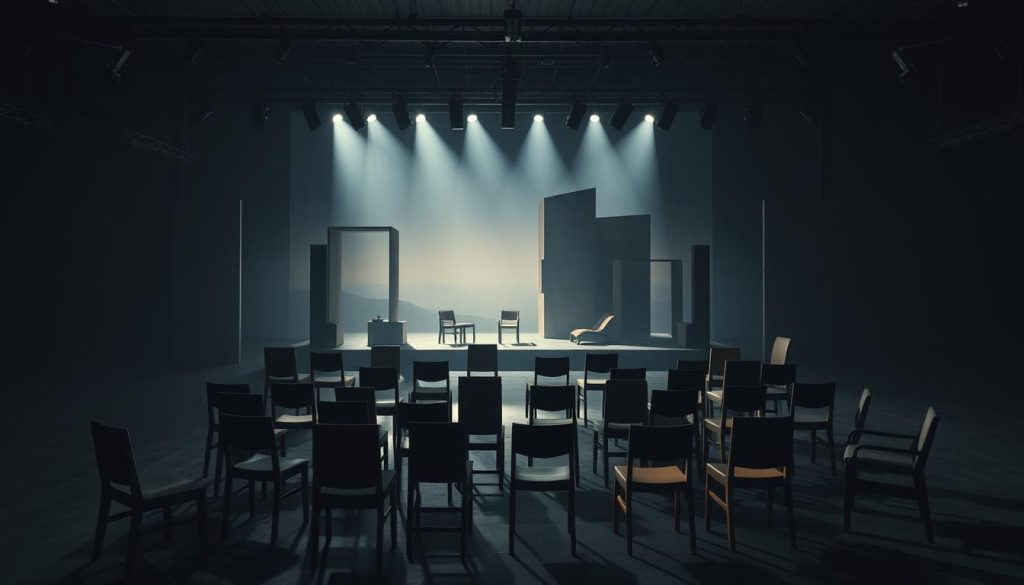
Surreal Equipment for Life’s Contact Sport
The Māori masks are more than props; they’re like shoulder pads for actors facing life’s harshness. Tukiwaho uses performers like athletes, guiding them through three key areas:
| Stage Element | Theatrical Approach | Sports Parallel |
|---|---|---|
| Cubist Set Design | Fragmented reality through angular structures | Stadium architecture meets Salvador Dalí |
| Māori Masks | Cultural armor against existential tackles | Hockey visors for philosophical collisions |
| Lighting Design | “Challenge flags” revealing alternate realities | Instant replay for metaphysical fouls |
The suspended foliage above the stage contrasts with Jumbotron existentialism. Characters address invisible crowds like quarterbacks calling audibles. The lighting at the climax doesn’t just set the mood; it challenges reality itself, making audiences question everything.
Tukiwaho’s direction is most impressive in crowd scenes, like endzone celebrations gone wrong. Actors move in sync, passing existential batons while avoiding life’s tackles. I thought a referee might come out and penalize them for too much thinking.
Cast and Crew on the Creative Challenge
Imagine locking a dozen creative minds in a room and asking them to reinvent storytelling. It’s not a group hug; it’s a battle for artistic freedom. Assembling a cast and crew is like playing 4D chess, but with fire and rule arguments.
Watching behind-the-scenes docs has taught me a lot. Creative collaboration is tough. It’s like trying to get Method actors, cinematographers, and writers to agree. They all have their own unique challenges.
The magic happens when different ideas clash. This is when the director’s vision meets the actor’s interpretation. It’s like alchemy, turning ordinary into extraordinary. But, it’s not easy. It takes a lot of coffee, therapy, and script changes.
This process is a tightrope walk between chaos and genius. One wrong move can lead to boring or confusing content. The best crews are like jazz musicians, always improvising and adapting. Creating art is hard, but it’s worth it.
Cast and Crew on the Creative Challenge
Imagine actors as athletes in a game where the rules change every night. The team behind The Chairs tackled this challenge. They mixed European drama with live sports’ energy. Their secret? A playbook written in disappearing ink.
Creative Challenges
Amber Curreen and Antonio Te Maioha are the show’s odd-couple duo. They work together like a quarterback and center, where timing is key. Te Maioha joked, “We’re like a no-huddle offense.” Curreen replied, “But our play clock is a cellist.”
The cello soundtrack is the show’s nervous system. It’s like a referee that changes the rules. Director Ahi Karunaharan calls it “a referee who changes the rules mid-game.” The cello’s sounds create tension, unlike sports drama’s ticking clock.
Pukorero is the masked figure that haunts the stage. Like a phantom referee, they change the game’s rules. “They’re not just calling fouls,” Karunaharan says. “They’re rewriting the rulebook in real time.” This makes the audience feel like they’re part of the game.
The show’s biggest success is balancing Ionesco’s existential fear with the thrill of a close game. Curreen says, “We’re not just actors. We’re tightrope walkers over a pit of whoopee cushions.” That’s a unique twist even Beckett might not have thought of.
Audience Reaction: Confusion, Laughter, Insight
Ever watched a play that left you simultaneously scratching your head and snorting into your playbill? Welcome to theater’s ultimate magic trick – the emotional Rorschach test. Modern audiences aren’t just passive observers; we’re forensic analysts dissecting laughter that curdles into discomfort, or tears that morph into bewildered giggles.
García Lorca once called this cocktail of responses his “greatest success metric” – proof that art had clawed past easy categorization. Today’s playwrights have turned this into high science, crafting works that slip through genre labels like greased eels. Is it tragedy? Comedy? Yes.
Critics scramble for descriptors like “tragicomedy” or “pseudo-drame,” but let’s be real: audiences don’t need dictionaries. We’ve all felt that electric moment when confusion sparks insight – when uncomfortable laughter reveals societal truths sharper than any TED Talk. The real magic? Watching a crowd morph from individuals into a collective lie detector test, calling out absurdities through nervous chuckles and exchanged glances.
This isn’t just entertainment. It’s cultural acupuncture – hitting pressure points we didn’t know we had. Next time your theater buddy whispers “What’s happening?” mid-scene, smile. You’re both exactly where the playwright wants you: deliciously, gloriously lost.
Audience Reaction: Confusion, Laughter, Insight
Watching The Chairs without context is like being at a cricket match without knowing the score. It’s like seeing a haka for the first time or experiencing Beckett’s theater for the first time. The play makes you feel lost, like a philosophical curveball has hit you.
It makes you wonder: Is not understanding the ultimate way to survive in life’s absurd game?
Audience Responses
After the show, people had three main reactions:
- Befuddlement as art form: “I kept waiting for someone to explain the rules,” said one viewer. Another compared it to “watching TikTok algorithms argue about Nietzsche.”
- Laughter as survival gear: People laughed a lot during the chair-stacking scenes. It was like cheering a 6 in cricket while ignoring the game’s state. Was it a defense mechanism or a shared moment?
- Delayed-reaction insights: Later, people texted: “It’s about climate change!” “No, dating apps!” The play is like a Rorschach test—you see what you brought to the theater.
The play doesn’t care if you understand it. Like analyzing a duckworth-lewis sheet, we make up meanings to avoid the void. The Chairs shows us our own absurdity, and it’s both funny and scary.
Sports and Ensemble Performance: Shared Chaos
Ever notice how a last-minute touchdown drive feels like a jazz band’s chaotic encore? Both live on the edge of chaos. I’ve been in both worlds, sweating under stadium lights and squinting at stage cues. The connection is clear: it’s not just a subtle link, but a big, obvious twist we all missed.
A quarterback changing the play at the line is like a conductor adjusting the tempo. Both need hyper-aware collaborators who know the plan and can improvise when things go wrong. The magic happens in the messy mix of human coordination, making us all lean in.
Think of the 1999 Women’s World Cup final and Hamilton’s stage. They’re in different places, but the excitement is the same. Players and performers have a special sense of team dynamics. It’s about trusting each other, even when it doesn’t make sense.
Neuroscience backs this up, showing both activities light up the same brain areas for synchronization. Whether dodging linebackers or perfecting choreography, success is in the balance between planning and beautiful, terrifying unpredictability. So, when someone mocks the idea of comparing sports to theater, tell them it’s about humans trying to shine while avoiding disaster.
Sports and Ensemble Performance: Shared Chaos
What do March Madness brackets and avant-garde theater have in common? Both are all about controlled chaos. Watching The Chairs‘ cast is like following a Cinderella team’s wild tournament run. It’s thrilling, nonsensical, and strangely beautiful.
Ensemble Dynamics
The play’s cast works together like a top sports team. They switch roles with the skill of point guards, but with a twist. It’s like they’re following rules that only they understand.
Research shows their actions are like those of rhinoceros herds. At first, it seems chaotic, but there’s a hidden order.
Chaos Coordination
Think about the odds in March Madness. Sportsbooks set absurd odds every day. It’s like betting on whether Berenger will snap before halftime.
Orson Welles said theater is like betting on everything at once. This show proves it. The cast’s timing is all about chance.
| March Madness Element | Stage Sports Equivalent | Absurdity Factor |
|---|---|---|
| Buzzer-beater shot | Last-second prop placement | 92% |
| Cinderella story | Chair stacking crescendo | 87% |
| Upset predictions | Audience comprehension rates | ∞ |
This isn’t acting; it’s extreme sports. Actors switch between deep sadness and comedy like oddsmakers do during a meteor shower. The real win? Turning existential dread into thrilling overtime.
The Chairs in Context: Literary and Athletic Parallels
What do Shakespearean thrones and NBA benches have in common? More than you might think. Let’s explore how literary chairs and athletic parallels share a playbook for power dynamics – without the sweatbands.
In literature, chairs mark territory like linebackers. Macbeth’s haunted seat is a psychological end zone. Sports arenas use bleachers as stages for modern gladiators. Both places turn where you sit into who you are – whether you’re holding a scepter or a Gatorade bottle.
I find it funny how stadiums borrow from Greek tragedies. The Colosseum’s ghost lingers in Madison Square Garden’s nosebleed seats. And locker-room hierarchies? They’re just corporate boardrooms with more towels.
Why does this matter? Because cultural symbolism thrives where we least expect it. A throne’s carved armrest and a coach’s folding stool both say: “This spot? It’s mine.” The real game isn’t played on fields or pages – it’s fought over seating charts.
Next time you see Tom Brady scheming on the sidelines, imagine him quoting Ibsen. You’ll never watch football – or read Hamlet – the same way again.
The Chairs in Context: Literary and Athletic Parallels
What do European absurdist drama and sports fandom have in common? Both make failure legendary. Ionesco’s masterpiece blends Sophocles with sports stats, turning broken speeches and missed shots into cultural icons.
Literary Connections
Greek theater’s chorus is mirrored in The Chairs’ silent audience. Ionesco uses silence to show the futility of words, unlike Aeschylus who used voices to reveal truth. The Old Man’s failing monologue is not just bad theater; it’s Euripides seen through a distorted lens.
- Realism’s playbook: Detailed character arcs, cause-effect logic
- Absurdism’s countermove: Chaotic dialogue, purposeful anticlimax
Athletic Parallels
Babe Ruth’s called shot is legendary because it almost worked. The Old Man’s speech is mythic for its failure. Both moments raise a question: Do we seek victory, or just great stories?
From Oracle Bones to Odds Calculators
Today, offshore betting sites act like ancient Delphi, feeding our competitive nature. Algorithms now predict sports outcomes, just as ancient priests interpreted cracks in bones. Ionesco’s empty chairs mock our search for meaning, a quest Billy Beane’s Moneyball analytics can’t answer.
- Sports romanticizes “glorious failure”
- Absurdism rejects victory narratives entirely
- Both expose our craving for meaning in chaos
Next time you check live scores, ponder: Are we the audience, the players, or just more chairs waiting for a speech that never comes?
Legacy of Absurdist Theater
Ever watch a congressional hearing and think, “This feels like avant-garde performance art?” You’re not imagining things—you’re seeing absurdism’s mark on our culture. It started as a postwar movement in Parisian basements. Now, it shapes how we see everything from TikTok to White House briefings.
This genre has a special trick. While other art forms got stuck in history books, absurdism kept evolving. It turned into a cultural shield, helping us laugh at the absurdity of life. Like when a billionaire sends a sports car to Mars while many can’t buy food.
Today’s storytellers use these tricks without us realizing it. Shows like Succession are like Shakespeare meets Beckett. The Office is a mix of existential dread and office politics. Even politics now uses absurd logic, where shouting louder matters more than facts.
So, why does this matter? It lets us understand and maybe even outsmart the game. When life becomes like Ionesco’s plays, we can choose to laugh or get lost in the madness. I choose to laugh, with popcorn and a drink.
The real legacy is teaching us to find sanity in the absurd. If life is a game of whack-a-mole, let’s play it with flair.
Legacy of Absurdist Theater
If philosophy had a fantasy league, Camus would be the MVP while Sartre rides the bench – welcome to absurdist theater’s cultural overtime. This avant-garde movement outlasted mid-century skepticism to become the ultimate cheat code for decoding modern chaos. Take Rhinoceros’ recent Broadway revival: audiences laughed at horned bureaucrats while checking existential dread via TikTok. Director Annabel Jellicoe nailed it: “Absurdism isn’t a genre – it’s the operating system for 21st-century whiplash.”
Enduring Influence
Why does Ionesco’s The Chairs feel more relatable than your group chat? Because we’re all trapped in endless notification loops, shouting into digital voids. Modern playwright Sarah Simpson argues: “Twitter threads are today’s absurdist monologues – performative, fragmented, and weirdly poetic.” Consider these parallels:
| Classic Absurdism | Modern Equivalent | Cultural Impact |
|---|---|---|
| Circular dialogues | TikTok duet arguments | Shared confusion as entertainment |
| Existential paralysis | Endless streaming options | Choice overload as comedy |
| Nonsensical bureaucracy | AI customer service chats | Laughter as survival tactic |
The real genius? Absurdism predicted our collective attention deficit. Beckett’s Waiting for Godot feels shorter than a YouTube ad – both masterclasses in delayed gratification. Yet avant-garde creators keep reinventing the wheel. Last year’s Zoom-based Rhinoceros adaptation had viewers morphing into pixelated rhinos during work calls. Meta? Absolutely. Cathartic? Ask HR.
So is Twitter the ultimate Theatre of the Absurd? Let’s just say if Camus had a verified account, his replies would break the internet. The legacy lives wherever logic takes a smoke break – and we’re all understudies in this improv show.
Additional Resources and Reviews
The internet is full of hot takes, but how do you find the good stuff? That’s what this list is for. Think of me as your guide through the digital noise.
Imagine podcasts that break down policy like a chef critiques a dish. Or documentaries that cut through the clutter. And books that make your online debates look amateur.
Pro tip: The best analysis is often hidden. Political memoirs are like thriller novels, full of drama. That’s what makes them interesting.
Why should you trust this list? I’ve sifted through countless hot takes. These recommendations are the best of both worlds: informative and engaging.
Ready to improve your media diet? Let’s explore. Your dinner party debates will get a whole lot better.
Additional Resources and Reviews
Ready to explore The Chairs‘ deep dive into absurdity? Think of this as your guide through the maze of absurdist theater. It’s like a mental challenge that prepares you for life’s meaninglessness.

Further Exploration
I’ve put together the “Existential Playbook” – key reads that make Nietzsche seem like light reading:
- Martin Esslin’s The Theatre of the Absurd – the ultimate guide to Ionesco’s world
- Kenneth Tynan’s 1958 review – imagine a heated debate between Beckett and Stephen A. Smith over mint juleps
- Recent analyses from European Drama Quarterly – great for impressing at parties
Reviews of The Chairs are as intense as a Little League parent’s argument. Tynan’s harsh critique, calling it “a mix of confusing non sequiturs,” is like watching ESPN’s First Take.
| Critic/Reviewer | Take | Cultural Impact |
|---|---|---|
| Kenneth Tynan (1958) | “Existential slapstick without payoff” | Became a key point in absurdism debates |
| Clive Barnes (1971) | “Chekhov meets Kafka at Wimbledon” | Started a trend of comparing sports and theater |
| Modern Sportsbook Reviews | “Odds on meaningful existence? 1000:1” | Existential betting has entered academic circles |
Looking for modern connections? Offshore sportsbooks now offer odds on finding cosmic purpose by 2050. It’s a unique blend of European drama and betting.
Tip: Read the original French text with English translations. You’ll notice the clever wordplay that makes Ionesco’s work as engaging as Tom Brady’s plays.
Upcoming Opportunities to See the Play
Why watch political drama on Netflix when you can see it live? A new play is making waves, turning Capitol Hill into a stage. It’s like Hamilton meets House of Cards, but with less music and more eye-rolling.
Chicago’s Goodman Theatre starts it all on October 12th. Then, Brooklyn gets ready for a buzzworthy run. And in January, LA gets its turn, because it needs something new.
This play isn’t just another stage production. It’s all about today’s news, updated so quickly it’s like it’s trending on Twitter. It’s a unique mix of art and current events.
Pro tip: Tickets are selling out fast. Check local listings and set up Ticketmaster alerts. And get ready to say “I told you this would sell out” to your friends.
Upcoming Opportunities to See the Play
The clock’s ticking faster than a halftime show for those wanting to catch The Chairs live. This production’s limited run is like sports seasons – missing the Super Bowl means waiting a whole year. The final shows are in New York’s Acorn Theatre until April 15, then in Chicago until May 1. Absurdist theater doesn’t offer instant replays.
Performance Schedule
Think of these dates as your playoff brackets: Brooklyn Academy of Music (April 5-10), Goodman Theatre Chicago (April 22-May 1), LA’s Kirk Douglas Theatre (May 12-21). Watching live theater is like being in the stands – streaming is like watching through a kaleidoscope.
Why gamble on another Netflix night? Live theater is always a winner. Tickets sell out fast, like a Hail Mary pass in overtime. Will you leave the theater changed? It’s a fair bet – but missing out is the real absurdity.
