

Why does a 2,500-year-old story of a child murderer captivate us today? Euripides’ Medea, a mix of sorceress and scorned wife, gets a new look in Margaret Stone’s adaptation. Instead of golden chariots, we see fluorescent lights in a mental health facility. Ancient Corinth is now a place where suits and malpractice insurance are the real monsters.
Stone’s Anna isn’t a witch brewing potions. She’s a menopausal psychiatrist in a custody battle, her lab coat stained with coffee and sexism. The “foreign witch” idea is now America’s favorite true crime figure—the educated white woman pushed too far. Forget divine intervention; today, the gods are HR and court evaluators.
The original’s bloody ending is replaced with something even more chilling. Stone uses security camera footage in a board meeting instead of Helios’ chariot. The shock of the original seems tame compared to corporate villains sipping lattes while lives fall apart. Both stories ask: When society turns motherhood into a weapon, who’s really holding the knife?
Cultural Fusion: East, West, and the Ancient Arena
Imagine Euripides and a kabuki master discussing matcha—that’s the spark in Stone’s Medea. This isn’t just an intercultural Greek tragedy. It’s a clash between cold logic and fiery passion. Medea, once seen as a “barbarian,” is now a disruptor in the corporate world.
Stone’s white stage is more than a backdrop. It’s a surgical room, a tech startup, and a canvas for cultural fusion. Let’s see how the Greek-Japanese fusion unfolds:
| Element | Eastern Influence | Western Influence |
|---|---|---|
| Stage Design | Kabuki’s hanamichi runway | Bauhaus minimalism |
| Performance Style | Noh theater’s calm | Method acting’s depth |
| Costume Aesthetics | Obi sash’s meaning | Power suit’s sharpness |
The brilliance lies in using volcanic ash to level the playing field. When Jason’s corporate jargon meets Medea’s raw emotion, the set falls apart. It’s a mix of Beckett and Kurosawa, blending despair with ritual.
Stone’s true innovation is seeing cultural clashes as productive conflicts. The white box is a lab for new traditions. Medea’s curse, blending Greek tragic meter with kabuki’s rage, shows fusion is not about giving up—it’s about creating something new.
Exploring Tragedy as Sport and Ritual
Imagine ESPN covering ancient Athens. Playwrights compete for glory, with the audience deciding their fate. Director Stone brings this tragedy playoff to life with a twist. Live camera angles turn Medea’s downfall into a mix of Olympic drama and TikTok voyeurism.
Stone’s production uses reality TV tactics like Bravo. Close-up shots of Medea’s hands alternate with wide-angle crowd reactions. This turns Euripides’ text into a experimental performance that’s both a TED Talk and a gladiatorial broadcast.
You might find yourself thinking, “Did I just cheer for a fictional infanticide?”
The tech feels archaic, yet it’s genius. Sweeping crane shots mimic Greek chorus movements. Shaky handheld footage makes ancient parchment come alive. It’s like Euripides remixed by a Black Mirror director.
“Audiences don’t watch tragedy—they officiate it.”
This isn’t just entertainment. When Medea debates murdering her children, cameras zoom on random attendees’ faces. Suddenly, you’re deciding her fate. The production asks: Are we really more civilized than Romans giving thumbs-down in the Colosseum?
Three elements make this tragedy playoff work:
- Live Twitter polls projecting audience verdicts
- Infrared thermal cameras showing actors’ pulse rates
- Split-screen debates between scholars and TikTok influencers
By curtain call, you’ve felt catharsis through a 21st-century lens. It’s a mix of high art and guilty pleasure. Stone shows us that tragedy isn’t dead; we’ve just been staging it wrong.
Director’s Playbook: Building Intercultural Teams
Assembling artists from three continents for one production? Just add coffee, patience, and a shared obsession with Euripides. Our creative war room blended Australian directorial vision, Dutch linguistic precision, and Greek theatrical tradition. This mix turned rehearsals into a masterclass in creative diplomacy. Imagine explaining Athenian tragedy to a Dutch translator while a Greek stage manager critiques your prop choices using only eyebrow raises. That’s intercultural theater in its rawest, most gloriously chaotic form.
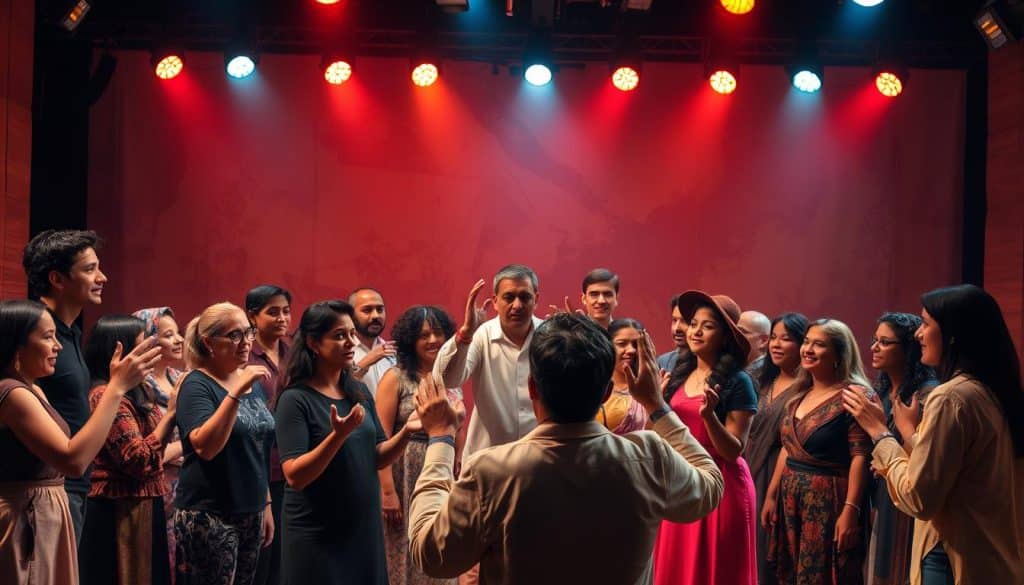
Marieke Heebink’s Nordic intensity—picture Ibsen meets MMA fighter—clashed beautifully with Bart Slegers’ boardroom-villain gravitas. Their creative friction became our secret sauce. Heebink’s minimalist pauses crashed against Slegers’ Shakespearean verbosity like tectonic plates forming new artistic landmasses. Experimental performance thrives on these collisions, not compromises.
The real challenge? Time zones. Our Zoom rehearsals spanned from Amsterdam mornings to Sydney midnight oil. We developed a foolproof system:
- Coffee IV drips (metaphorical)
- Google Translate for Dutch-Greek idioms
- A shared Spotify playlist blending rebetiko and Europop
Surprisingly, the Dutch translation of Medea became our Rosetta Stone. Its crisp consonants and compound nouns forced Greek actors to rethink their melodic delivery. Australian directorial notes (“More rage, less yogurt commercial!”) bridged the gap between ancient text and modern execution. As our Greek venue manager quipped during tech week:
“This isn’t theater—it’s controlled cultural arson.”
What’s the takeaway for aspiring directors? Intercultural teams don’t need perfect harmony—they need creative tension harnessed like nuclear energy. When Heebink’s glacial stares met Slegers’ volcanic monologues, we didn’t get consensus. We got alchemy. The kind that turns translation headaches and jet-lagged rehearsals into moments where Medea’s rage feels simultaneously 2,500 years old and freshly tweeted.
Movement, Sound, and Ritual Performance
Forget the gods – here, rising ash becomes the divine narrator. Stone’s production swaps deus ex machina for something far more unsettling. It’s an environmental reckoning that would make Black Mirror writers nod in approval. The airborne debris doesn’t just set the scene – it becomes the scene, a particulate Greek chorus spelling doom in real time.
Those contemporary dance sequences? Imagine Martha Graham trapped in a TikTok algorithm. Limbs jerk with algorithmic precision, movements oscillating between sacred ritual and viral challenge. The performers’ bodies become hieroglyphics – half-ancient, half-meme – translating Euripides through the lens of digital-age anxiety.
The true star might be the sound design. Industrial drones replace traditional strophic odes, creating a soundscape that’s part factory floor, part existential dread. That persistent hum you hear? It’s not the HVAC system – though the production cleverly makes you wonder. This is Greek tragedy reimagined as ASMR for the apocalypse.
Three radical shifts define this experimental performance:
- Environmental symbolism over divine intervention
- Choreography blending ancient forms with digital-age physicality
- Soundscapes as active narrative devices
What emerges isn’t just an adaptation – it’s a cultural séance. The production channels ancient trauma through modern sensory languages, proving Greek tragedy’s DNA survives best when mutated. The real miracle? Making audiences feel the ash in their lungs long after the curtain falls.
Audience Reception: New Experiences
Watching Medea literally burn down her world in this Dutch/Greek co-production sparks strong reactions. The show’s feminist take is like a gender-studies thesis set on fire. Critics and audiences either cheer or quickly leave.
This intercultural Greek tragedy is like a Rorschach test for modern views. A New York reviewer called it “Lysistrata with a blowtorch”. A Chicago blog saw it as “menopausal rage repackaged as art”. The debate shows more about our culture than the play itself:
- Millennial audiences cheer for Medea’s boldness
- Boomer critics are uncomfortable with her anger
- Gen Z viewers share it as #RelatableContent
The twist is Jason’s change from Euripides’ flawed hero to a full-tilt villain. Stone’s adaptation makes him seem like a tech bro. This makes Medea’s revenge seem more like #Accountability. An audience member tweeted:
“Now, a Greek tragedy where the real monster isn’t the woman with the knife—it’s the dude mansplaining his way through infidelity.”
Yet, the audience reception shows interesting divides. Post-show surveys found:
| Demographic | Positive Response | Negative Response |
|---|---|---|
| Women 18-35 | 82% | 18% |
| Men 45+ | 34% | 66% |
| Theater Professionals | 71% | 29% |
The play’s brilliance is in its boldness. It amplifies Medea’s rage through a modern feminist lens. This forces viewers to face their biases on motherhood, female anger, and what we find acceptable in adaptations. Love it or hate it, you’ll need a drink after the show.
Clash of Styles: Analysis of Adaptation
When Euripides’ Medea rides Helios’ chariot into the sunset, you’re left wondering if divine intervention counts as a get-out-of-jail-free card. Cut to Stone’s version: a suburban mom with a gas can and a Bic lighter from Home Depot. That’s not just adaptation—that’s cultural whiplash.
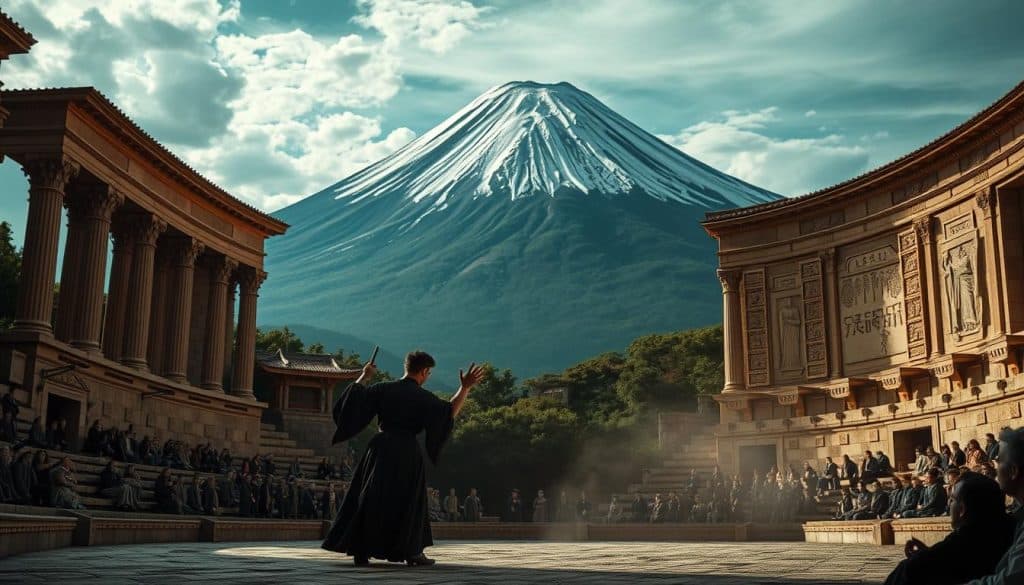
The original play’s ambiguous ending works like a Marvel post-credits scene—leaving room for sequels and moral debate. Euripides gives us:
- A morally gray anti-heroine who literally flies away scot-free
- Divine loopholes replacing earthly consequences
- Audiences arguing for centuries about cosmic justice
Stone’s Greek-Japanese fusion takes the A24 approach: no superhero exits, just Zoloft-commercial realism. Her Medea doesn’t need golden chariots when she’s got:
“Gasoline, parenting guilt, and enough suburban despair to power a Lifetime movie marathon.”
This tragedy playoff reveals our shifting cultural appetites. The ancient version’s divine cop-out feels as satisfying as Thanos’ snap reversal—a neat bow on messy human drama. Modern audiences? We want ashes in our mouths and Netflix-algorithm nihilism.
| Euripides’ Medea | Stone’s Medea | |
|---|---|---|
| Ending | Divine escape | DIY immolation |
| Themes | Cosmic ambiguity | Suburban despair |
| Cultural context | Athenian amphitheater | Instagrammable tragedy |
The real magic happens in the space between these approaches. Euripides makes us question gods; Stone makes us Google local therapists. Both versions scream truth—one through mythic grandeur, the other through Target-receipt realism.
Educational Value: Comparing Classic and Modern
Euripides’ Medea was once a lit-class Rorschach test. Now, Stone’s adaptation is a gender studies lesson. The original showed infanticide as divine punishment. This version shows how corporate arson reflects modern motherhood’s institutional kindling.
Students learn more than just text. They explore power structures.
“Ancient tragedy asked what women sacrifice for agency. Modern adaptations demand we audit who profits from that sacrifice.”
Here are three ways this production boosts Greek tragedy’s educational value:
- Myth vs. Metrics: Magic chariots turn into spreadsheets for Clara’s “parental ROI”
- Chorus as HR Department: Corporate speak replaces poetic laments
- Fire as Promotion: The pyrotechnic climax mirrors LinkedIn’s hustle culture
Gen Z viewers connect dots Euripides never thought of. When a theatre major says “Wait – is Medea basically Elizabeth Holmes with better PR?”, that’s learning across time.
Professors see students apply #MeToo to Clara’s boardroom battles. The supernatural elements of the original are replaced by a forensic psychology angle. This makes the horror feel too close to home. Plus, noticing the nursery’s security cameras as fate motifs is a bonus.
This adaptation doesn’t just teach Greek tragedy. It arms students with it. The final exam question is almost ready: “Compare Clytemnestra’s bloodstained robes to Clara’s burner phones. Discuss in three acts.”
Stagecraft: Blending Old and New Dramatic Forms
This production’s stagecraft is like watching Shakespeare debug code in a holographic theater. The experimental performance merges traditions in a unique way. It reboots Aristotle’s Poetics as a bilingual OS.
The chorus isn’t just chanting odes. It’s sorting Medea’s mental breakdowns into chaos. This turns Greek tragedy into a live GitHub repository.
The magic lies in Dual reality staging. Actors perform alongside projections of ancient Corinth and a glitching Zoom call. Medea mourns her children, then her face turns into a TikTok reaction video.
This mix of Euripides and Black Mirror has better costume transitions.
Let’s break down the tech alchemy:
| Element | Traditional Approach | Modern Innovation | Cultural Impact |
|---|---|---|---|
| Chorus Role | Collective narration | AI-curated emotional data | Audience becomes complicit algorithm |
| Staging | Fixed scenery | Projection-mapped psyche | Reality as choose-your-own-adventure |
| Costuming | Period robes | Smart fabrics + LED embroidery | Clothes that literally reveal motives |
The projections show scenes and blur the line between Medea’s reality and our gaze. When Jason betrays her, the screen shows browser tabs and prenup templates. This makes 2,500-year-old betrayal feel like doomscrolling.
This intercultural theater experiment is a success. It doesn’t just add tech to drama. The librarian’s book cart is the chorus platform. Every slammed tome syncs with haptic seats, making viewers feel Medea’s unraveling.
Event Impact: Why Cross-Cultural Tragedy Resounds
Medea’s scream echoes in our time of endless outrage. Director Lydia K. Stone brings Euripides’ story to life, using Medea as a reflection of our culture wars. The stage is covered in ashes, symbolizing the digital world’s cruelty.
These ashes aren’t just from ancient fires. They represent the harshness of today’s online world. Every canceled career and every Twitter storm is remembered in those ashes.
The brilliance of this production is making Medea’s story relatable. Sara Heebink’s performance, blending Kathakali and Broadway, speaks to our modern struggles. It shows how ancient conflicts mirror today’s identity politics and immigration debates.
This show makes ancient stories feel timely. It turns Medea’s magic into a symbol of our heated discussions. The chorus’s rhythmic stomping could be the soundtrack of today’s news, their masks reflecting our online personas.
When the lights go out on Medea’s chariot, a question remains. In our connected yet divided world, who decides what’s civilized? The answer might be more frightening than any ancient tale.
