

Existential dread is real, even in the age of TikTok. Imagine being three hours into Instagram Reels, feeling lost. Modern stages are more than just plays. They’re existential group therapy sessions in disguise.
Gunjan’s 2024 research shows something interesting. Beckett’s “Godot” now feels like a mirror to our collective psyche. Why does a play about waiting resonate? Maybe because we’re all waiting for someone to text back while scrolling through news.
Ionesco’s works are not just revivals—they’re rebellions. They thrive in our era of algorithmic whiplash, where meaning disappears quickly. The real absurdity? We’ve created a world that makes “The Bald Soprano” seem straightforward.
This isn’t just about mid-century drama. It’s a mirror to our performative reality. Every Zoom call could be a Pinter pause. The question is, have we become the characters we used to laugh at?
Origins and Influences
Imagine Paris in the 1950s, filled with Gauloise smoke and a sense of doom. The aftermath of World War II was fresh, and playwrights were tearing apart theater itself. They were not just writers but demolition teams with typewriters, questioning everything. The absurdists, a group of outsiders, turned anxiety into art, making Chekhov seem like a comedy.
Key Playwrights and Works
Samuel Beckett introduced us to waiting as a sport with Waiting for Godot in 1953. His characters didn’t grow; they just kept going, stuck in endless conversations. Beckett’s early work as James Joyce’s secretary is evident in his precise language, now used to create labyrinths.
Eugène Ionesco, a Romanian, made small talk a battleground in The Bald Soprano (1950). He turned everyday conversations into a war, making language the enemy. Ionesco crafted verbal traps, not just dialogue.
In Britain, Harold Pinter focused on the silence between words. His play The Birthday Party (1957) showed characters speaking in riddles, with the real drama in the silences. Pinter showed that what’s left unsaid can be louder than any words.
“The Theatre of the Absurd has renounced arguing about the absurdity of the human condition; it merely presents it in being.”
These playwrights used circular logic, language tricks, and absurd situations. Their works were not just plays but existential survival guides for a world gone mad. Who needs a story when faced with the vastness of the universe?
Defining the Absurd: Themes & Techniques
Absurdist theater is like a surreal cooking show. It mixes existential dread with slapstick comedy. Imagine Julia Child making a meringue out of nihilism, all while questioning human connection.
This genre has three main parts: linguistic malfunction, bureaucratic satire, and tragicomic futility. It’s all served with a question: “Wait, is this supposed to be funny?”
Let’s look at the existential drama playbook:
- Circular dialogues that mirror your group chat’s deepest debates (“But why ARE we here?” “IDK, pizza?”)
- Plots with less direction than a GPS in a black hole
- Characters trapped in situations like a Slack thread gone rogue
“Language becomes a minefield where words detonate their own meanings.”
The real magic is in the Kafkaesque two-step:
- A character makes a logical request (e.g., “I’d like to live, please”)
- The universe responds with nonsensical bureaucracy (e.g., “Form 27B/6 required”)
| Absurdist Technique | Modern Equivalent | Existential Payoff |
|---|---|---|
| Meaningless Repetition | Endless Zoom Meetings | Highlights communication futility |
| Illogical Plot Twists | Streaming Algorithm Suggestions | Mirrors modern decision fatigue |
| Tragicomic Tone | Memes About Climate Change | Balances dread with laughter |
Why do these plays affect us so deeply? They’re like scrolling through Twitter at 2 AM – both horrifying and hilarious. The theater of the absurd doesn’t just reflect society; it shatters the mirror and asks us to dance on the shards.
Today’s shows use these techniques in new ways:
- Meta-commentary on digital communication
- Interactive elements mimicking app interfaces
- AI-generated dialogue that talks in circles
It’s not just depression – it’s existential drama with better lighting. The real genius is making us laugh at the void while wondering if our Tinder dates are absurdist performance art.
The Audience Experience: Humor, Despair, Reflection
Ever found yourself laughing hard at a play where characters debate who gets to disappear into the void first? That’s the weird charm of existential drama. It turns discomfort into a joke, like a philosophy teacher cracking jokes during a world-ending seminar.
Modern revivals show why absurdist plays are more impactful after 9/11 and COVID-19. Third Source’s analysis explains:
“The empty chairs outnumbering living characters in Ionesco’s work now feel less like surrealism and more like Zoom meeting documentaries.”
Millennials love Beckett more than Instagram influencers for three reasons:
- The Nihilism-to-Meme Pipeline: Vladimir and Estragon’s endless waiting is like refreshing for climate crisis updates
- Conformity as Comedy: Rhinoceros’ herd mentality is like a TikTok trend – funny until you see everyone buying the same Stanley cup
- Silence as Script: Pinter’s pauses are like premium content – the theatrical version of paying $8/month for less Twitter noise
Gunjan’s research reveals the key: absurdist plays make us complicit in the joke. That awkward chuckle when a character forgets their purpose? It’s you recognizing your 3pm existential crisis meeting in Google Calendar. The genius is in making us face three conflicting feelings:
- Laughter at the ridiculousness
- Panic at the underlying truths
- A strange urge to call your therapist
Today’s shows add to this through existential drama Easter eggs. A recent Off-Broadway Waiting for Godot had Vladimir checking Apple’s Vision Pro while saying “We could have been influencers.” The real absurdity? Half the audience updated their LinkedIn profiles during intermission.
Modernist Innovations in Staging and Narrative
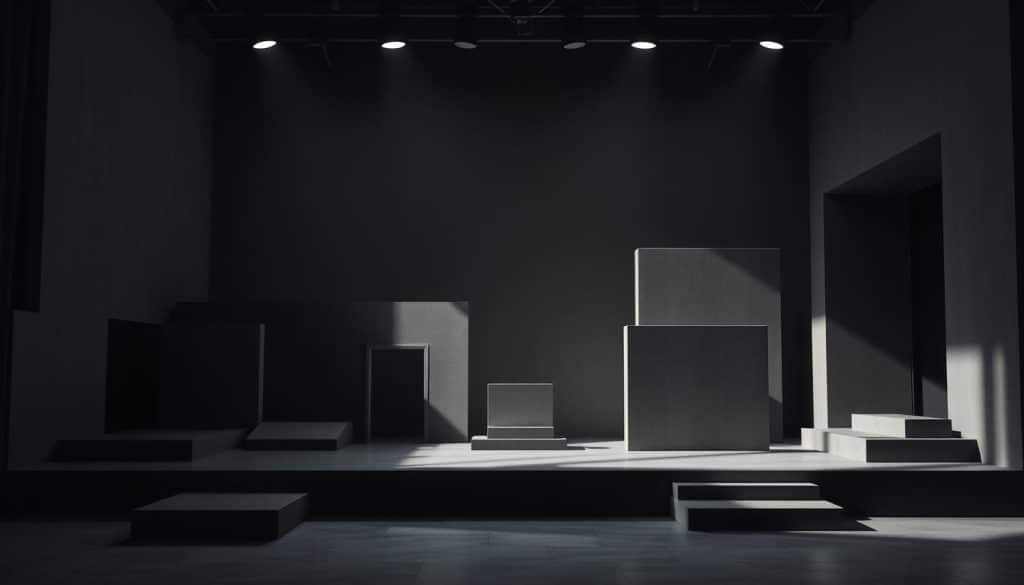
Imagine a stage where silence is more valuable than words. Modernist theater didn’t just break the fourth wall. It sold the stage itself on eBay. Playwrights like Beckett and Ionesco rewrote the rules of storytelling.
They turned traditional tales into glitchy, stuttering scripts. Their stages became places where the usual rules didn’t apply. They replaced Victorian settings with empty, existential spaces.
Pinter’s famous pauses were like theatrical mic drops. They made audiences feel the tension as much as the characters. This was different from Ibsen’s long speeches, where words were used to fill space.
Beckett’s Endgame was a minimalist masterpiece. His stage directions were simple, yet powerful. He used just two trash cans and a ladder to create a world of meaning.
This forced audiences to help create the story. It was like getting a 404 error and having to write the website yourself.
| Traditional Theater | Absurdist Innovation |
|---|---|
| Linear plot progression | Narrative recursion (think broken hyperlinks) |
| Psychological character depth | Archetypes as empty vessels |
| Climactic resolutions | Endings that echo into existential voids |
Today, directors use digital projections and augmented reality to enhance these ideas. A recent Waiting for Godot revival used facial recognition to mirror audience emotions. This turned Beckett’s absurd wait into a real-time Rorschach test.
The true innovation is in what’s left unseen. These sparse stages require audience participation. It’s like a Zen koan, where the less given, the more we’re forced to think.
The real drama happens in our minds. This idea would make Aristotle swipe left.
The Absurd in the 21st Century: New Revivals and Reinterpretations
Samuel Beckett’s Waiting for Godot got a Silicon Valley twist: now, Vladimir and Estragon update LinkedIn profiles. They debate if Elon’s Mars colony is “arriving.” Today’s directors use absurdist plays to reflect our world’s fears and tech chaos.
Watching a Zoom version of Beckett’s Endgame was impactful. Hamm’s wheelchair was a broken gaming chair. It felt more real than any talk on AI ethics.
Gunjan’s analysis shows why absurdist plays are popular online. TikTok users share 15-second existential moments inspired by Pinter’s works. Reddit fans discuss if crypto crashes are like The Bald Soprano‘s circular logic.
The pandemic-era No Exit reboot featured Siri and Alexa as silent heroes. It was a genius move.
“Today’s absurdism isn’t about waiting—it’s about refreshing six apps simultaneously while your Uber driver takes the scenic route through societal collapse.”
Why do Gen Z see these works as survival guides? Here’s why:
- Climate anxiety makes us all wait for solutions that never come
- Zoom isolation makes Beckett’s sparse dialogues eerily relatable
- Crypto culture’s absurdity mirrors Pinter’s power struggles
The latest Rosencrantz and Guildenstern Are Dead revival on Broadway uses AI for dialogue. It changes with Twitter trends. Characters might talk about NFTs or Mark Zuckerberg’s role in absurdist plays.
These revivals entertain and diagnose our times. When Clov in Endgame says “I’ll leave you,” but doesn’t, we check our work Slack. The absurdity? We keep refreshing, hoping for change.
Critical Perspectives and Debates
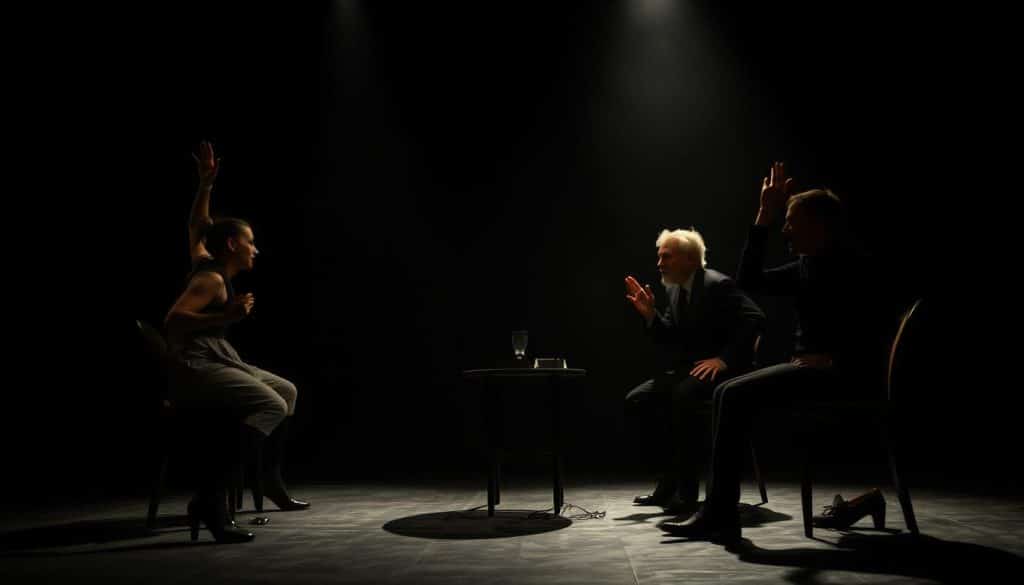
Imagine Sartre and Ionesco stuck in an elevator. Sartre is looking for meaning in the manual, while Ionesco is laughing at the broken buttons. This scene shows the big debate between existential drama and theater of the absurd that sparks online arguments.
“Existentialism is a humanism. Absurdism is… a cosmic prank call.”
Experts can’t agree: Is Beckett’s Waiting for Godot a deep truth or just a long wait? Sartre’s followers say absurdist plays lack “constructive despair”. Ionesco countered, saying we need better questions, not answers.
The Great Existential/Absurdist Cage Match
| Existentialist Drama | Theater of the Absurd | |
|---|---|---|
| Philosophical Approach | Humanity defines meaning through action | Meaning is Schrödinger’s cat—both dead and irrelevant |
| Narrative Structure | Linear progression with moral stakes | Circular logic meets Dadaist word salad |
| Audience Role | Active participant in ethical dilemmas | Confused witness to cosmic joke |
Today, critics like Gunjan Patel question if laughing at Godot makes us accomplices or analysts. Is absurdism’s “embrace the void” message therapeutic or just a form of nihilism with better marketing?
Now, TikTok has entered the fray. When Gen Z creators use deepfakes to make The Bald Soprano characters talk about NFTs, are they:
- Keeping the absurdist tradition alive?
- Showing how language has lost its meaning?
- Just using surreal content to get more views?
The answer, like many things in this genre, depends on whether you’re holding the script or the straitjacket.
The Appeal to Today’s Theatergoers
In today’s world, Zoom meetings can feel like Pinteresque power struggles. They’re filled with muted mics and fake nods. Modernist theater seems more real than history. It shows our digital fears back at us.
Think of Ionesco’s Bald Soprano. Characters talk like ChatGPT. It sounds all too familiar.
“We live, as never before, surrounded by incomprehensible things.”
Change “things” to “notifications” for a 21st-century twist. We see our own texts come to life on stage.
Here’s why these plays are loved today:
- Corporate absurdity: Pinter’s silences remind us of awkward boss moments
- Existential validation: Seeing characters in meaningless rituals helps us understand our own digital lives
- Analog catharsis: Live theater is a rare, unedited human experience in a world of deepfakes
These plays make us uncomfortable. They’re like Netflix algorithms that make us squirm. Or like Ionesco’s Amédée, leaving us feeling lost. We seek this productive unease – it’s cheaper than therapy and looks better.
Gunjan’s research shows we’re not just here for fun. We go to modernist theater to feel less alone. It’s like scrolling through TikTok, but with better lights.
Conclusion
Samuel Beckett once said we’re all born astride a grave. Today, absurdist and modernist theater takes this dark idea seriously. It finds new meaning in our doomscrolling world.
If Ionesco’s rhinoceroses stood for fascism, what symbols fit our era of AI and climate change? The theater of the absurd now showcases reality’s most absurd moments.
Modern revivals of Pinter and Genet’s works feel like documentaries. The 2023 Waiting for Godot revival on Broadway sold out. People who’ve spent years refreshing empty inboxes flocked to see it.
Playwrights like Caryl Churchill and Branden Jacobs-Jenkins use fragmentation and circular dialogue. They show how modernist techniques can cut through TikTok and algorithmic despair.
These works don’t just reflect chaos; they create meaning from it. A Broadway producer shared that audiences now laugh more at Rosencrantz and Guildenstern Are Dead’s coin-flipping scenes. Why? We’ve all become pros at games of chance, from vaccine lotteries to crypto roulette.
Absurdism isn’t just a style; it’s a way to survive. When house lights go up, one truth remains: theater that celebrates life’s absurdity lasts longer than sanitized stories.
The next time someone calls a Zoom meeting “Kafkaesque,” smile. The theater of the absurd has won. The curtain’s down, but the existential disco is open all night.
