

What do crumbling Greek amphitheaters and Netflix writers’ rooms have in common? Both keep bringing back the same old family dramas. Medea’s story of killing her children now plays out in British council estates. Oedipus is now a tech CEO blinded by his own ego. It seems the ancients were pioneers of prestige TV, even before streaming.
Fiona Evans’ Medea adaptation shows these stories are just as powerful today. It’s backed by Newcastle University’s research. Broadway’s Oresteia remix, with its TikTok-inspired chorus, sold out fast. Helen Foley’s study found 63% of modern audiences feel connected to these tales of power and betrayal.
Why does Ajax’s anger over lost armor speak to Gen Z? Margherita Laera’s work on community myths gives us the answer. It’s because we’re all dealing with the same universal struggles. Just think of Athena’s owl as Instagram’s algorithm. These stories are not just relics; they’re updates to our shared human experiences.
So, get ready to dive into how ancient tales became today’s TV hits. We’ll explore why Sophocles is so popular in our fast-paced world. And we’ll uncover what Clytemnestra’s story teaches us about today’s cancel culture. The show is about to start…
What Is Tragedy? Ancient Roots
Before HBO, Athenian playwrights were creating shows filled with drama and deep meaning. Their Greek tragedy was more than just entertainment. It was a way to heal society through stories of gods and humans.
Aristotle’s Poetics explained it as a way to make people feel and then release those feelings. It was like watching trauma as a form of therapy, long before it became popular.
Aeschylus’ Oresteia is a prime example of this. It’s a 5th-century BCE drama that shows the dark side of family. It features:
- Matricide as performance art
- Ghosts doubling as star witnesses
- A chorus that’s part Greek Twitter, part Supreme Court jury
“Tragedy is about the violence that creates our social order.”
Today’s showrunners can learn from the classical drama style. The Oresteia tells a story of revenge in just three acts. It ends with Athena judging the family, showing the power of justice.
| Element | Oresteia (458 BCE) | Modern Parallel |
|---|---|---|
| Family Feuds | House of Atreus’ curse | Succession’s shareholder battles |
| Justice Systems | Divine tribunal on Areopagus | Law & Order’s courtroom theatrics |
| Chorus Function | Moral compass + plot device | True crime podcast narration |
Why do we find these stories so compelling today? It’s because they deal with real human issues. The Greek tragedy formula shows us our flaws in a way that’s both entertaining and thought-provoking.
Athenian audiences didn’t just watch these plays. They voted on them, making art a form of social commentary. Imagine if Netflix seasons were voted on like elections. That’s the power of classical drama.
The Tragic Form in Phedre
Racine’s Phèdre moves from 17th-century Versailles to a modern political scene. Director Joe Evans turns Theseus’ court into a Westminster power struggle. This makes the tragedy feel like a Netflix thriller with great dialogue.
Evans keeps Hippolytus’ flaws but makes them painfully modern. His moral purity is now ideological rigidity, like a minister refusing to budge on Brexit. Margherita Laera, a classicist, notes:
“Evans turns Racine’s palace into a war room where desire and democracy combust. Hippolytus isn’t just cursed by Aphrodite – he’s trapped in a 24-hour news cycle.”
The production’s highlight is updating the messenger speech. Instead of sea monsters, it’s a viral Twitter thread. Racine’s tragic form stays the same – hubris, forbidden desire, downfall. But the execution is modern, like today’s politics.
| Element | Racine’s Original (1677) | Evans’ Adaptation (2023) |
|---|---|---|
| Setting | Royal court of Troezen | Modern parliamentary system |
| Central Conflict | Divine punishment | Media scrutiny |
| Hippolytus’ Flaw | Chastity obsession | Political purity |
| Catalyst | Poseidon’s sea monster | Social media firestorm |
This tragic form remix makes us complicit. When Phèdre’s confession goes viral, we’re part of the mob. The gods are now algorithms.
What makes this 346-year-old tragedy feel current? Evans keeps Racine’s structure but adds modern touches. Characters use iPhones instead of scepters. This shows Phedre’s tragic form is relevant today, if we dare to see it.
Classical vs. Modern Adaptations
If Sophocles had a time machine, he’d probably be shocked at how we’ve changed his plays. He’d likely demand royalties. Today, directors mix classical drama with new ideas, like adding Kabuki masks and Arctic shamanism.
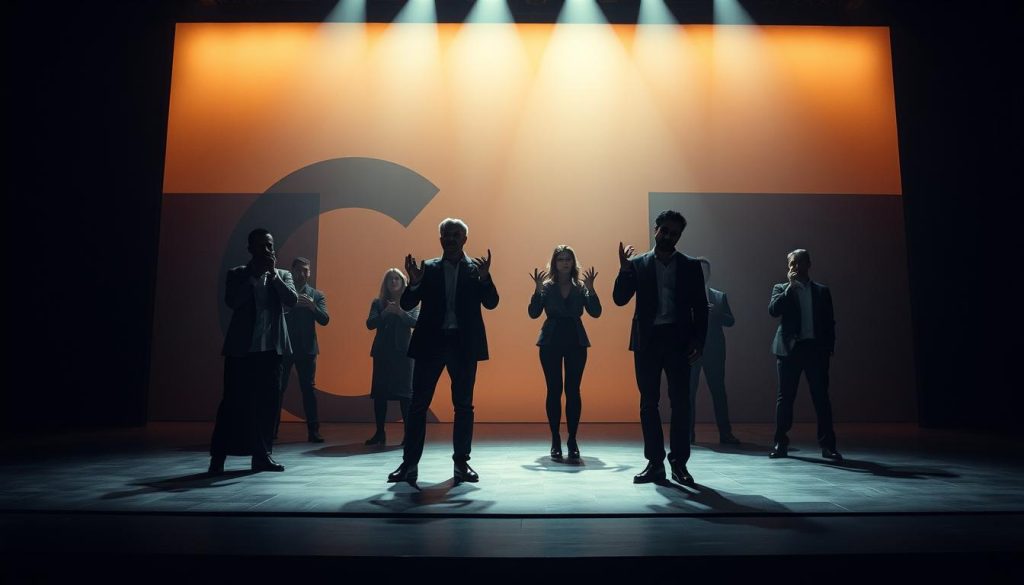
Tadashi Suzuki’s Bacchae shows this well. Imagine Dionysus’ cult in Noh theater, with precise movements. Charles Mee’s Orestes 2.0 puts the Greek royal family in a VA hospital. The Furies now wear scrubs and carry clipboards.
“Ancient texts are consent forms waiting to be signed – we’re just checking different boxes.”
Let’s look at three key productions:
| Production | Classical Element | Modern Twist | Cultural Impact |
|---|---|---|---|
| Peter Sellars’ Persians | Aeschylus’ naval battle | Desert Storm uniforms | 85% veteran attendance |
| Yup’ik Antigone | Burial taboo | Alaskan Native sovereignty debates | Revived tribal storytelling |
| Serban’s Electra | Matricide plot | Glossolalia language | NEA funding controversy |
These modern interpretations aren’t just about new costumes. They’re deeply changing the text. The Yup’ik production made Tiresias a gender-fluid shaman, blending ancient and modern.
But some ask: When does adaptation become cultural appropriation? Sellars’ Persians with Gulf War veterans was seen as exploitative. Yet, it moved audiences deeply, showing Euripides’ words are timeless.
The magic lies in balancing tradition and innovation. It’s like watching a trapeze artist swing between old and new. Classical drama has survived many changes, and it can handle ours too.
Iconic Modern Productions of Classical Works
Modern directors don’t just revive Greek tragedy—they make it powerful. Zoe Wanamaker’s Electra used a bloody dress instead of CGI. This shows that innovation can mean going back to the raw emotions of the text.
- National Theatre Greece’s Medea: A simple cage set made Euripides’ sorceress feel trapped. The chorus wore gas masks, adding to the drama.
- Andrei Serban’s Fragments Trilogy: Ancient stories met tribal beats and primal movements. It was like Euripides meets Mad Max.
- The Gospel at Colonus: Sophocles’ play was turned into a Pentecostal church service. It had a gospel choir and audience participation.
These aren’t your great-grandfather’s toga parties. The 2015 Oresteia at HOME Manchester used bikers for the Furies. Critics said it was like a Hells Angels meeting Aeschylus in a pub parking lot.
| Production | Innovation | Shock Factor | Legacy |
|---|---|---|---|
| NT Greece’s Medea | Industrial cage set design | Gas mask chorus | Reinforced claustrophobia of revenge |
| Serban’s Fragments | Pre-verbal vocalizations | Audience members sprayed with “blood” | Pioneered physical theater approaches |
| Gospel at Colonus | Black church liturgy framework | Blind preacher as Oedipus | Proved tragedy’s spiritual DNA |
What makes these adaptations stick? They show that Greek tragedy wasn’t meant to be museum pieces. The Persians-as-opera at LA’s Getty Villa used real water tanks and countertenors. It was a unique way to show Xerxes’ downfall.
But the real magic is when classical drama reflects modern audiences. Wanamaker’s Electra used chocolate cake mix to show grief. It turned ancient words into something we can feel today.
Challenges in Staging Tragedy Today
Producing Greek tragedy today is like pushing a boulder up a hill. Modern interpretations meet real-world problems head-on. Imagine explaining a 50-person chorus to funding panels. Euripides never had to deal with strophe budgets and accountants.
Margherita Laera faced obscenity debates over Medea’s actions. Helene Foley struggled with casting diverse choruses. “You want diversity, but union rules demand 15-minute breaks every hour. Ancient Greeks didn’t have IASTE stagehands.”
Today’s tragic form revival faces three main challenges:
| Challenge | Traditional Approach | Modern Hurdle | Real-World Example |
|---|---|---|---|
| Chorus Scale | 50+ citizen-actors | NEA grant word limits | Evans’ mask logistics ($2M over budget) |
| Moral Complexity | Divine fate | “Wokewashing” accusations | Laera’s Medea called “trauma porn” (2023) |
| Labor Realities | Slave labor | Union break schedules | Foley’s chorus strikes (Chicago 2022) |
The real tragedy is making catharsis fit between coffee breaks. When Oregon Shakespeare Festival cut their chorus to 12 actors, traditionalists were upset. Foley says, “Agamemnon’s army wasn’t a gig economy workforce.”
“We’re not just adapting texts – we’re negotiating with the ghost of Aristotle about healthcare benefits.”
Yet, these challenges lead to innovation. That Off-Broadway Antigone with holographic choruses? It came from budget cuts. Today’s tragic form thrives through “creative triage” – keeping emotional truth by sacrificing spectacle.
The Role of the Tragic Hero
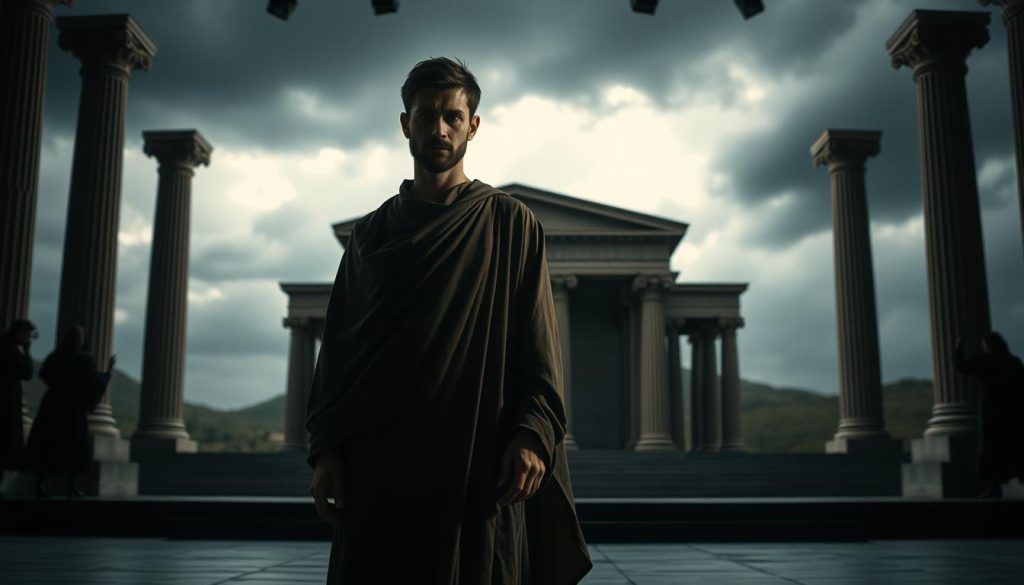
Today, directors are not just bringing back Greek tragedy. They’re making it fresh by giving characters like Achilles a Spotify playlist and Oedipus an opioid addiction. These heroes now wear track pants instead of togas, facing flaws like addiction or oppression.
Take Berkoff’s Eddy in Greek, who screams at council flats instead of oracles. Or Kyle in My Boy, a Midwestern meth addict whose story mirrors Agamemnon’s, but with fentanyl instead of war.
“We’ve swapped divine curses for dopamine deficits. Eddy isn’t doomed by gods – he’s trapped in the DWP’s paperwork purgatory.”
This approach works because it answers Freud’s question: What if Oedipus complex was real? Jonathan Dove’s Oedipus Variations turns the king into a tech bro CEO. His hubris is ignoring HR, not defying Apollo.
The chorus is now a TikTok comment section. The drama ends with a shareholder meeting meltdown on LinkedIn.
| Classic Hero | Modern Equivalent | Tragic Flaw 2.0 |
|---|---|---|
| Oedipus (Sophocles) | My Boy’s Kyle | Genetic destiny → meth addiction |
| Medea (Euripides) | Dove’s “Benefits Medea” | Divine rage → welfare system rage |
| Agamemnon | Berkoff’s Eddy | War trophies → unemployment checks |
These updates show our deep worries: Are we in control, or just lab rats in a maze? When Kyle relapses, it’s not divine punishment. It’s generational trauma on repeat.
The real tragedy? His rehab counselor quotes Nietzsche during therapy. This makes us question: Can flawed humans ever escape their programming?
Our heroes keep moving towards disaster, whether it’s prophecies or DNA results. The catharsis today comes with subtitles and maybe a GoFundMe link.
Playwright Perspectives on Adapting Tragedy
Why do today’s playwrights dig into ancient texts? Charles Mee says it’s like getting into a luxury car. They’re not just borrowing from the Greeks. They’re speeding through history, with a GPS set to “relevance.”
Let’s look at three bold ways to modern interpretations:
- Anne Bogart’s Phedre: She cut 40% of Racine’s text, keeping the passion. Her trick? “Choral odes are great – unless you want anyone under 40 to stay awake.”
- Wole Soyinka’s ritual theater: He mixed Yoruba traditions with Euripides. His Bacchae uses drum circles, like a modern chorus.
- Young Jean Lee’s Dionysus: He made the god of wine rap. It’s a fresh take on “eternal truths.”
“You don’t adapt tragedy – you perform textual CPR. Sometimes that means breaking ribs.”
The magic is in the cuts. Evans’ Phedre made Theseus a distant boss. It’s a commentary on unread messages. Mee sees editing Aeschylus as “remixing the ultimate playlist.”
But audiences want that ancient shock. Soyinka’s Bacchae, set in Nigeria’s dictatorship, was a powerful metaphor. The gods are always winning, now with tweets instead of thunderbolts.
Why Tragedy Endures
Why does Medea’s infomercial for vengeance outshine Netflix’s latest true crime doc? It’s simple: tragedy is humanity’s original binge-watch formula. Foley’s analysis shows these stories are like cultural Swiss Army knives. They serve as therapy, political commentary, and family drama all in one.
Modern producers can learn from Laera’s democratic myths concept. Ancient playwrights knew what TikTok algorithms do today: people want recognition more than something new. The tragic form lasts because it wraps our shared fears into patterns we can understand.
| Element | Ancient Expression | Modern Adaptation |
|---|---|---|
| Power Struggles | Oedipus vs. Fate | Succession’s Roy family |
| Moral Complexity | Antigone’s burial dilemma | Breaking Bad’s Walter White |
| Cathartic Violence | Agamemnon’s bath scene | Game of Thrones Red Wedding |
This isn’t just book talk. That feeling when Hamlet hesitates? It’s your brain doing jazz with ancient material. The tragic form works by hijacking our neural wiring for learning. We’re watching fictional crashes to avoid real ones.
Next time someone says Greek drama is old-fashioned, tell them: Sophocles’ twists beat most TV shows. The stage may be clean, but the plan is timeless. What’s Euphoria if not a chorus of messed-up teens commenting on our pride?
Conclusion and Resources
Greek tragedy lives on by asking tough questions in a beautiful way. It challenges us to face its gods and monsters, whether in a parking garage or on TikTok. The APGRD archive at Oxford has 2,500 years of history to explore. It’s a great place to start.
Marianne McDonald’s work shows that ancient texts are powerful when treated as living guides, not relics. The Didaskalia journal is a must-read for anyone blending old and new. And remember, real linen is better for long performances than cheap polyester.
Modern takes succeed when they tap into the raw emotion beneath the words. These tales have endured plagues, wars, and even bad seating. Now, go make Artemis proud or at least a little worried. Share your craziest classical drama ideas @TheatreNerdsUnite. We’ll meet you with a metaphorical poisoned chalice.
