

Imagine a 1903 Viennese theater filled with gasps. The original “are they gonna show that?” moment was happening. Arthur Schnitzler’s La Ronde broke through society’s doors like a cultural bomb.
It’s like Euphoria met Jane Austen, but everyone was too busy to notice the corsets.
This was more than a pre-Hays Code rebellion. It was like a series of Russian nesting dolls. Ten characters, ten encounters, each one passing the story to the next.
Today, we’d call it binge-worthy. Back then, it was theatrical poison wrapped in lace.
What makes La Ronde the forgotten architect of modern TV’s “everyone’s connected” trope? Its circular story came before Love Actually by a century. It made Game of Thrones look simple.
Each scene’s climax became the next scene’s start. It was like a Tinder swipe before theaters had electricity.
The real scandal wasn’t the content—it was the context. In a time when proper ladies fainted at ankle sightings, Schnitzler exposed hypocrisy. His characters weren’t just breaking taboos—they were curating them like a Victorian OnlyFans.
They proved that the most dangerous stories aren’t about what happens. It’s about who’s watching.
Introduction: Setting the Stage
What do fin-de-siècle Vienna and reality TV have in common? Both are known for stage taboo moments that shock audiences. Arthur Schnitzler’s La Ronde was a groundbreaking play that pushed boundaries. Its 1950 film adaptation was so provocative that censors used a carousel to spin away the most daring scenes.
D.A. Miller’s study on film censorship in the mid-20th century shows a deeper issue. Audiences were not just shocked but also scared by controversial plays that reflected their own desires. Schnitzler’s “sexual merry-go-round” exposed power dynamics in a way that was both powerful and uncomfortable. Here’s a look at some cultural panic moments:
| Era | Play/Film | Censorship Tactic |
|---|---|---|
| 1890s Vienna | La Ronde (original) | Complete ban + pearl-clutching |
| 1950s Hollywood | La Ronde film | Metaphorical carousel edits |
| 2000s Broadway | Angels in America | “Moral majority” boycotts |
Today, theater controversies are just as heated. They range from queer narratives to immersive shows like Slava’s Snowshow. The question isn’t “How far have we come?” but “Why are we so shocked?” Schnitzler’s play showed society’s true nature through its circular structure of relationships.
Arthur Schnitzler & Historical Context
Imagine Freud with a playwright’s quill – that’s Arthur Schnitzler for you. This Viennese physician-playwright didn’t just diagnose patients; he dissected society’s repressed desires with surgical precision. While Freud theorized about the unconscious, Schnitzler staged it – earning whispered admiration from the father of psychoanalysis himself. As Freud confessed:
“I avoided you out of a kind of fear of meeting my double.”
Schnitzler’s medical career wasn’t just a day job – it was his secret weapon. His clinical eye transformed Vienna’s drawing rooms into examination theaters, where bourgeois hypocrisy bled out through ten interconnected scenes of erotic dominoes. Where Ibsen dealt in symbolism, Schnitzler wielded psychological realism like a scalpel, mapping the nervous system of modern desire.
Consider the cultural petri dish of 1900 Vienna:
- A society buttoned up in imperial grandeur, yet throbbing with sexual revolution
- A medical community obsessed with “hysteria,” while ignoring the epidemic of loneliness
- Artists and scientists playing tag in the same smoky cafés
This was the world that birthed La Ronde – a play so dangerously insightful, it took 20 years to premiere in Schnitzler’s own city. His dual expertise created a new dramatic language: modern drama that treated characters like case studies, their romantic entanglements revealing deeper social pathologies.
While critics clutched their pearls, Schnitzler’s medical-trained detachment asked the uncomfortable question: What if morality is just a symptom of bad diagnosis? His work became the blueprint for everything from noir films to prestige TV – proof that the best drama doesn’t just entertain, but autopsies.
Plot Overview and Cycle Structure
Imagine a Victorian-era game of Six Degrees of Kevin Bacon, but with scandalous trysts instead of Hollywood connections. That’s the cycle structure of La Ronde. It’s a carousel of lust through 10 characters in Vienna’s social ladder. Each scene pairs two lovers, then one partner appears with someone new next time.
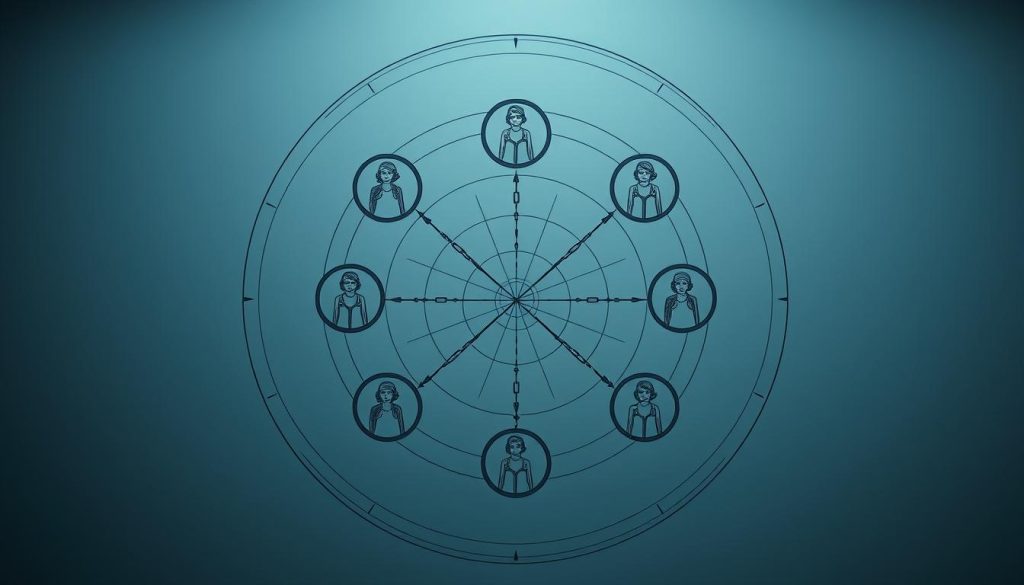
The Guardian called it: this is more than storytelling—it’s “the original ‘it’s a small world’ nightmare.” A soldier sleeps with a prostitute, then falls for a parlormaid. She seduces her employer’s son, and the chain goes on through aristocrats, poets, and actresses. Schnitzler created a circular maze of mirrors.
“The true horror isn’t the sex—it’s realizing everyone’s three bedsheets away from catching syphilis from their own spouse.”
This cycle structure is revolutionary. It turns intimacy into a contagion. Each encounter is a twisted game of telephone, where desire mutates through social classes. The countess thinks she’s slumming with an artist, unaware he’s fresh from romancing her husband’s mistress. It’s Upstairs, Downstairs meets Eyes Wide Shut.
Three key patterns emerge:
- Power shifts with each pairing—the pursued becomes the pursuer
- Confessions spill in one bed that poison the next
- Every character becomes both predator and prey
This isn’t just about who’s sleeping with whom. The real scandal is how Schnitzler’s carousel exposes society’s hidden machinery. That parlormaid? She’s not just a plot device—she’s the grease keeping the whole system turning. By the final rotation, you realize the true protagonist was the hypocrisy all along.
Scandal and Censorship: Provoking Society
What makes a 1920s theater censor nervous? Schnitzler’s La Ronde shook things up, showing ten scenes of love and lust. It was like a bomb going off, revealing the hypocrisy of society. The play was banned in Berlin and Boston, and called “obscene” by critics.
The 1950 film version had a clever twist. Anton Walbrook played a narrator who cut scenes with scissors. It was a clever way to poke fun at all the fuss over stage taboo.
This wasn’t just about censorship. It was a show about censorship itself. A critic wrote:
“The play doesn’t merely cross lines – it burns the map and salts the earth beneath.”
Police raids became a big part of the show. In Vienna, officers stormed theaters like they were on a mission. In New York, producers kept scripts hidden like they were illegal goods.
The backlash showed a funny side. People were okay with cheating in secret but not in controversial plays. Critics were fine with violence but not with love and sex.
- Audiences were okay with cheating in secret
- Critics were fine with violence
- But controversial plays about love? That was a no-go
In the 1950s, America was even more upset. The House Un-American Activities Committee saw Schnitzler’s work as communist propaganda. But every ban made people want to see the play even more.
Today, we see similar fights over what’s acceptable. Call it “cancel culture” instead of “sexual revolution,” and the 1920s look like the early days of online outrage. The real shock is how La Ronde showed society’s tendency to hide the truth.
Key Themes: Power, Desire, Morality
Behind La Ronde‘s fancy curtains lies a world of human deals. It’s like a Tinder for the 19th century, but with more serious stakes. Schnitzler shows how desire and power are traded like currency, with each encounter changing the balance.
“The chambermaid’s smile costs exactly three florins, while the poet’s flattery comes free with his rent arrears.”
Let’s explore the three main themes of this 1897 play, which feel eerily relevant today:
| Theme | Victorian Context | Modern Parallel |
|---|---|---|
| Power Dynamics | Military ranks dictating bedroom privileges | Instagram follower counts as social capital |
| Transactional Intimacy | Chambermaid trading favors for job security | “Netflix and chill” as dating currency |
| Moral Flexibility | Married countess risking scandal | LinkedIn virtue vs. Tinder bios |
Schnitzler’s characters ignore morality long before we had smartphones. The soldier doesn’t woo the parlormaid; he consumes her, like an Uber Eats order. Today, we ghost instead of write love letters.
Modern drama often hides its power struggles behind fancy settings and music. Schnitzler shows us the truth without any frills. His play is a raw look at humanity’s darkest deals, lit only by candlelight.
The real shock? We’re using the same tactics today. The countess traded her pearls for love, but we worry about our body count and future prospects. Has progress really changed us?
Major Adaptations On Stage and Screen
Adaptations of La Ronde show how artists use the cycle structure in different ways. Max Ophüls’ 1950 film is a prime example. It used camera technology to create a visual feast of doomed desire.
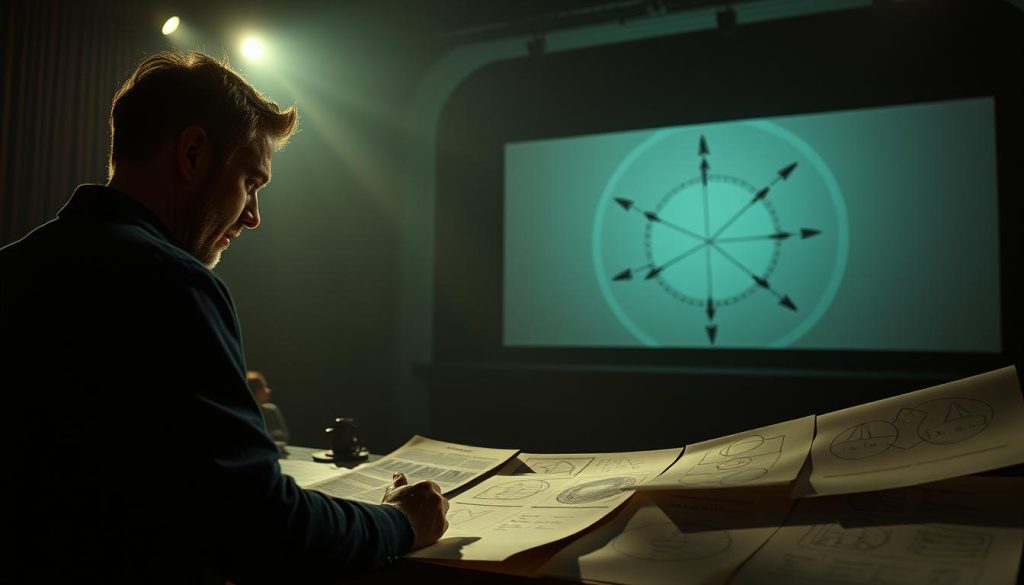
Ophüls’ use of tracking shots made the camera a character. It moved through Vienna’s spaces with smoothness. Each shot transitioned between lovers, echoing the play’s chain of events.
The camera’s spin added a sense of dizzying motion. It was like society’s endless cycle of attraction and consequence.
| Adaptation | Signature Approach | Cycle Structure Reflection |
|---|---|---|
| Ophüls’ 1950 Film | 360-degree tracking shots | Mechanical precision mirroring social machinery |
| 2003 Stage Revival (London) | Rotating turntable set | Physical manifestation of sexual carousel |
| 2021 Postmodern Digital Remix | Algorithmic scene shuffling | Tinder-era infinite swipe dynamics |
Modern directors have used the cycle structure to reflect their times. A 2021 digital version used AI to mix up pairings. It asked: “When algorithms mediate desire, who’s really spinning the wheel?”
These adaptations show the play’s real scandal is its form. The circular narrative is like a hamster wheel we can’t stop. Even as we criticize it, we keep running.
As Ophüls showed, sometimes the most revolutionary statement is simply holding up a camera. Letting the lens keep spinning.
Critical and Modern Reception
What was once burned in public squares is now studied in drama classes. La Ronde has changed how we see Schnitzler’s work. Critics now see it as a mirror to our society, showing the truth about our intimate connections.
The Guardian called it a “sadness-hangover.” This feeling is familiar to those who’ve felt empty after a date. It’s like wondering where the real connection went.
Today, directors see the play as a proto-algorithm for human connection. It’s like swiping left and right, but everyone ends up alone. Schools and colleges study it, comparing it to our modern world.
The irony is that we understand its message better than ever. Yet, we’re also more resistant to its truths.
Reception Evolution: Then vs. Now
| Era | Perception | Cultural Context | Educational Status |
|---|---|---|---|
| 1900s | “Pornographic filth” | Moral panic over sexual openness | Banned in 12 countries |
| 2020s | “Prophetic social critique” | #MeToo discourse & dating app fatigue | IB Drama prescribed text |
Audience surveys show a pattern: people leave feeling empty. Is it the play’s cycle of short connections or our own addiction to modern drama? Schnitzler’s ghost is probably enjoying his absinthe.
“We watch these characters chase connection like it’s a WiFi signal—full bars, zero bandwidth.”
Lasting Theatrical Influence
What do Fleabag’s fourth-wall smirks and Cabaret’s seedy Kit Kat Club have in common? They both come from Schnitzler’s stage taboo masterpiece, La Ronde. This play’s circular structure shocked audiences and became theater’s first hyperlink.
Today, “hyperlink plays” exist thanks to Schnitzler. Alan Ayckbourn’s The Norman Conquests and Lucy Prebble’s The Effect show this. Even Phoebe Waller-Bridge’s Fleabag uses La Ronde’s style, but with a modern twist.
Breaking Taboos, Building Bridges
La Ronde’s legacy is all about pushing boundaries:
| Theatrical Innovation | La Ronde (1903) | Modern Echo |
|---|---|---|
| Circular storytelling | 10 interlocking scenes | Hamilton’s revolutionary chronology |
| Power dynamics | Prostitute/Soldier encounter | Slave Play’s charged dialogues |
| Audience complicity | Implied voyeurism | Cabaret’s immersive emcee |
As critic Mark Fisher noted:
“La Ronde taught us that every sexual revolution needs a dramatic revolution first.”
This idea shows up in works like Tony Kushner’sAngels in Americaand Jeremy O. Harris’ Daddy. Here, stage taboo is both a tool and a reflection.
The play’s impact goes beyond theater. Reality TV’s The Circle uses its idea of connecting through isolation. TikTok duets also mirror its style of building connections. Schnitzler’s insight? Human desire is stronger than any scripted bond.
Resources for Further Study
Ready to dive into La Ronde at your next rooftop debate? Start with Arthur Schnitzler’s unapologetic diaries. They mix Freudian self-analysis with Viennese gossip. Pair them with Margaret Jacobs’ essay “Power Grids of Desire” for a mix of academic depth and party talk.
Next, watch Max Ophüls’ 1950 film adaptation of La Ronde. It’s a wild ride that makes Last Tango in Paris seem tame. Simone Signoret’s acting is so powerful, her gloves do more acting than many modern movies.
For a modern twist, check out Peter Zadek’s 1974 Berlin staging. It’s full of Brechtian flair that critiques our dating lives. It’s a sharp commentary that’s as relevant today as it was back then.
Academic fans should read Laura Marcus’ Schnitzler in Context. It links the play’s circular structure to the social collapse of Weimar Germany. Listening to Mahler’s Fifth Symphony while reading adds to the experience. Its dissonant crescendos mirror Schnitzler’s critique of hypocrisy.
Pro tip: Bookmark the Arthur Schnitzler Digital Archive for your next dinner party. It’s a great conversation starter. Mentioning the author’s medical background adds a layer of depth to your discussion. You’ll impress everyone.
