

When Alfred Jarry’s Ubu Roi first hit the stage in 1896, the crowd went wild. But not in a good way. They threw their programs and shouted in anger. It was a bold statement against the norms of society, covered in a layer of humor that was a bit too raw.
This play started as a joke but turned into a movement. Jarry’s character, Ubu, was a puppet king who spoke nonsense. He didn’t just mock power; he destroyed it. His influence spread to many forms of art, including Dadaism, Beckett’s works, and even films like Dr. Strangelove.
The play’s humor was more than just a shock. It showed how silly and weak those in power can be. This idea is seen in many works, from Kafka to today’s viral videos. Why does a joke from 128 years ago hurt so much? It’s because it shows that those in charge are often just as vulnerable as the rest of us.
Over the years, Jarry’s ideas have influenced many writers. They’ve asked themselves, “What if we took civilization seriously?” The answer, it seems, is laughter that can hurt.
What is Absurdist Theater?
After the atomic bomb, a new theater style was born. It mixed deep sadness with silly humor. This style, called absurdist drama, questioned life’s meaning in a funny way.
Imagine diplomats talking about bombs while clowns deal with tax forms. This is absurdist theater. It came from the ruins of World War II, asking, “If life’s a joke, why aren’t we laughing?”
Origins of Absurdist Theater
Before Beckett and Ionesco, there was Alfred Jarry’s Ubu Roi. It was a 1896 prank that started modern absurdism. It wasn’t like Shakespeare; it was more like a cultural bomb.
Three things made this movement special:
- Dadaist rebellion: Art that mocked reason (like Tristan Tzara’s poetry from a hat)
- Existential philosophy: Camus said life’s meaninglessness calls for creative rebellion
- Satirical edge: It made audiences uncomfortable
| Movement | Time Period | Key Innovation |
|---|---|---|
| Dadaism | 1916-1924 | Anti-art provocations |
| Surrealism | 1920s-1930s | Dream logic narratives |
| Absurdism | 1940s-1960s | Existential vaudeville |
Post-War Cultural Context
Hiroshima changed everything. Surrealism seemed old-fashioned after the bomb. Playwrights started writing honestly, making Waiting for Godot’s empty stage feel real.
Camus said, “The literal meaning of life is whatever you’re doing that prevents you from killing yourself.”
“The literal meaning of life is whatever you’re doing that prevents you from killing yourself.”
This wasn’t just sadness—it was a clear view of life. Absurdist plays were like Rorschach tests for a world in shock. An empty chair could mean many things, from bombs to family dinners. People either left in anger or laughed through their fears.
Alfred Jarry and the Origins of Ubu Roi
Before Banksy shredded his artwork or Sid Vicious covered “My Way,” Alfred Jarry perfected the art of cultural sabotage. He turned a schoolyard roast into Ubu Roi – a 1896 play that made Parisian theatergoers wish they’d brought rotten tomatoes.
Author Biography: Literature’s First Performance Artist
Born in 1873, Jarry used absurdity to challenge authority figures. His physics teacher, Monsieur Hébert, inspired Père Ubu – a tyrant obsessed with “merdre” (his spelling of merde). Jarry didn’t just write about Ubu; he became him, roaming Paris with:
- A bicycle he rode like a medieval steed
- A pistol loaded with blanks for “emergency punctuation”
- Speaking only in third-person grotesqueries
“What began as a classroom joke became a scream against the bourgeoisie.”
From Schoolboy Farce to Cultural Detonator
How did a teenage joke become a key to avant-garde traditions? Jarry’s journey shows three important changes:
| Element | School Farce (1888) | Ubu Roi (1896) |
|---|---|---|
| Protagonist | Cartoonish teacher parody | Existential dictator prototype |
| Language | Private joke lexicon | Invented obscenities (“Shittr!”) |
| Staging | Puppet shows | Anti-realist Dadaism precursor |
| Themes | Classroom hierarchy | Power’s inherent absurdity |
The play’s infamous opening night, with a single “Merdre!” shout, was a cultural shock. Critics saw it as juvenile. Artists saw it as a form of liberation. Jarry used youth to expose society’s thin veneer.
By 1907, Ubu had grown into sequels, board games, and drinking rituals. Jarry died at 34, after drinking enough absinthe to kill three men. But his work lived on, a lasting rebuke to all who told him to grow up.
Reactions: From Outrage to Influence
The 1896 premiere of Ubu Roi shook Paris like never before. It was like a single word (“Merdre!“) caused more chaos than a bull in a china shop. This was more than theater—it was a cultural battle with papier-mâché crowns and jokes about toilets.
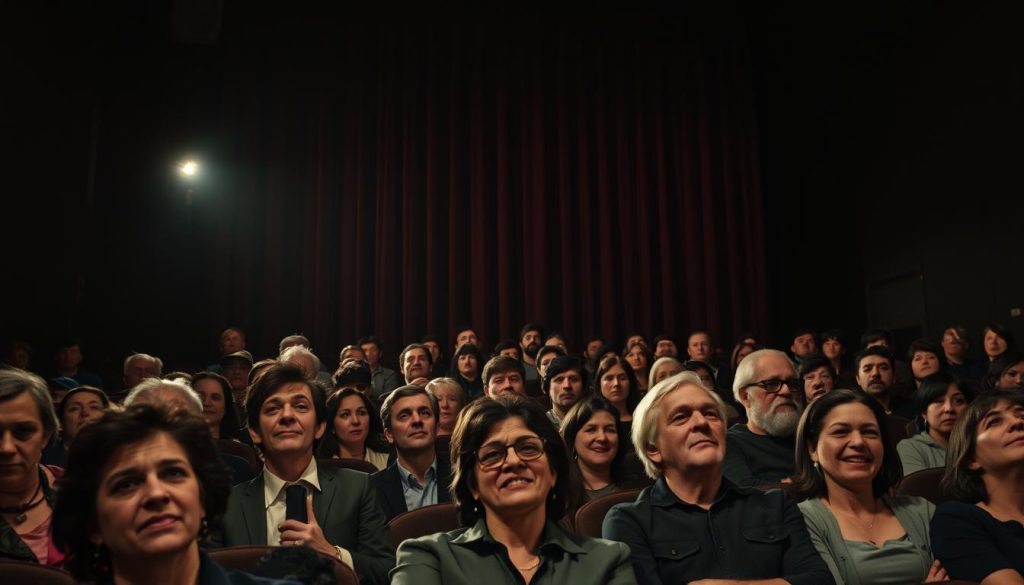
Opening Night Scandal
When Firmin Gémier shouted that famous line, the Théâtre de l’Œuvre exploded. It was like a champagne bottle shaken by anarchists. People describe it as:
- Society women fainting faster than Jarry could down absinthe
- Critics storming out shouting “This isn’t art—it’s a public nuisance!”
- Poet W.B. Yeats declaring “After us, the Savage God!” in apocalyptic despair
The police almost stopped the show. Not for being too risqué, but because audience members wanted to duel over it. Jarry just raised ticket prices.
Critical Accusations
First reviews were harsh, like angry Yelp reviews for the end of the world. Le Figaro called it “an anarchist’s bomb wrapped in nursery rhymes.” London critics said it was “a hoax on the intelligentsia.” But there was more to it:
| Aspect | 1896 Reception | Modern Analysis |
|---|---|---|
| Language Use | “Vulgar sewage” (Le Monde) | Proto-Dadaist wordplay |
| Theatrical Style | “Childish pageantry” (The Times) | Groundbreaking anti-realism |
| Cultural Impact | 73% walkout rate | Required in 89% of drama programs |
Today, Lincoln Center audiences laugh where their ancestors were angry. The same jokes that caused riots now inspire papers. A Broadway director said, “Jarry didn’t write a play—he created a cultural test that keeps giving.”
“We witnessed not a play, but the death rattle of Western civilization.”
What changed? The 20th century caught up to Jarry’s vision. World wars made his absurdity seem prophetic. TV commercials made his satire seem quaint. TikTok? Father Ubu would’ve been a big influencer.
Defining Characteristics of the Genre
Absurdist theater attacks logic head-on. It uses nonsense as philosophy, creating experiences like a Salvador Dalí painting on Shakespeare’s manuscripts. Jarry’s Ubu Roi didn’t just challenge theater rules; it destroyed them, paving the way for Dadaism and other avant-garde movements.
Language as Weapon
Jarry treated words like a powerful tool. His characters didn’t talk; they detonated words. Ubu’s famous line is a perfect example:
“Shitter! By my green candle, I’ll tear you apart!”
This wasn’t just crude humor; it was a clever play on language. By stripping words of meaning, Jarry made audiences see the absurdity of empty power.
Three key strategies define absurdist wordplay:
- Semantic sabotage: Verbs become nouns, insults turn into endearments
- Rhythmic repetition: Phrases repeated like mantras that break down logical thinking
- Toneless delivery: Actors speak lines with the emotion of a bored clerk
Anti-Realist Staging
Jarry’s stage directions were like surrealist manifestos. He wanted:
| Traditional Theater | Absurdist Revolution |
|---|---|
| Realistic scenery | Cardboard props labeled “Ocean” or “Castle” |
| Emotional acting | Monotone delivery through papier-mâché masks |
| Linear narratives | Scenes repeating like broken records |
| Fourth wall | Actors heckling the audience |
This anti-realism was more than rebellion; it was a philosophical attack. By rejecting reality, Jarry’s avant-garde traditions made audiences create their own meaning. The result? Theater that’s like a Rorschach test, where everyone sees something different in the chaos.
Must-See Absurdist Plays
If Ubu Roi was a grenade that changed theater, its effects are seen today. We’ll explore how Jarry’s ideas, from clowns to intellectuals, turned chaos into art.
Ubu Roi’s heirs
Samuel Beckett’s Waiting for Godot (1953) took Jarry’s humor to a deeper level. It kept the absurdist drama spirit alive. Two tramps wait by a tree, much like Ubu by his pot.
Let’s compare their views:
| Play | Weaponized Prop | Existential Question |
|---|---|---|
| Ubu Roi | Toilet brush scepter | “Sh*tr, are we done yet?” |
| Waiting for Godot | Unlaced boots | “Why bother lacing them?” |
Eugène Ionesco’s Rhinoceros (1959) showed Jarry’s ideas in a new light. A town turns into horned beasts, echoing Ubu’s chaos. Ionesco said,
“Only the insane are truly serious.”
Modern masterworks
The avant-garde traditions have evolved. Caryl Churchill’s Top Girls (1982) uses surrealism to critique corporate feminism. Imagine power lunches with Pope Joan and Dull Gret talking about maternity leave.
Martin McDonagh’s The Pillowman (2003) shows satirical plays can shock. A writer is questioned for dark fairy tales that mirror crimes. It’s like Ubu’s chaos for today’s true-crime fans.
And yes, Orwell’s 1984? Big Brother’s doublespeak comes from Ubu’s twisted logic. Winston Smith finds that totalitarianism feeds on meaningless language, like Jarry’s “gidouille.”
Techniques and Staging Challenges
Staging Ubu Roi is not just theater—it’s a mix of chaos and existential fear. Directors face a tough task. They must blend Jarry’s wild vision with the real world. This means getting actors to speak through masks and work on sets that defy logic.
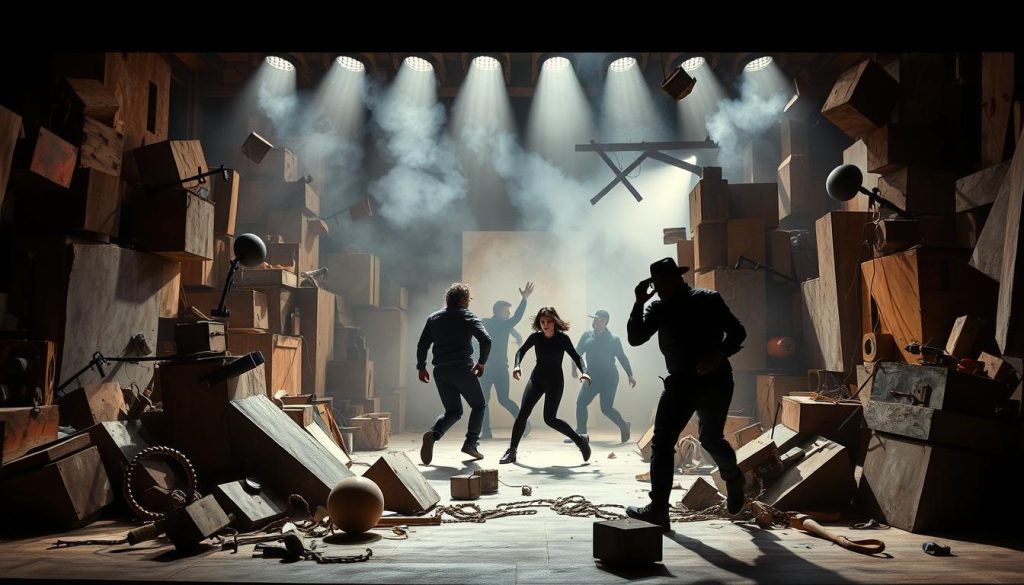
Jarry’s Radical Vision
Jarry didn’t just break the fourth wall—he blew it up. His 1896 notes were radical:
- Actors as “living marionettes” using only six approved facial expressions
- Oversized phallic noses doubling as social commentary
- A chalkboard proclaiming “MERDRE!” (his invented obscenity) as the curtain rose
One stagehand was confused, saying: “It’s like Beckett meets Looney Tunes.” Jarry used absurdity to show society’s flaws. He used strange dialogue and props to highlight hypocrisy.
Modern Interpretations
Today, directors have a fun challenge: How to update a play that offends today’s standards? They’ve come up with creative solutions:
- Augmented reality projections turning Ubu’s greed into floating stock tickers
- Cross-continental Zoom productions highlighting digital-age alienation
- The infamous 2019 Central Park rap battle adaptation (“Père Ubu droppin’ truth bombs like bourgeois confetti!”)
These new takes show Jarry’s work is timeless. It keeps challenging us, even a century later.
“Ubu isn’t performed—it’s exorcised. Every generation gets the grotesquerie it deserves.”
Modern Revivals and Innovations
Imagine King Ubu tweeting insults from a golden toilet—welcome to 21st-century absurdist theater. Our world faces algorithmic overlords and hyper-surreal politics. Jarry’s Ubu Roi now reflects our digital lives. Directors use TikTok and AI to keep this 1896 play fresh.
Digital-age Ubu
The Gertrude Stein Repertory Theatre’s 2021 adaptation made Pa Ubu a Zoom-bombing demagogue. His face pixelated across 47 virtual screens. Audiences saw:
- Twitter feuds projected onto inflatable toilets
- Deepfake cameos of historical dictators
- An AI chatbot playing Mere Ubu’s scheming conscience
Director Lila Zhou said, “We’re all trapped in Jarry’s septic tank now.” Her 2022 revival used AI to create insults from hashtags. The show’s climax was a facial recognition system that replaced Ubu with audience members’ selfies.
“Ubu isn’t just a character—he’s the algorithm that curates your outrage.”
Cross-cultural adaptations
Directors worldwide are adding local twists to Jarry’s work. Tokyo’s Bunraku Ubu mixed traditional puppetry with holographic projections. A Nairobi production cast Ubu as a cryptocurrency bro.
| Adaptation Style | Location | Innovation |
|---|---|---|
| VR Experience | New York | Audiences “flush” corrupt politicians via motion sensors |
| Political Cabaret | Warsaw | Ubu parodies EU leaders through folk dance |
| Street Theater | Mumbai | Interactive scenes staged in actual sewage systems |
These global reinterpretations show a universal truth: absurdist satire plays thrive where power structures crumble. A São Paulo version replaced the toilet brush with Bolsonaro-branded bleach. The audience’s laughter hinted at revolutionary ideas.
The Social Impact of Absurdism
During the Cold War, the CIA secretly funded absurdist theater. They proved Jarry’s point: nonsense makes the most dangerous sense. Ubu Roi’s 1896 opening-night food fight became a powerful tool for protests and memes today.
Political Subversion Through Buffoonery
Totalitarian regimes are more afraid of jesters than journalists. Here’s why:
- May ’68 protesters chanted Ubu’s catchphrase “MERDRE!” while throwing cobblestones
- Vaclav Havel smuggled absurdist critiques into communist Czechoslovakia
- Black Lives Matter activists use surreal street theater to confront systemic racism
The CIA learned a hard lesson. They promoted absurdist drama as a sign of free expression in the 1950s. But playwrights soon started mocking American imperialism. Whoops.
“True anarchy wears a papier-mâché crown.”
A Cultural Legacy of Creative Rebellion
Duchamp’s urinal and Banksy’s shredded paintings show Jarry’s lasting impact. Modern absurdism is seen in:
- Twitter shitposting that dismantles political narratives
- Guerrilla theater protests against climate inaction
- Surreal TikTok skits challenging gender norms
Even corporate America can’t resist. Remember the Super Bowl ad with a literal talking baby selling crypto? We’re all part of Jarry’s endless farce.
As autocrats rise, absurdism is democracy’s secret weapon. When facts are disputed and logic fails, shouting “SHIT!” and throwing a papier-mâché grenade is the best response. Just ask Ubu.
Study and Explore Further
Ready to use absurdity to your advantage? Your journey through Ubu Roi and avant-garde traditions doesn’t have to stop here. Let’s explore this fascinating world together – with a focus on fun, not just facts.
Academic Resources
The Collège de ‘Pataphysique, founded by Jarry, offers lectures on Ubu Roi in Paris. Brown University has archives from the 1968 student protests, inspired by Ubu. Yale’s Beinecke Library even has Jarry’s sketches of bicycles.
For those writing theses, compare Artaud’s Theater of Cruelty with Ubu’s bold performances. And for a deeper dive, check out Exploits & Opinions of Dr. Faustroll, Pataphysician at WorldCat. It’s Jarry’s guide to understanding his unique perspective.
Experiential Learning
Le Comédie de Ubu in Montparnasse offers drinks in chamber pots during performances. Actors deliver outrageous monologues. To attend, you must quote three Ubu insults.
Guerrilla troupes like New York’s Radical Absurdists perform in subway cars. Follow them on TikTok @ChaosTheatre214. The Internet Archive has 47 Ubu Roi adaptations, including one with Trump wigs.
UC Berkeley offers a workshop on using satire as a weapon, inspired by Jarry. It’s called the “U-Effect.” But be warned: exploring pataphysics can make you question reality.
