

Forget what you know about theater. The stage isn’t just alive anymore—it’s evolving at warp speed. A new breed of storytellers has changed playwriting into a cultural lab. They mix Hamilton’s hip-hop with Black Mirror’s dark thoughts.
UNCSA’s Drama Dean says, “We’re seeing scripted rebellion—the kind that makes Tennessee Williams look like dinner theater.”
What makes this era different? Rulebooks burned faster than Broadway ticket stubs. Writers like Jackie Sibblies Drury break timelines like IKEA furniture. Tanya Saracho’s Latinx stories change who gets the spotlight.
These aren’t just plays—they’re cultural grenades with Tony Award hopes.
Why should you care? Today’s stages reflect society like funhouse mirrors. The best works don’t just entertain—they interrogate everything. They tackle racial politics and AI ethics, often before Twitter catches up.
It’s not just theater. It’s urgent, living commentary in costume.
What Defines a Contemporary Playwright?
In 2023, calling a playwright “contemporary” means more than just a date. It’s a statement. The term has become a battle cry in theater, like a hashtag fight. Modern drama, once defined as anything after 1950, now includes fast-paced stories and identity-focused plays.
Modern vs Contemporary: Cutting Through the Semantics
Let’s clear up the confusion. Modern playwrights, like Beckett and Williams, were the rebels who changed theater. Today’s writers, or contemporary playwrights, are hacking theater’s code. They use meta-theatrical landmines and break the fourth wall in new ways.
UNCSA’s study shows a big change. Modern writers used symbolism, but today’s writers use identity and digital themes. Branden Jacobs-Jenkins doesn’t just break the fourth wall; he demolishes it live.
Three big changes mark the difference:
- Identity as infrastructure: Modernists explored universal themes, but today’s writers like Sarah Ruhl focus on intersectional views
- Digital fragmentation: Dialogue now reflects short attention spans, seen in Lasha Chkhartishvili’s award-winning scripts
- Audience as co-conspirator: New plays require active participation, asking you to check your privilege
Contemporary plays are not just written; they’re engineered. Jacobs-Jenkins brings 19th-century drama to life through Zoom, not just quoting Pirandello. He’s curating cultural CPR for a world shaped by viral trauma and canceled celebrities. The result? Theater that cuts deep into society.
Featured Profiles: Will Eno, Sarah Ruhl, Branden Jacobs-Jenkins, and More
Modern theater has its own superheroes, and they are the writers who shake things up. They break through the traditional theater walls like Kool-Aid Men. Let’s look at the amazing writers changing American drama.
The Provocateurs
Will Eno doesn’t just write plays; he creates existential crises in dialogue. He’s called “the Samuel Beckett of antidepressants” by The New Yorker. His play “Thom Pain (based on nothing)” turns discomfort into art. It’s like a TED Talk from your darkest thoughts.
“Eno’s characters don’t break the fourth wall – they set it on fire and roast marshmallows over the ashes.”
Sarah Ruhl turns magical realism into documentary theater. Her play “In the Next Room (or The Vibrator Play)” explores Victorian sexuality. Her childbirth trilogy, written after a near-death experience, turns trauma into surreal poetry. She’s a new kind of Gabriel García Márquez.
Branden Jacobs-Jenkins’ “An Octoroon” tackles America’s racial past head-on. It’s a mix of a 1859 slavery drama, with a twist. The play features:
- White actors in blackface
- Black actors in whiteface
- A Br’er Rabbit narrator quoting Foucault
This play is like Jordan Peele rewriting Gone With the Wind under the influence of ayahuasca. Alexis Scheer’s “Laughs in Spanish” is about Miami teens and a cocaine kingpin. It’s darker than Euphoria. These writers are not just pushing boundaries; they’re blowing them up.
Innovations in Structure and Story
If Aristotle walked into a modern theater, he’d need a GPS and a therapist. Today’s experimental playwrights are not just challenging norms. They’re rewriting the rules of storytelling. Their plays are like live grenades, disguised as scripts.
Deconstructing the Fourth Wall
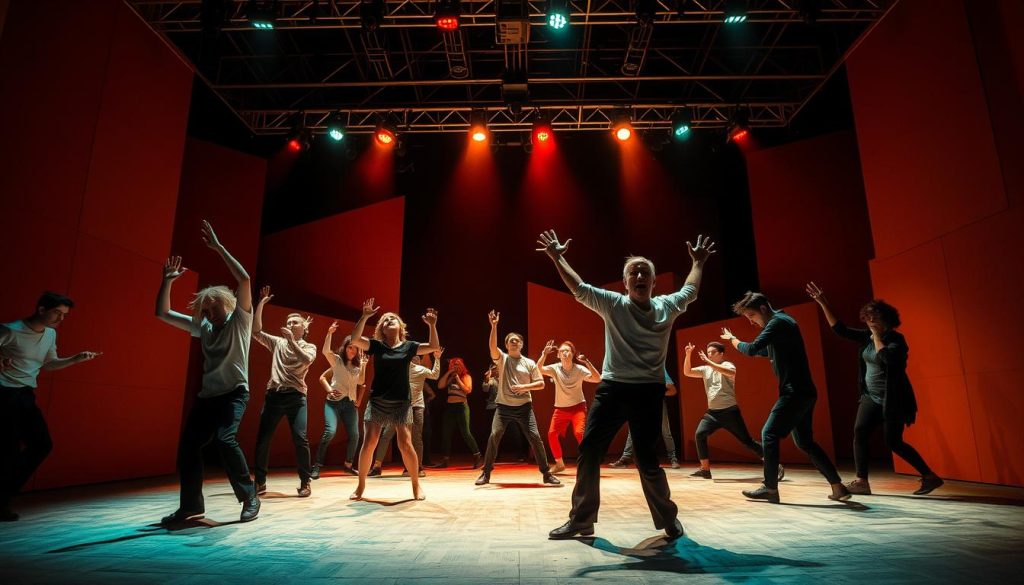
Remember when breaking the fourth wall was just a wink to the audience? How quaint. Jackie Sibblies Drury’s Pulitzer-winning Fairview does more than just break this rule. It turns it into a tool for racial exploration. “It’s not about making people comfortable,” Drury said backstage at Soho Rep. “It’s about making them present.”
Robert O’Hara’s Barbecue takes this idea further. It makes viewers part of a twisted game of class tourism. You’ll laugh at the satire, but also squirm at your role in it. When was the last time a play made you complicit in its message?
Nonlinear Narratives & Radical Empathy
Branden Jacobs-Jenkins’ Everybody throws out traditional storytelling. It’s a modern take on the 15th-century morality play Everyman. The play’s casting changes every night, forcing audiences to face their biases. “I want people to feel the ground shift beneath them,” Jacobs-Jenkins said during his Obie acceptance speech.
Young Jean Lee’s Straight White Men uses karaoke to explore identity politics. It makes you question your own reactions. As one Broadway patron tweeted: “Left the theater feeling like I’d been through an emotional car wash…with the windows down.”
“We’re not here to answer questions. We’re here to make you better at asking them.”
These new structures turn viewers into active participants. The real drama is no longer on stage. It’s in the silence as audiences question their own assumptions.
Case Studies: New Works & Festivals
Remember when plays needed actual theaters? Peasant times. Today, experimental playwrights are changing the game. They’re turning living rooms into theaters and TikTok into stages. Let’s look at three shows that made digital limits their strength.
From Page to Viral Phenomenon
Tim J. Lord’s UNCSA Virtual Theater Festival entry was a game-changer. His play “Bodies in Motion” used Zoom glitches as dance. It turned frozen screens into symbols of society’s freeze.
Audiences didn’t just watch; they joined in through chat overlays. It was more than a play; it was a shared experience.
Then, Alexis Scheer’s “Our Dear Dead Drug Lord” caught Gen Z’s attention on TikTok. Its viral scenes became a sensation, blending drama with social media.
Acosta’s “Song for the Disappeared” was a real shocker. It turned Zoom webcams into border checks. The “Leave Meeting” button became a matter of life and death. It made abstract issues real and political.
| Production | Platform | Innovation | Reach |
|---|---|---|---|
| Bodies in Motion | Zoom | Interactive latency art | 12K+ streams |
| Our Dear Dead Drug Lord | TikTok/Broadway | Audience-generated endings | 4.2M hashtag views |
| Song for the Disappeared | Hybrid Zoom | Location-based scripting | 86% post-show activism rate |
These works are aiming for Pulitzers, not Tonys. They’re making waves through culture. When your play goes viral before it even opens, you’re shaping our shared thoughts.
Voices: Playwright Interviews
What happens when authenticity becomes your sharpest quill? We talked to dramatists who push boundaries. They turn marginalization into mainstage material. Their interviews are like manifestos for rewriting theater’s rulebook.
Writing While Black/Brown/Queer
Tarell Alvin McCraney’s Miami housing projects inspired Moonlight. They became Oscar-winning alchemy. “We used to act out telenovelas in parking lots,” he laughs. “Now HBO Max streams my version.” His journey from Florida projects to Academy gold shows how identity-driven narratives dominate emerging drama.
“They told me Catholic guilt wasn’t ‘universal’ – then I made it rhyme with street smarts.”
Tanya Saracho’s Vida rebooted telenovela tropes into queer Latine empowerment. Her secret? “I weaponized the ‘write what you know’ advice they gave me in MFA programs.” The result? A HBO Max series that out-streamed Friends reruns in 18-34 demographics.
These contemporary playwrights aren’t just checking diversity boxes – they’re redrawing the entire scorecard. McCraney’s collaborations with Peter Brook reimagined Shakespeare through Yoruba cosmology. Guirgis turned confession-booth trauma into Pulitzer-worthy poetry. And Saracho? She’s currently developing a bilingual musical about quinceañera activists.
Their collective message through our interviews? “We’re not here to make audiences comfortable – we’re here to make them combust.” As American theater’s demographics shift, these voices prove that the most urgent emerging drama isn’t just seen – it’s felt in the bone.
How New Work Reaches the Stage
The journey from first draft to stage debut is not easy. It involves coffee-stained notes and packed black box theaters. Forget the Broadway dream. Today’s most innovative plays start in college workshops, activist groups, and even on Twitter.
From Twitter Threads to Tony Nominations
Sarah Ruhl’s plays began in feminist poetry groups before hitting regional stages. “I write for the women who’d prefer to analyze Emily Dickinson than bother a casting director,” she shared at a Brooklyn reading. Her work shows how playwrights can skip traditional paths.
Branden Jacobs-Jenkins didn’t need an agent to start. He honed his craft on “Gloria: A Life” while TV work supported his theater projects. This is the era of the portfolio playwright.
Three new ways theater is evolving:
- TV writer crossovers: TV budgets fund stage experiments
- MFA industrial complex: Yale and BU rival Marvel in creating stories
- Viral script economy: Jeremy O. Harris’ “Slave Play” went viral before HBO took notice
Programs like Keys to the Kingdom are key. They let playwrights work in real apartments. One play about gentrification is now at Lincoln Center, with its original IKEA furniture.
“Broadway’s just the souvenir stand. The real art happens where the fire marshals aren’t looking.”
In 2024, Tony nominations are just a small part of the journey. The true win is when your script circulates like a secret mixtape in Brooklyn bars.
The Impact on Audiences and Communities
Contemporary theater doesn’t just reflect society—it cuts deep. Forget the usual applause and wine breaks. The real drama unfolds when the lights go up and we face the harsh truths playwrights reveal. They tackle everything from racism to housing issues. It’s not about escaping reality; it’s about examining it closely.
Theater as Social X-Ray
Jackie Sibblies Drury’s Fairview turns the tables on white audiences, making them the main attraction. After the show, 43% of viewers talked about racial bias with others. Straight White Men uses humor to highlight privilege, with actors measuring their power with tape.
The Vida trilogy has also made a big impact. It sparked a 22% rise in donations to LGBTQ+ causes. One audience member said:
“I didn’t know plays came with aftercare instructions until I sobbed through three encores.”
| Play | Social Lens | Audience Catalyst | Community Ripple |
|---|---|---|---|
| Fairview | Racial perception | 72% reported self-reflection | 15+ DEI workshops launched |
| Between Riverside and Crazy | Gentrification | 41% attended local council meetings | 3 tenant rights bills referenced |
| Vida | Queer intersectionality | 68% shared resources online | $250k+ fundraising impact |
Now, theaters measure their impact as much as their ticket sales. They host town halls and partner with sociologists. For example, a Baltimore theater studied how Between Riverside and Crazy influenced views on evictions. The results? People who saw the play were 3x more likely to support housing petitions than those who read about it.
This isn’t just new drama; it’s urgent. Playwrights are writing about our biggest challenges. And audiences are eager to discuss them. It’s clear we’re all ready to face these issues head-on.
Supporting New Playwriting
Behind the applause, theater careers face a financial challenge. Playwrights balance on a tightrope, with grants shining like spotlights but fleeting.
Grants, Ghosts & Game Changers
The MacArthur “Genius” Grant is like Broadway’s golden ticket. It’s life-changing if you get it, but crushing if you don’t. Yet, playwrights like Will Eno show that small efforts can make big waves:
- The Apothetae-Lark Fellowship helps disabled writers to “make limp narratives walk”.
- The Steinberg Playwright Award gives $56,000, helping artists between jobs.
- Universities offer six-figure residencies, a creative lifeline.
“We turned bullets into dialogue.”
Svich’s work shows theater’s power to transform pain into profit. But for every Hamilton, many writers struggle:
- They live off SAG residuals from a single TV episode.
- They work as baristas, fitting in rehearsals.
- They deal with grants that demand detailed reports.
Colleges now see playwrights as leaders, paying them more than some professors. This raises questions about the impact on experimental work.
As funding changes, a question remains: Are we supporting artists or creating institutional ghosts?
How to Discover and Champion Emerging Voices
To find the next big names in theater, look beyond the fancy theaters. The next Lynn Nottage might be writing in a Bushwick microbrewery between shifts. To see the future, start with these hidden gems.
Beyond Broadway’s Blinkers
Brooklyn’s Bushwick Starr is a hotbed for new talent. Here, plays about cryptocurrency and queer Appalachian ghost stories share the stage. The Kilroys’ list of unproduced works has launched more careers than Yale Drama School.
TikTok’s @PlaywrightProblems uses memes to explain theater structure. It shows how Chekhov’s gun now comes with a warning.
Krispy Kritters in the Scarlett Night – Case Study
Krispy Kritters in the Scarlett Night is a meth-lab opera that took TikTok by storm last fall. It started as Zoom readings and became a hit Off-Broadway show. It blends coal-country politics with EDM, showing how drama can thrive online.
Spotting talent means looking beyond fame. That shaky video from Portland’s Backdoor Theater could be the next big thing. And those scribbled napkins at your local dive? They might be the next Pulitzer Prize winners. Just follow the misfits and fund the obsessives.
