

Imagine 700 raw scripts turning into Tony-winning shows. The O’Neill Center is not just a pretty place in New England. It’s where dreams become Broadway hits.
What if Silicon Valley’s energy met Shakespeare’s creativity? You get America’s top theatrical boot camp. It’s not about boring lectures. It’s about writers’ rooms where old and new stories meet.
The O’Neill’s secret? Artistic risk and a dash of chaos, all set against the sea. It’s a place where creativity knows no bounds.
This isn’t just about supporting the arts. It’s about pushing the limits of storytelling. Those workshop readings? They’re like live tests of emotional depth.
Pro tip: The magic happens when words meet the air. Writers here test human experiences. And when a first draft meets its first dramaturg, watch out for magic.
Why New Play Development Matters
In today’s world, algorithms pick your music and movies. But theater’s blind submission process is like finding a rare letter in your spam. The National Playwrights Conference gets over 1,500 scripts a year. That’s enough paper to cover the whole Hamilton touring set.
But here’s the amazing part: every script is read by at least two of their 200+ industry pros. No fancy checks or influencer fame needed. Just pure words.
The Democracy of Blind Submissions
Think of the NPC’s new play lab as a literary Hunger Games where everyone is equal. Your Yale MFA is as valuable as a coffee shop writer’s notes. One reader shared:
“I’ve recommended plays written on napkins and rejected ones with Pulitzer winners’ blurbs. The page never lies.”
This system brings together people from all walks of life. A retired Ohio mechanic’s drama might sit next to a Brooklyn hipster’s experimental play. The only thing they have in common? Raw talent over who you know. While Broadway focuses on familiar stories, these indie writers are crafting the next Angels in America in their spare time.
The stats show a story of defiance: 43% of chosen plays are from first-time writers. Almost 60% are from underrepresented groups. It’s not the American Dream, but a true meritocracy. The stamps on those 1,500 envelopes show that hopeful writers believe in it.
Inside the Process: From Workshop to World Premiere
Imagine a place where writers and designers meet to create. They swap tips and debate over coffee. This isn’t school, but a place where scripts come to life.
The O’Neill Method: Writer-Led Laboratories
At the Eugene O’Neill Theater Center, workshops are intense. Writers share their work, and everyone else keeps their ego in check. No directors or producers are allowed at first.
Take Dominique Morisseau’s Pipeline for example. It started as a classroom play but became something more. Designers helped turn scenes into moving parts. “We turned detention scenes into rotating metal cages,” she said. “Suddenly the play wasn’t just heard – it physically trapped the audience.”
Dream Design Collisions
These workshops are where creativity meets chance:
| Stage | Focus | Wild Card Element |
|---|---|---|
| Cold Read | Text Clarity | Non-actors reading stage directions |
| Design Labs | Spatial Storytelling | 3D model smashing |
| Public Staging | Audience Chemistry | Forced perspective seating |
Costume designers joining writing sessions is magic. I saw a Tony-winning lighting designer use gel filters to explain plot. “Your second act needs more Rosco 08 – less sepia, more interrogation glare.”
These theater workshops show that innovation doesn’t need a lot of money. It’s about pushing brilliant minds to think differently. The result? Productions that don’t just tell stories, but embody them.
Case Study: Sidewinders & Other Premieres
Let’s look at two shows that changed theater. One was a big hit on Broadway, the other a surprise in a smaller theater. These stories show how new play labs help stories grow and shine.

From Festival to Broadway: The Lempicka Trajectory
Do you remember when art deco was just in museums? Lempicka, a bio-musical, turned that around. It started at the O’Neill Theater Conference and became a Tony nominee.
Its success came from three years of new play lab work. Creators kept tweaking the show, using feedback from live audiences. This made it a hit on Broadway in 2025.
People loved it because it mixed history with drama and style. A producer said it was like “Hamilton meets Klimt’s golden phase – with better choreography.”
In Arizona, Phoenix Theatre’s Let the Good Times Roll took a different path. It started as a simple reading and grew into a full show in 2025.
- A 90-minute staged reading with folding chairs
- To a fully orchestrated world premiere in their 2025 season
- Now eyeing a Netflix adaptation deal
Their artistic director calls it “the slow-cooker approach to play development”. It’s about letting themes simmer in jazz until they’re just right. This approach is better than rushing to get a show on stage.
Voices from Playwrights, Dramaturgs, and Directors
The rehearsal room is like a lab where creativity meets precision. Indie playwrights and directors work together, carefully shaping experimental plays. They use tools like highlighters to dissect and refine their work.
Bensussen’s First Rule: Kill Your Darlings (Politely)
Melia Bensussen, a renowned director, approaches script development with a unique blend. She combines her love for Spanish poetry with Broadway know-how. “Your favorite monologue?” she asks. “It’s probably the tumor.”
“Great plays aren’t written – they’re excavated. My job’s part archaeologist, part couples therapist.”
She has a three-step process to trim down scripts:
- The 24-Hour Rule: Let cut scenes marinate before resurrecting them
- Stage Directions Roulette: Delete 50% – see what survives
- The Whisper Test: If it can’t be heard in the back row, it shouldn’t exist
| Tactic | Traditional Plays | Experimental Works |
|---|---|---|
| Script Evolution | Linear refinement | Non-linear mutations |
| Audience Role | Passive observers | Active co-conspirators |
| Failure Tolerance | 5% allowable | 35% mandatory |
Today’s dramaturgs are like tech startup CTOs, fixing emotional codes while keeping the art alive. They might cut your favorite metaphor. But then, they help you turn it into powerful dialogue.
Balancing Experimentation with Production Realities
New play development is like trying to build a Tesla in a horse-drawn carriage factory. You have new ideas, but someone keeps saying “But the hay budget!”. This mix of creative dreams and practical needs is what theater economics is all about today. It’s a challenge when you’re trying to write something new and dealing with spreadsheets.
The 10-Actor Ceiling Conundrum
When the O’Neill Theater Center set a 10-performer limit, writers felt like they were cooking with Spam instead of beef. But, limits can actually spark creativity. Here are some challenges that theater workshops face today:
- Union minimums make big casts expensive
- More actors mean higher rehearsal costs
- Large tours are as complex as space missions
A report from the National Playwrights Conference shows that adding 3 actors can raise costs by 42%. But, some Broadway hits work well with small casts. “Hamilton” uses clever casting, and “Sweeney Todd” turns actors into part of the set.
“We’re not killing art – we’re teaching it parkour. Smaller casts force writers to innovate.”
| Cast Size | Average Weekly Cost | Creative Solutions Used |
|---|---|---|
| 5-7 actors | $18,000 | Role doubling, puppetry |
| 8-10 actors | $34,000 | Multi-rolling, immersive staging |
| 11+ actors | $61,000+ | Non-union casts, grant funding |
When theater workshops see limits as opportunities, magic happens. That 10-person limit has led to more creative doubling techniques than ever before. Writers now create plays where actors change roles quickly, all while keeping accountants calm.
Audience Feedback as Creative Fuel
Imagine if Hamilton debuted without test audiences. We’d be stuck with awkward rhymes. Today, new play development sees audiences as partners, not just viewers. At NPC’s readings, you’re helping shape the art before its world premiere.
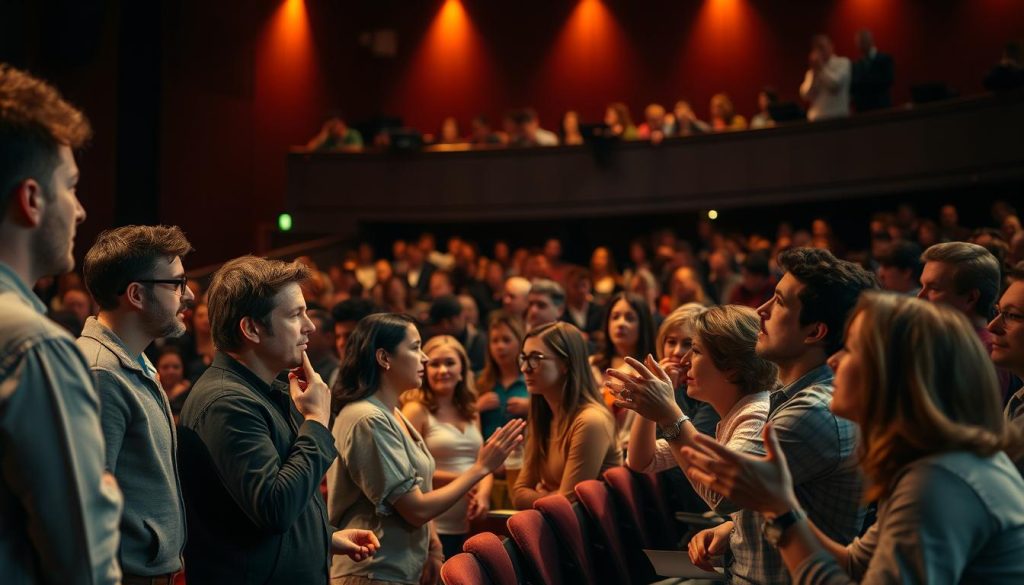
Reading Between the Post-Show Gasps
The magic happens when the lights come on. Phoenix Theatre’s festivals turn Q&As into places where:
- A cough can signal a problem
- Wine talk helps analyze themes
- An enthusiastic clap can uncover comedy
“Our tryout of The King of Harlem was eye-opening. We rewrote Act Two during dessert.”
This feedback loop is like the Starbucks effect. Insights flow through rewrites quickly. The table below shows how theaters use this energy:
| Theater | Feedback Format | Unique Metric | Impact on Revisions |
|---|---|---|---|
| NPC | Structured surveys + live tweets | Laughter decay rate | 63% dialogue adjustments |
| Phoenix Theatre | Post-show speed dating | Emotional whiplash index | 41% structural changes |
| Steppenwolf | Intermission eavesdropping | Bathroom break timing | 28% pacing edits |
Audience engagement is a playwright’s secret weapon. It’s a real-time guide between vision and resonance. The best test? When crowds can’t tell if they’re watching a disaster or a masterpiece.
Building a Supportive Indie Playwriting Scene
Imagine a barista creating foam art while thinking about deep themes in suburbia. Today’s indie playwrights face a tough balance between their creative work and making ends meet. But what if the industry changed and opened its doors?
The $15 Application Revolution
The National Playwrights Conference made a big change by lowering submission fees to just $15. This move is like Elizabeth Warren checking Ticketmaster’s prices. This isn’t just kindness; it’s a smart move to find new voices.
Think of NPC’s fee waiver program as playwrights’ Pell Grants. It’s based on need, not who you know. In 2023, they saw:
- 42% first-time submitters
- 28% working artists without MFAs
- 17% recipients of full fee waivers
| Program | Old Fee | New Fee | Waiver Rate |
|---|---|---|---|
| NPC Submissions | $75 | $15 | 15% |
| Regional Theater X | $50 | $45 | 3% |
| Fringe Festival Y | $30 | $25 | 8% |
This change does more than make things cheaper. It changes what gets seen on stage. When new play labs stop charging to consider plays, they open up to new stories. As Obie-winning playwright Donja Love said last year:
“We’re not mining for polished gems. We’re providing shovels.”
This leads to more opportunities for new writers without high costs. It also means better plays for everyone. And audiences will see more diverse stories, not just Yale Drama School plays.
Guide: Submitting, Developing, or Producing New Work
Getting through theater workshops is a mix of strategy and survival skills. It’s like Lord of the Flies but with Zoom meetings and a 47-page guide. You need to know how to survive.
The Unwritten Rules of Playwright Residencies
I’ve made it through three residencies that were tougher than The Shining. Here’s what they don’t tell you in the welcome packets:
1. Dorm Life ≠ Artist Retreat: The dreamy cottages in the brochure? They’re next to a generator that plays showtunes all night. Bring earplugs and learn to ignore your roommate’s slam poetry.
2. COVID Protocols Are Your Co-Conspirator: NPC’s testing isn’t just about safety. It’s a great reason to miss late-night trust exercises. Schedule tests during awkward feedback sessions.
“Residencies are where plays go to either become world premieres or therapy bills – sometimes both.”
3. Eavesdrop Like a CIA Operative: The real value is in the coffee line gossip. Learn to listen in without being obvious:
- Hang out near literary managers talking about submissions
- “Accidentally” follow producers discussing their schedules
- Charge your phone near the artistic director’s favorite spot
4. Seaside Strolls = Career Currency: Those “networking walks” are actually important talks. I solved my play’s midpoint on a cliffside walk about Hamilton fanfic. Just call it “environmental immersion.”
Every world premiere starts with surviving the residency. It’s not just about writing talent. It’s about making it through shared bathrooms without losing your mind.
Looking Ahead: The Future of New Play Development
Experimental playwriting and machine learning are set to change the game. The next decade will see theaters digitize the stage. They’re exploring AI script analysis, virtual table reads, and holographic set designs.
When Algorithms Read Between the Lines
The O’Neill Theater Center tested AI script evaluation systems. They found AI could predict audience engagement with 72% accuracy. These tools analyze data from thousands of shows, giving insights humans might miss.
Now, playwrights can work with actors in New York while designers in London tweak designs in real time. Digital platforms have boosted experimental play submissions by 140%.
But, there’s a catch. Keeping theater human is key. As one director said, “We can fake laughter, but can we capture live gasps?”
The future needs balance. AI can help with logistics, but human touch creates magic. Virtual workshops open doors, but nothing beats live performances. We aim to keep theaters dark, letting imaginations shine.
