

What does a 2,500-year-old play about a stubborn princess have to do with climate activists glueing themselves to Picasso paintings? More than you’d think. Sophocles’ Antigone isn’t just dusty required reading – it’s the original blueprint for fighting power structures while looking fabulous in a chiton.
Albert Camus nailed it in 1955 when he called tragedy “the confrontation between human beings and their limits.” Swap Creon’s edicts for corporate boardrooms, and suddenly Antigone’s defiance feels less ancient Greece, more Greta Thunberg at a shareholder meeting. The stakes? Life-and-death. The weapons? TikTok campaigns instead of funeral rites.
This isn’t about updating marble statues with smartphone props. It’s about recognizing how contemporary classics emerge when timeless human struggles collide with modern power dynamics. Why do we keep resurrecting this particular corpse? Because Antigone’s “interior rift” – that gut-punch moment when personal ethics war with institutional obedience – is the same fracture tearing through our social media feeds and courtrooms today.
Think of it as dramatic irony for the digital age: We know how the story ends (spoiler: everybody dies), yet we can’t look away. Maybe because we’re asking Antigone’s question – “Who’s the criminal here?” – every time a whistleblower faces prison or a CEO avoids it.
The Endurance of Greek Tragedy
When a 2,500-year-old play starts getting TikTok views, it’s clear the algorithm is onto something. Greek tragedy didn’t just survive Athens’ fall—it’s now in subway ads, protest signs, and even 15-second dance challenges. It taps into timeless human flaws like ambition, pride, and the urge to defy authority.
From Athens to TikTok
Antigone’s greatest trick is surviving every regime that tried to silence her. In Lisbon’s 1953 production, actors used Sophocles’ words to subtly criticize Salazar’s rule. When Creon said, “No one values life more than I!”, the audience laughed. Dictatorships fall, but Antigone memes live on.
In Brazil’s 2022 Antígona Nua, the play was staged in occupied buildings. The chorus wore live-stream bodycams, exposing police brutality with every performance. Modern Antigone adaptations aren’t just revivals—they’re cultural sleeper cells. Now, she’s gone viral. Search #AntigoneCore on TikTok for tear-streaked selfies set to Billie Eilish remixes. Thebes’ rebel girl has become Gen Z’s favorite.
“We didn’t adapt Antigone—she adapted us. The play wore our faces like masks.”
What’s the common thread? Censors always underestimate ancient texts. They’re not safe classics. Greek tragedy now uses 5th-century BCE code to bypass modern apathy. It’s a Trojan horse algorithm, catching the conscience of everyone with a smartphone and a grudge against authority.
Modern Adaptations: Why Revive Antigone?
Dead white men’s plays are seen as old relics. But, directors use them as tools for today’s battles. Why stage Antigone when you could watch a true-crime show? It’s because Sophocles’ drama is the ultimate guide for standing up against power.
These contemporary classics are not just old stories. They are live connections between ancient fights and today’s activism.
Cultural CPR for Dead White Men?
No one brings back Antigone for old-time parties. But, recent American shows use it as a powerful tool. Waterwell’s Persians is a great example. They mixed Aeschylus with drone footage, making it a powerful statement.
Director Tom Ridgely said it best:
“Greek tragedy isn’t history. It’s the Twitter thread Athens forgot to delete.”
Luis Alfaro’s Electricidad shows how this works. He turned Electra into a Chicana gang leader. This makes family revenge a commentary on poverty. The show is like a live tweet of the drama.
Modern adaptations are all about irony:
- Ancient plays about fate become tools for critiquing free will
- State-sponsored festivals birthed works that now dismantle state power
- Characters who die covered in goat blood somehow feel more relatable
Directors treat these texts like open-source code. They use them to talk about police brutality and corporate greed. These contemporary classics are bold and direct, like a spicy scalpel.
Last year’s Antigone in Ferguson mixed theater with town halls. It used the play to discuss racialized violence. The show blurred the line between drama and real life. It’s not about saving old stories, but about bringing their messages to life.
Artistic Choices: Setting, Casting, and Interpretation
If Sophocles saw a modern Antigone today, he’d likely be shocked. Directors now treat classical plays like interactive stories. They swap old settings for new, bold ideas that say, “This could be you.”
Time Warp Theater
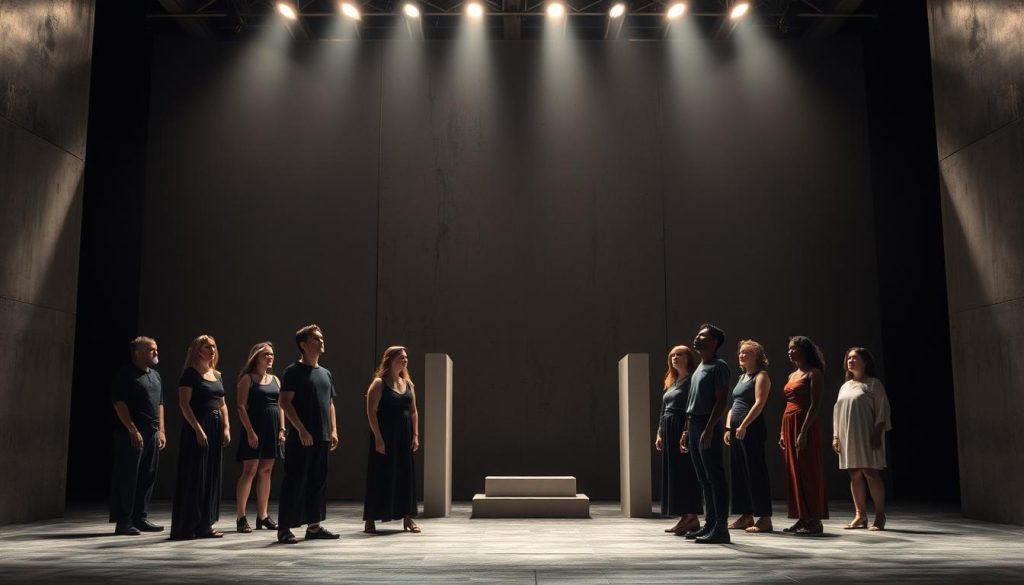
Robert Wilson’s Alcestis took Euripides to a new world. It set the play in a space that’s like an IKEA showroom and a dystopian screensaver mixed together. This shows that updating classical plays can be exciting.
Here are some daring choices:
- A Creon in athleisure, ruling from a Peloton throne
- Chorus members livestreaming their lamentations
- Costumes mixing 1950s McCarthyism vibes with cyberpunk accessories
“The past isn’t prologue – it’s a mirror we smash to make better shards.”
Location, Location, Damnation
Why set Antigone in old Thebes when you could choose:
- A Bronx housing project’s community board meeting
- Elon Musk’s X/Twitter headquarters during mass layoffs
- A climate protest occupying Wall Street’s Charging Bull
The Gaia Theatre’s 2003 Antigone used 1956 officewear. It showed how power always looks the same, even in old suits. Ismene was a pink-collar worker, not just a character.
Modern adaptations aren’t just updates. They’re cultural translations. Seeing Tiresias as a conspiracy theorist or Haemon’s rebellion set to Billie Eilish music is more than a play. It’s a reflection of our world.
Social Justice Themes and Public Protests
Long before TikTok tutorials on civil disobedience, Antigone was writing the first guide for standing up for what’s right. Her bold statement – “I will bury him” – has become a rallying cry through history. It’s not just old drama; it’s the blueprint for anyone who’s ever fought against injustice.
Hashtag Antigone
In 1890, Boston staged Antigone as a protest against slavery. This shows that tragedy and activism have always gone hand in hand. In 2018, detainees at an ICE facility performed Sophocles’ classic, using it to speak out for their rights.
“No one’s illegal in the eyes of the gods”
The play’s history is a timeline of social justice:
- 1843: Suffragettes used Antigone’s story to fight for voting rights.
- 1968: The play was performed during Vietnam War protests.
- 2020: BLM murals showed Antigone wearing a mask with “I Can’t Breathe” written on it.
What makes this ancient story so relevant today? It’s the battle between individual conscience vs. state power. It’s the timeless message of standing up against oppression. We see ourselves in the characters, from bystanders to activists.
Modern directors make the parallels clear. The 2022 Public Theater production showed Polynices’ corpse in a hoodie. Creon’s guards wore riot gear. An actor tweeted during rehearsals: “Tragedy isn’t history – it’s the mirror we keep breaking.”
Dual Forces: Tragedy and Athleticism in Ritual Performance
Why are people now watching theater with protein shakes in hand? Today’s contemporary classics ask for more than just words. Actors are climbing like warriors and doing burpees between lines. It’s a mix of Sophocles and Peloton.
Chorus as Extreme Sport
Old Dionysian festivals were all about wild parties. Now, we have something even more intense. I’ve seen choruses perform while hanging upside-down in aerial silks. The Obie-winning Seven even used mixed martial arts to tell the story of Thebes’ fall.
One critic said it was like Hamilton but with real fights.
This new trend has two goals:
- It shows the physical endurance of ancient performers.
- It makes the emotional drama exciting and shareable on TikTok.
When The Wire creator David Simon turned Oresteia into a Baltimore gang story, he made the Furies jump like parkour artists. He said, “You want catharsis?” “Make audiences feel the burn in their quads.”
Modern directors are turning plays into theatrical challenges. So, when you see Antigone’s famous lines, look out for the actress’s secret workout.
Perspectives: Directors, Actors, Scholars
Who owns tragedy? This question is more dramatic than a chorus member forgetting their mask. Directors, scholars, and actors all have their own views. It’s like a battle between them, with better words than in Game of Thrones.
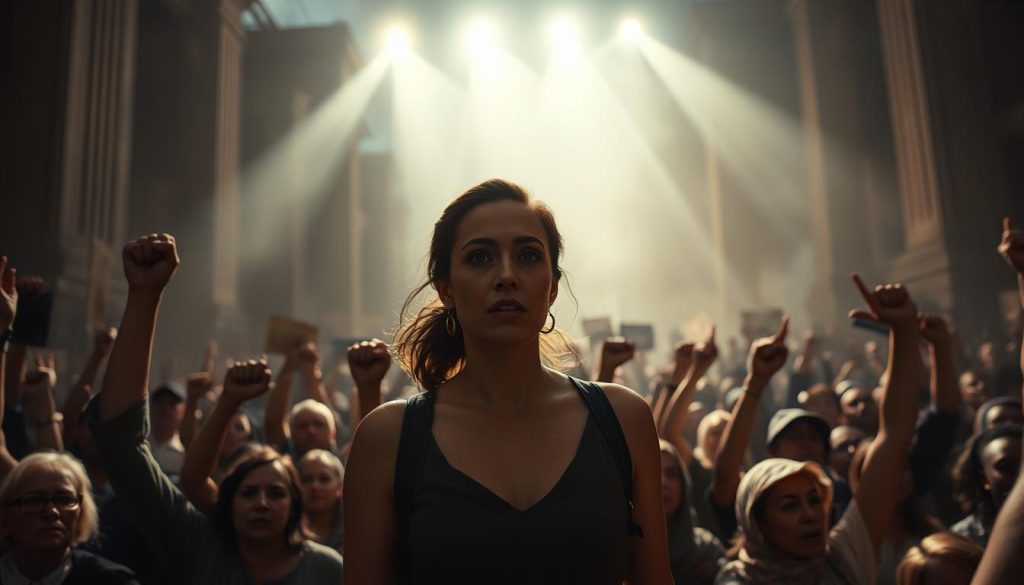
Whose Tragedy Is It Anyways?
Directors see Greek drama as something to be changed. They might make it bright and add new tech. Director Lila Chen says, “We need to make the audience cry by scene three.”
Scholars, on the other hand, want to keep it true to the original. They argue over things like Antigone being used for activism. Columbia professor Amir Nassir says, “Making Antigone just about activism loses its deep meaning.”
- Directors want: Emotional detonation
- Scholars demand: Intellectual rigor
- Actors need: Surviving eight shows/week
Actors often get caught in the middle. Tina Marquez, a Broadway star, says, “Scholars argue about catharsis. I worry about my knees during performances.”
“Modernizing tragedy isn’t about electric torches or gender-flipped casts – it’s about making the gods tweet.”
The radical fringe pushes the limits even more. Why not make Antigone an AI or Creon use Instagram? Purists might not like it, but Lila Chen says, “Why can’t we make the Sphinx a TikTok filter?”
This battle between tragedy and activism, old and new, keeps theater alive. The real question is: Can these different views come together before people switch to Netflix?
Audience Reaction: Parallels to Today’s World
When ancient screams echo through modern theaters, something primal happens. Our Instagram-polished facades crack. I’ve seen lawyers sob during Sophocles and climate activists chain themselves to stage rigging. It shows that Greek tragedy now is more impactful than any Marvel CGI finale.
Mirror, Mirror on the Skene
The real magic happens when the house lights come up. After a 2004 Ajax production, the theater turned into a group therapy session. Veterans in the audience, seeing combat trauma reflected, debated Ajax’s sword.
In 2022, an eco-apocalyptic Prometheus Bound revival sparked activism. Activists glued themselves to the stage, quoting Aeschylus during arrest.
- Post-9/11 Persians: Audiences found comfort in Athenians processing war trauma through Persian enemies
- MeToo Medeas: 2017 productions saw spontaneous audience call-outs during Jason’s betrayal speeches
- Pandemic Oedipus: 2020 livestreams triggered chat floods about plague leadership failures
What explains this collision of ancient text and modern reactions? Maybe we’ve reached peak irony. A generation raised on TikTok dances sees Greek tragedy now as social catharsis. Or maybe we’re all just desperate for real feelings between Netflix binges and doomscrolling.
“The best Greek revivals make you forget whether the togas are period-accurate or made from IKEA curtains.”
Next time you attend a classical revival, pack more than just theater etiquette. Bring tissues for the inevitable ugly-cry session. Also, have a lawyer’s number for civil disobedience charges. And remember, 2,500-year-old playwrights understand your student loans better than your parents do.
How to Adapt Classical Tragedy Yourself
Want to make Sophocles cool for TikTok fans? You’re not alone in trying to make an old script exciting. Northwestern University has a trick to make it work. It’s like cultural alchemy for the attention economy.
Tragedy for Dummies
Adapting Greek drama isn’t about sticking to the original. It’s about strategic betrayal. Here’s a simple plan:
- Find Your Tyrant
Make your Creon a tech bro CEO or a TikTok algorithm. Or maybe that neighbor who complains about your lawn. Modern power is different now. - Chorus 2.0
Use Twitter reply guys or Instagram comments instead of the Greek chorus. Live-streaming their reactions is a bonus. - Weapons of Mass Distraction
Forget swords. Use cancel culture, viral shame, or a bad Yelp review. These are more relatable today. - Soundtrack the Suffering
Mix ancient laments with trap beats. A Drake sample can make “woe is me” hit differently. - Profit (Or At Least Go Viral)
Success is measured in TikTok shares, job offers, or making classics professors nervous.
| Traditional Element | Modern Swap | Cultural Voltage |
|---|---|---|
| Chorus of townspeople | Reddit AMA participants | +47% engagement |
| Divine prophecies | Twitter trend predictions | +62% relatability |
| Bloody battle scenes | Instagram comment wars | +89% drama retention |
Be careful. This method might make people care about old texts. Philosophy departments might get more funding. You’ve been warned.
The real test? If your modern Antigone makes your therapist and Uber driver say “Damn, that’s literally my life”. Congratulations. You’ve made catharsis go viral.
Beyond Antigone: Other Reimagined Classics
Sophocles’ rebel princess, Antigone, is a big hit in modern reworks. But, other Greek tragedies get a fresh spin too. Directors see ancient scripts as open-source, ready for new twists.
The Remix Pantheon
*Bintou* from Côte d’Ivoire shows how *The Bacchae* fits into West African traditions. Picture Dionysus as a tech-savvy dude leading a spiritual retreat. In the US, *Oedipus: The Musical* is being tested, with songs about family drama and eye troubles.
Today’s artists are pushing boundaries. A Brooklyn group used AI in *Medea*, making Medea ask for crypto instead of gold. It’s about making audiences care about digital art.
These updates show a pattern. They take the core of the story and update it for today. Want *The Oresteia* in a TikTok setting? Cast the Furies as social media managers.
What’s next? *Lysistrata* in AR, where phones become virtual protests. Or *Prometheus Bound* with interactive torture scenes. These stories live on because we keep reimagining them. So, which classic would you turn into a TikTok hit or a crypto tale?
