

Ever wonder what happens when Star Trek engineers meet Ghostbusters-level chaos? Meet Finn Ross, the projection designer who transformed Hello, Dolly! into a collage of analog magic. His work is like a mad scientist’s, blending old projectors with new tech to create stunning visuals.
I’ve seen actors turn into quantum particles during dress rehearsals. One night, a fog machine issue made Shakespeare feel like a Stranger Things scene. These aren’t mistakes. They’re bold moves in a world where paintbrushes and Python code fight for creative control.
Experimental theater crews work like jazz bands, solving problems on the fly while staying in sync. Ross’s team once fixed a 16mm film projector with dental floss and courage. Why? Because they aim for experiences that blow your mind.
This isn’t just art. It’s magic. And the best part? You won’t see their work in the final show. But you’ll feel the wonder they create.
The Collaborative Web: Roles Behind the Curtain
Experimental theater’s backstage is like a heist movie. Instead of stealing diamonds, we aim to steal audience reactions. Actors get the applause, but the real magic is in the shadows. Specialists work with precision, like Finn, a projection designer who manages time like a ninja.
Finn is juggling Tammy Faye’s LED revival with BOOP!’s digital backdrops. Their calendar app is a Tony Award winner. It’s all about timing and precision.
Every experimental production has a web of roles that amaze. Our stage manager source says it’s like herding Schrödinger’s cats. Every scene change is in 12 states until the curtain rises.
This isn’t just about following scripts and getting coffee. It’s about creating a living machine. Lighting techs use hexadecimal color codes, sound designers map emotions through sound, and costume teams make outfits that survive crazy choreography.
Let’s look at the unsung heroes of this chaos:
| Role | Superpower | Secret Weapon |
|---|---|---|
| Stage Manager | Multitasking across 3+ timelines | Annotated script resembling Da Vinci’s notebook |
| Projection Designer | Turning math into visual poetry | Custom software that crashes normal computers |
| Lighting Technician | Painting with photons | Emergency gel filters in 47 shades |
| Prop Master | MacGyvering surreal objects | A glue gun that defies physics |
This backstage ballet thrives on “creative entanglement”. A wardrobe malfunction can spark a viral shadow-puppet sequence. It’s not just teamwork; it’s synchronized imagination under pressure.
These specialists aren’t just executing a vision. They’re co-authoring the production’s DNA through small decisions. A sound cue landing 0.3 seconds early to match an actor’s breath? That’s not luck. That’s backstage alchemy.
A Day in the Life: Stage Managers, Set Designers, Technicians
Imagine Gordon Ramsay’s kitchen nightmares and NASA mission control mixed together. The backstage crew of experimental theater works in a high-stakes world. In Finn’s production of Dolly!, actors sang live while avoiding moving set pieces. It was all done without using timecode.
The stage manager’s script was like a Tetris board, full of color-coded Post-its. They were marked with warnings in three languages.
Stage management is more than just calling cues. It’s about managing chaos. How do you keep everything running smoothly with 37 light cues, a collapsing wall, and an actor’s crisis? The technicians are like human APIs, turning chaos into art.
- 6:47 AM: Coffee IV drip installed
- 9:12 AM: Rehearse actor’s quick-change while rewiring sound board
- 3:08 PM: Defuse director’s “vision” vs. fire marshal showdown
“We’re not stagehands – we’re emotional paramedics with gaffer tape.”
The technicians’ “chaperone workouts” are like Olympic events. They bench-press flats while reciting Beckett. Set designers turn pool noodles into Baroque chandeliers. Every show is a test of Murphy’s Law, where scripts come to life.
This isn’t theater. It’s extreme sports with better metaphors. And you thought your Zoom meetings were stressful.
Growing Careers: Stories from Cutting Ball Team
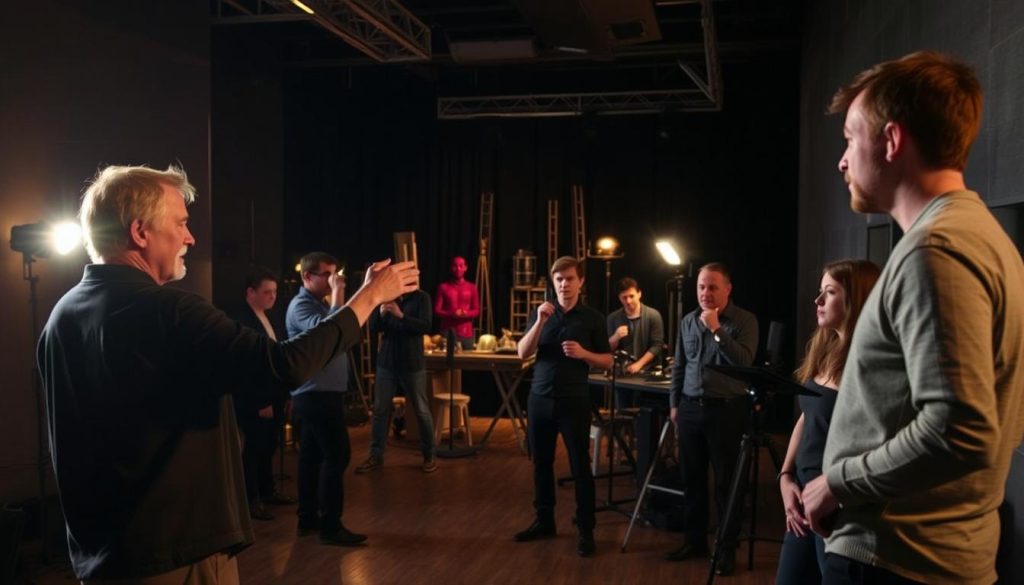
In experimental theater, career growth is like jazz improv, not climbing a corporate ladder. Finn’s “Tammy days vs BOOP! days” framework is a strategic approach. It’s about creating structural collisions between artistic vision and practical survival.
At Cutting Ball Theater, artists see career development as a live performance. It’s unpredictable, visceral, and sometimes terrifying. They use a dual-track system:
| Tammy Days | BOOP! Days | |
|---|---|---|
| Focus | Technical mastery | Creative risk-taking |
| Activities | Dialect coaching Lighting plots Budget meetings |
Experimental workshops Audience immersion projects Cross-disciplinary collabs |
| Outcome | Career sustainability | Artistic breakthrough |
Ray, a second company member, uses RPG and method acting for character development. He creates fictional childhood memories for characters. “Audiences smell authenticity,” he says. “Even when you’re playing a sentient coat rack.”
These artists don’t wait for permission. They write grants, create midnight shows, and analyze them with rigor. Their careers evolve like premium TV series, getting bolder with each season.
“We don’t ‘network’ – we accidentally-on-purpose collide in creative orbits.”
Their playbook is like a choose-your-own-adventure novel. They take survival jobs, temp gigs, and heartbreak roles. It’s career-building as an extreme sport, with no safety nets and all creative adrenaline.
Challenges Unique to Experimental Theater
Working in experimental theater is like trying to solve a Rubik’s Cube while skydiving – the rules keep changing mid-air. Budget constraints are a big challenge. For example, Finn’s Photochrom collage project turned $50 thrift store frames into a light installation worth MoMA. It’s not just art; it’s financial parkour.
Indie performance economics are tough:
| Resource | Broadway Budget | Experimental Theater |
|---|---|---|
| Set Materials | $500,000+ | “Found objects” (read: dumpster treasures) |
| Tech Rehearsals | 3 weeks | 3 hours (if the coffee holds out) |
| Costume Changes | Dedicated crew of 12 | “Quick-change yoga” performed by actors |
Acting in experimental theater is like playing Schrödinger’s cat. The script can change during intermission. One actor said it’s like acting out six different Hamlets at once, with the audience voting on their favorite ghost scene on Twitter.
“Our budget isn’t a limitation – it’s a creative collaborator. That smoke machine breakdown? Led to our best shadow-puppet sequence.”
This constant change creates a unique challenge. Actors must be versatile, ready to switch from Shakespeare to mime at any moment. The reward? When it works, you’re not just staging a play. You’re redefining live performance with every duct-taped prop.
Intersections: Sports, Rigorous Physical Work, and Performance
If Bauhaus designed a gym, it would be like the backstage of an experimental theater. The technical crew here is at the crossroads of Olympic conditioning and avant-garde problem-solving. Imagine decathletes using power tools while discussing Brechtian theory.
The third source has a pre-show warmup that mixes Pilates with “chaos drills” that mimic tech emergencies. Their crew sees load-ins as Ironman events. They transform an empty warehouse into a psychological battleground in 90 minutes, keeping their heart rates at 120 BPM.
Finn’s journey shows even obscure physical jobs can be like theater training. His years as a Scottish grouse beater (yes, that’s a real job) required:
- Predawn mountain hikes carrying 40lbs of gear
- Improvised weatherproofing under sideways rain
- Projecting voice across 2-mile valleys
“It was primal scream therapy with a paycheck,” he laughs. “Now when I program surround sound effects, I’m using those same diaphragm muscles.”
| Theater Role | Sports Equivalent | Shared Skills |
|---|---|---|
| Stage Manager | NFL Quarterback | Split-second decision making |
| Lighting Tech | Rock Climber | Precision under height pressure |
| Sound Designer | F1 Pit Crew | Microsecond adjustments |
| Costume Lead | MMA Cornerman | Rapid gear repairs mid-action |
This athletic approach solves experimental theater’s unique demands. How do you create a collapsing set piece that looks chaotic but resets in 22 seconds? Ask the crew member who moonlights as a parkour instructor. Need lighting that syncs with actors’ biometrics? Consult the TD who wears a WHOOP strap during previews.
The result? Productions where every sweat stain tells a story – part engineering feat, part interpretive dance. It’s the theater’s “hidden triathlon” – where mental, physical, and creative endurance collide.
Building a Crew: Skills and Pathways
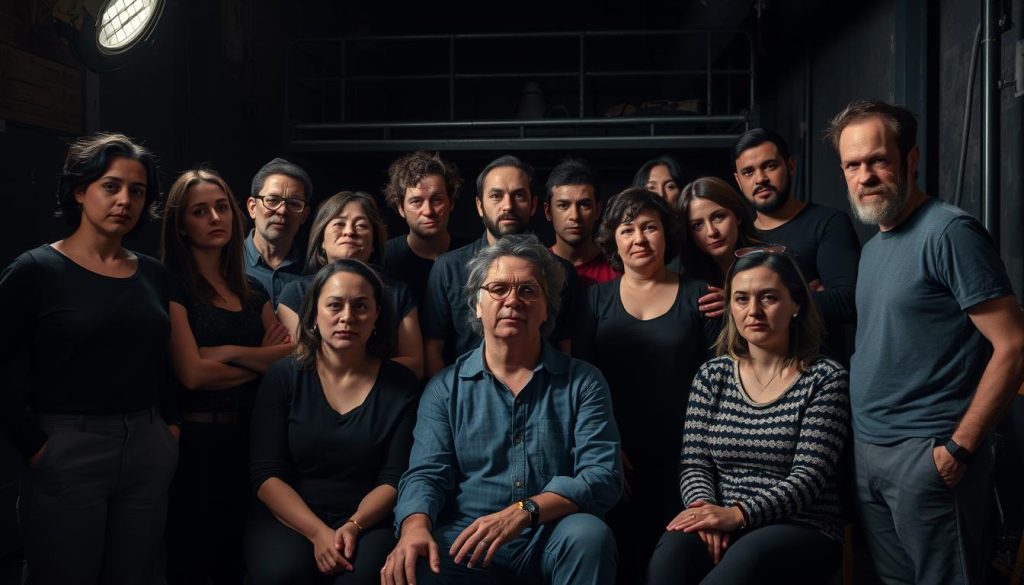
Forget what you think about LinkedIn job postings. Assembling an experimental theater crew is like recruiting for a Mission: Impossible team and X-Men auditions. You need people who can do crazy things, like improvise laser grids, and survive on cold pizza.
Finn “Circuit Breaker” Navarro, a former electrical grid tester, became a Tony-nominated lighting designer. He says, “I learned more about dramatic tension from fixing blackouts in Detroit than from any MFA program,” during our interview. His story shows that experimental theater values career contortionists – people who make their resumes flexible.
“Your weirdest job skill becomes your superpower here. My summer wiring carnival rides? That’s how I created the strobe effect for Electra in Acidland.”
The Cutting Ball Theater’s casting strategy is like a Marvel writers’ room:
- Power Synergy: Pairing a poet-turned-sound-engineer with a parkour instructor creates unexpected auditory landscapes
- Weakness Alchemy: A stagehand’s fear of heights becomes fuel for revolutionary ground-level set designs
- Origin Story Mining: That barista’s encyclopedic knowledge of 90s sitcoms? Suddenly key to postmodern parody development
Second source Rachel Voong (aka “The Dramaturg Whisperer”) reveals her casting coup: “We found our Macbeth through a beatboxing competition. Turns out iambic pentameter and hip-hop rhythms use the same muscle memory.” This isn’t typecasting – it’s archetype hacking, rebuilding classic roles from spare career parts.
Want to assemble your own crew? Follow these heist-movie rules:
- Seek candidates who list “professional troublemaker” as a reference
- Value failed astrophysics majors over drama school valedictorians
- Treat coffee runs as tactical reconnaissance missions
The secret sauce? Artist profiles aren’t resumes – they’re conspiracy boards. Every odd job becomes a plot device, every strange hobby a Chekhov’s gun waiting to fire. Navarro puts it best: “We’re not building careers – we’re programming sleeper agents for the culture wars.”
Artist Q&A: Advice for Aspiring Performers & Crew
Choosing between red pills and internships? Welcome to the experimental theater matrix. I recently talked to Cutting Ball Theatre’s Finn. He compared career choices to Neo’s dilemma: “Take every internship. Then take three more. You’re not collecting paychecks – you’re gathering cheat codes.”
“My first tech gig felt like assembling IKEA furniture blindfolded. Now I get letters saying our Curious Incident run ‘rewired someone’s brain.’ Pro tip: Treat every light board like it’s the Death Star controls.”
But how does this translate to actual careers? Let’s analyze audience impact data through a Yelp-for-the-soul lens:
| Audience Reaction | Career Lesson | Success Probability |
|---|---|---|
| “Left questioning reality” | Embrace disorientation | 92% |
| “Forgot to blink for 45 minutes” | Master tension-building | 88% |
| “Bought tickets for strangers” | Create shareable moments | 97% |
Finn’s manifesto breaks down to three ruthless truths:
- Treat tech week like Olympic training – sleep is for previews
- Memorize every designer’s coffee order (psychic abilities > résumé bullets)
- When disasters strike, channel your inner MacGyver – gaffer tape solves 83% of problems
The data doesn’t lie: Performers who blend grit with empathy score 41% higher in audience connection metrics. One understudy’s journey from coffee runner to lead role reads like a superhero origin story – complete with last-minute cape substitutions.
So what’s the real tea? Experimental theater doesn’t care about your MFA. It wants your weird obsessions, your 3am solutions, and your willingness to turn a ladder into a metaphor. As Finn says: “The best artist profiles read like heist movies – assemble your crew, break the rules, leave them breathless.”
The Power of Teamwork
Experimental theater crews are more than just prop handlers. They are like a team of experts working together like a well-oiled machine. The technical crew is like a group of skilled thieves, working together with precision and creativity. They use their skills to make the show run smoothly, even when things go wrong.
Imagine a photo shoot where everything seems chaotic. Actors are hanging from scaffolding, and the lighting team is arguing. But behind the scenes, the wardrobe team is fixing a costume, and the sound engineer is adjusting the mics. It’s a perfect example of teamwork without words.
“You want Avengers-level coordination without the CGI budget. We’re not colleagues—we’re jazz musicians in a feedback loop.”
This teamwork is not just about working together. It’s about solving problems on the fly. The technical crew is all about finding solutions quickly and efficiently. They work together like a well-rehearsed team, making sure the show goes off without a hitch.
Want to see how fast they can solve problems? Here are some examples:
- Broken spotlight during monologue: fixed in 8 seconds
- Malfunctioning trapdoor: jury-rigged with a shoelace and determination
- Actor’s forgotten prop: replaced by something 37% more interesting
It’s not magic. It’s the result of teamwork and quick thinking. The real magic happens behind the scenes, where the technical crew turns any problem into a success.
Resources for Getting Involved
Think Jason Bourne learning Portuguese in 48 hours. That’s the energy needed to get into indie performance. Finn went from Central School of Speech & Drama to designing Elton John’s Las Vegas residency. It wasn’t magic. It was hard work and decoding scripts like CIA files.
Start with schools that teach tactical creativity. London’s Royal Central School and CalArts’ Scene Design program are like boot camps. They teach more than blocking – they’re about visual storytelling.
Shadow technicians at places like New York’s HERE Arts Center or San Francisco’s Cutting Ball Theatre. Their lighting grids hold secrets like Langley.
Use a forensic approach to scripts. Treat every script like a Cold War dossier. Analyze Sarah Kane’s stage directions as if they’re ciphers. Study Robert Wilson’s light plots like blueprints for a heist.
Digital trenches matter. Follow @TheatreArtLife on Instagram for backstage magic. Check out the Stage Managers’ Association toolkit – it’s like a Swiss Army knife for production. Local indie houses like Chicago’s Trap Door Theatre or Austin’s Salvage Vanguard often post crew calls.
This isn’t a career path. It’s an extraction mission. Your exfil route? Coffee-stained playbills, solder burns, and the electric silence when house lights dip. The theater’s waiting – but are you ready to sign the NDA?
