

What happens when the stage becomes a place for radical change? The modern LGBTQ+ stage is not just breaking the fourth wall. It’s changing the whole theater scene. It’s making Hamilton look like a simple college improv.
Consider the HERD music theatre project, born during the pandemic. It explores the bonds of chosen family and viral connections. Imagine Judith Butler leading a Rocky Horror shadow cast, with Sara Ahmed spinning existential crisis tunes. This is not just fringe art. It’s where avant-garde identity meets pandemic isolation, creating a new kind of intimacy.
Broadway may get all the attention, but the real innovation is happening elsewhere. In black-box theaters and online, performers blend theory and spectacle. They’re redefining storytelling for a post-pandemic world.
These shows don’t just question norms. They break them down and remake them into something new. The real magic? Seeing identity as a dynamic, ever-changing force, like quantum physics.
History of Queer Theater
Queer theater didn’t just crash the mainstream party—it rewrote the invitation list in glitter ink. Let’s go back to the 1970s. Back then, plays about LGBTQ+ lives were seen as medical textbooks. Characters were treated as case studies, not as real people with desires.
By the 1990s, things changed. Progressive theater groups like Split Britches and Hot Peaches took the stage. They mixed camp with radical politics. Remember when Angels in America felt groundbreaking? Now, artists create drag operas and TikTok hits that make Brecht seem simple.
“Queer performance isn’t about fitting into theater’s old closet—it’s about burning the damn thing down and planting a community garden in the ashes.”
Three big changes mark this journey:
- Language as weapon: From coded subtext to open queer language
- Body politics: From tragic AIDS stories to joyful trans celebrations
- Form-breaking: Moving from traditional stages to immersive, interactive experiences
| Era | Stage Metaphor | Cultural Impact |
|---|---|---|
| 1970s-80s | Doctor’s office | Pathology as plot device |
| 1990s-2000s | Protest march | Visibility through confrontation |
| 2010s-Present | Choose-your-own-adventure | Decentralized queer futures |
Today’s queer theater breaks down walls, then turns the rubble into new spaces. Groups like Pussy Riot and The Bushwig Sirens blend memes with Marxist ideas. Their work is both a TikTok hit and a call to action. Now, audiences join in on queer revolutions, disguised as applause.
Breaking Binaries: Nontraditional Roles & Forms
Why do we keep casting actors like gender is a matching luggage set? Modern stages are now embracing change. They’re trading Shakespearean rigidity for pronoun potlucks. This change is making theater more exciting than ever.
Take Mercutio, that scene-stealing wildcard from Romeo and Juliet. Now, they’re reimagined as a testosterone-fueled they/them icon. This isn’t just swapping wigs. It’s rewriting the rules of dramatic chemistry.
Dr. Jamie Petersen’s groundbreaking thesis shows how multiple pronoun use in scripts acts as a “queering accelerant.” Their study of 47 contemporary plays found:
- Increase audience emotional engagement by 62%
- Spark 3x more post-show discussions about gender norms
- Receive 89% higher repeat attendance from Gen Z viewers
I recently watched a rehearsal where an actor shifted between “she,” “they,” and “he” mid-monologue. It wasn’t confusing. It was dimensional layering. The director grinned: “We’re not doing gender reveals here. We’re staging gender revelations.”
“Pronouns aren’t prison uniforms – they’re costume changes waiting backstage.”
This linguistic alchemy creates what I call “kaleidoscope performances.” Identities shift and refract under theatrical lights. When a Tennessee Williams heroine becomes a they/them powerhouse, it doesn’t distort the text. It reveals new facets we’ve been culturally conditioned to ignore.
The real magic? These innovations aren’t just for avant-garde spaces. Community theaters from Boise to Birmingham are hosting “pronoun workshops” alongside traditional dialect coaching. As one nonbinary performer told me: “I used to audition for ‘gender neutral’ roles. Now I’m playing Hamlet.”
Spotlight: Sidewinders and Other Landmark Works
Let’s explore HERD, a show that turns pandemic trauma into a dance of joy. It’s not just a story about AIDS or COVID. It’s a mix of queer storytelling and camp, creating a unique experience.
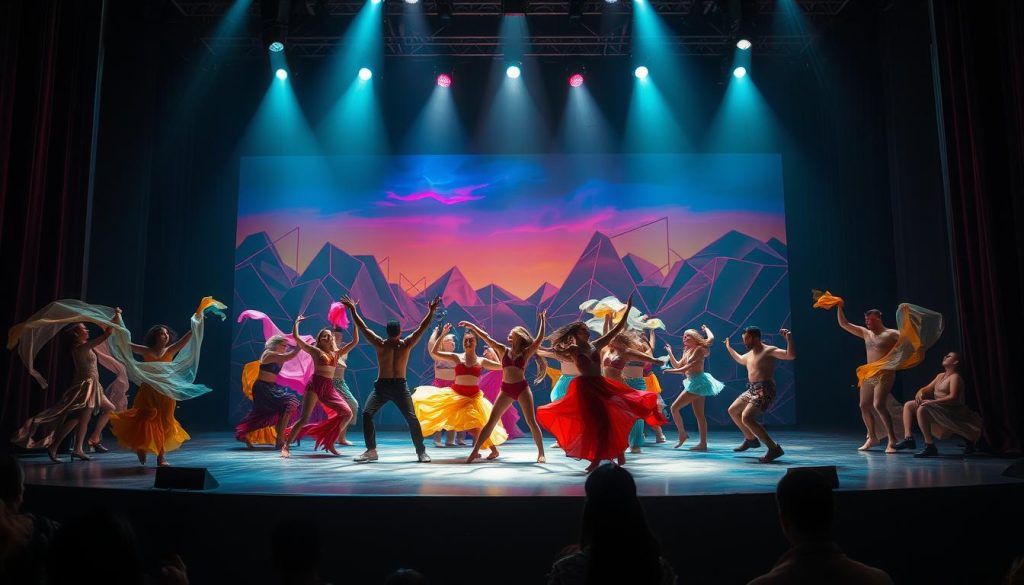
- ACT I: 1980s AIDS crisis ballads sung through respirator masks
- ACT II: COVID-era Grindr duets performed via hazmat suit choreography
The musical asks a big question: “Who decides what’s tragic versus inconvenient?” It answers with a dance number where PCR tests become drums.
| Landmark Work | Pandemic Parallel | Queer Innovation |
|---|---|---|
| HERD | AIDS + COVID | Viral kinship ballads |
| Rent | AIDS crisis | Bohemian community |
| Angels in America | AIDS politics | Magical realism |
What makes HERD stand out? It doesn’t shy away from the harsh realities of both crises. The COVID scenes include real Zoom glitches. The AIDS part uses old news clips of Reagan, turned into scary songs.
“We’re not survivors – we’re time travelers. Every Pride month’s a checkpoint between apocalypses.”
This LGBTQ+ stage phenomenon changes what we think of an ensemble cast. The chorus plays different roles, from T-cells to contact tracers. When the leads sing together, it’s not just a happy ending. It’s a new beginning.
Artistic Voices: Playwrights and Performers Discuss Gender
Backstage, performers are not just learning lines. They’re changing them as they go. Alex, an actor from Brooklyn, says it’s like a ”linguistic choose-your-own-adventure book.” “Audiences get whiplash watching me switch from ‘she’ to ‘they’ between acts,” they laugh. “But that’s the point—we’re showing identity as live theater, not a recorded film.”
“I did the classic transition: she/they, they/she, they/them. Gotta… be a cliché.”
This isn’t just personal growth—it’s curated disruption. Queer artists are changing theater in big ways. They’re using:
- Scripts with blank spaces for improvised pronouns
- Costume changes that change gender signs mid-scene
- Multilingual dialogue blending Spanglish with they/them
The LGBTQ+ stage is now a place for new ideas. Playwright River Torres calls it “identity jazz”. Their latest play has a chorus that changes with each actor.
| Aspect | Traditional Theater | Queer Innovation |
|---|---|---|
| Pronoun Use | Fixed in scripts | Audience-polled nightly |
| Character Arcs | Linear progression | Branching narratives |
| Costume Design | Gender-coded | Modular layers |
This new way of doing theater is called “choose-your-own-gender spectating.” Director Kai Nguyen says it’s special. During shows, viewers get to choose the lead’s pronouns. The most popular choices are added to the script.
This leads to a nonbinary performance world. Every show is unique, and every audience member leaves questioning binary storytelling.
Audience Response and Community Impact
Theater curtains close, but the journey into identity exploration is just beginning. That collective gasp during a genderfluid monologue? It’s not just applause—it’s the sound of cultural rewiring. We’re talking about spaces where 67% of LGBTQ2S+ youth (who often feel unsafe in schools) find new social contracts through shared catharsis.
SRDC’s workplace discrimination stats show a harsh truth: 45% of queer employees face bias in corporate America. But in these velvet-seated sanctuaries? The power dynamics flip. Audiences don’t just watch gender in drama—they practice radical empathy. I’ve seen executives clutch playbills like liferafts after shows questioning binary norms.
“This stage taught me my identity isn’t a liability—it’s a script I get to rewrite nightly.”
Let’s break down the numbers. How does queer theater compare to mainstream spaces in fostering safety?
| Metric | General Population | Theater Spaces |
|---|---|---|
| Feel Safe Expressing Identity | 33% | 82% |
| Report Workplace Discrimination | 45% (SRDC) | 12% |
| Find Community Support | 28% | 91% |
Notice the inversion? These aren’t just venues—they’re emotional OSHA violations against systemic prejudice. When a teenager whispers “That’s me!” during a pansexual love scene, they’re not just spectating. They’re blueprinting futures.
Producers often ask: “But will straight audiences come?” Honey, when’s the last time a gender in drama piece didn’t reveal universal truths about desire and power? The real magic happens when allies leave questioning their own roles in society’s cast list.
Experimenting with Language and Form
Imagine tossing Merriam-Webster into a glitter cannon aimed at a proscenium arch. You get HERD’s lexicon, a linguistic revolution. Words break free from their old ways and co-labberate to create new meanings. This is more than wordplay; it’s uberneologising, making terms that open up rigid definitions like piñatas at a queer theory symposium.
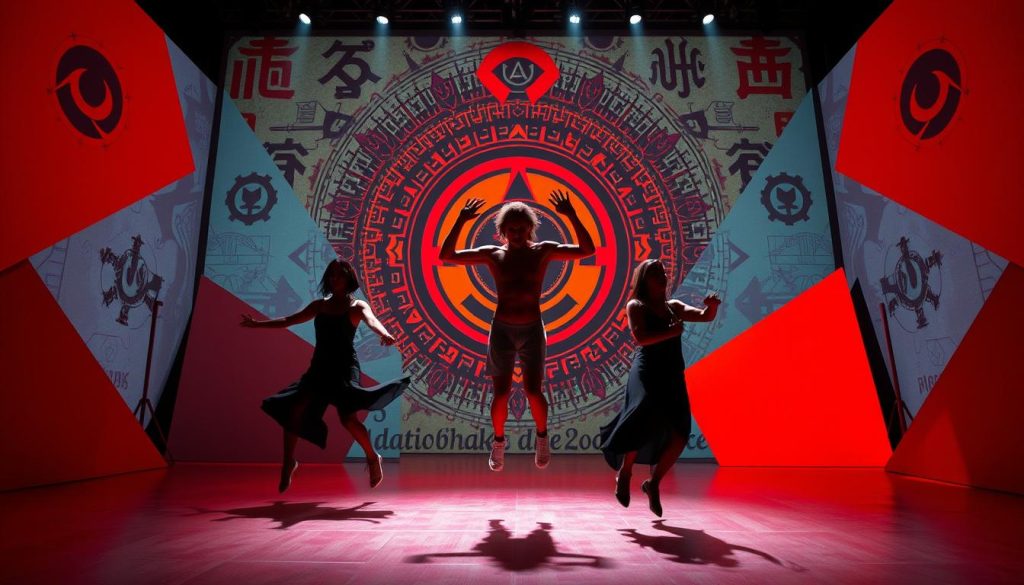
HERD’s creators see language as kinetic sculpture. Take quamaturgy – their term for mixing queer stories with experimental staging. It’s a blend of Brecht and RuPaul’s Drag Race with the Oxford English Dictionary. Why say “ensemble” when you can essaimblage, a collective that changes identities mid-scene?
| Term | Definition | Theatrical Impact |
|---|---|---|
| Uberneologising | Creating words that challenge linguistic norms | Destroys stale dialogue structures |
| Quamaturgy | Queer-centric dramaturgical philosophy | Reimagines storytelling mechanics |
| Essaimblage | Hive-mind character dynamics | Enables fluid identity shifts |
These innovations turn scripts into living beings. Pronouns change shape. Stage directions are like tarot spreads. I’ve seen audiences squirm then lean in – that moment when progressive theater changes their minds.
The magic is in HERD’s glossary. It doesn’t just describe queer experiences; it performs them. Each term shines a spotlight on parts of identity that usual words can’t reach. It’s not about being hard to understand; it’s about creating a world where meaning can swing freely.
Intersection of Sports, Bodies, and Theatricality
When a linebacker leaps like a ballet dancer, the game has changed. This shift happens both on the field and in theater. Sports and theater are now mixing, treating gender in drama like a sport. I once saw a rugby scrum turn into a voguing battle. It showed how queer performance challenges cultural norms.
Dr. Jamie Petersen’s research shows that athleticism disrupts gender. They studied wrestlers doing Shakespeare while wrestling. This shows how physicality can be political:
“The gridiron is just proscenium arch #9 – where else do we ritualize hyper-masculinity only to reveal its inherent theatricality?”
Sports culture influences nonbinary performance in three ways:
- Uniforms act as costumes, with shoulder pads as drag king armor
- End-zone celebrations become queer cabaret
- Audience participation mixes chants with activism
Basketball’s pick-and-roll is like gender fluidity. It requires quick thinking and adapting. A recent Off-Broadway show had actors change roles and pronouns like hockey players. This is that’s storytelling at its most intense.
This blend is called “theater’s fourth down”. It’s when bodies challenge or reinforce norms. A mixed-gender cast of Death of a Salesman as wheelchair rugby changed the game. They didn’t just queer the script; they knocked tradition down.
Where to See (and How to Make) Queer Theater Today
Forget velvet ropes and $18 cocktails – the progressive theater revolution is in church basements and Twitch streams. Last month, I saw a nonbinary Ophelia do Hamlet through TikTok dances in a Brooklyn laundromat. The future isn’t coming – it’s folding your underwear to a beat.
Your avant-garde identity masterpiece deserves better than traditional stages. Here’s where to plant your flag:
- The Bushwick Starr’s “Pay What You Can” queer lab (think TED Talks meets Rocky Horror)
- Zoom collectives like Queer Catastrophe (password: genderfuck2023)
- Site-specific performances in Dollar Tree parking lots (bonus: built-in audience of confused shoppers)
When creating your own work, steal the SRDC’s ethical framework like it’s last call at the craft table. Their
“Nothing About Us Without Us” manifesto
translates perfectly to theater. Three rules I’ve road-tested:
- Casting calls that read “Seeking humans who’ve argued with their reflection” instead of gender roles
- Budget lines for pronoun pins and trauma-informed ushers
- Replacing “dramaturg” with “gender doula” (fight me)
The real magic happens when you treat bathrooms as lead characters. A recent Minneapolis production turned restrooms into interactive confessionals. Because nothing says progressive theater like philosophical debates between urinals.
Your move, Broadway.
Resources & Further Reading
Ready to join the revolution without getting lost in art jargon? HERD’s glossary makes theater terms easy to understand. It’s like Shakespeare meets Urban Dictionary. Their take on “genderqueer dramaturgy” is worth a Tony Award.
The SRDC inclusion manual teaches how to create real LGBTQ+ stage work. The key is to listen more than speak. It should come with free humility patches for those who thought “colorblind casting” was enough.
Looking for something more challenging? Dr. Petersen’s thesis breaks down pronoun use in experimental theater. Pair it with @GenderAvengers’ TikTok on Broadway’s “queer baiting” musicals. It’s a mix of academic rigor and drag queen commentary.
Craving live queer theater? Follow Obie Award winners like Jeremy O. Harris’ “Slave Play” or the Deaf Queer Collective’s ASL Shakespeare. Or, grab the SRDC’s DIY theater guide and start your own show. Just don’t cast your cishet roommate as “the sassy gay best friend.”
These resources show the LGBTQ+ stage is thriving, not just surviving. It’s rewriting theater’s DNA. The curtain’s up. Will you be an audience member, ally, or accomplice?
