

What do a 55-year-old theater company and a veteran actor have in common? They both stand strong against our throwaway society. CSC’s legacy and Parsons’ career show that age can make things more valuable, not less.
In a world where making content often means chasing clicks, Parsons works differently. He’s like a theater’s foundation, steady and enduring. His approach is similar to Fiasco Theatre’s, focusing on reuse, adaptation, and lasting impact.
Most Hollywood careers are short-lived, like a streaming series. But Parsons keeps exploring Shakespeare, even when Netflix was just starting. His secret is treating acting like a fine wine, focusing on depth over quick success.
This isn’t just about looking back. It’s a lesson in keeping creativity alive for years. Parsons doesn’t just act; he creates living, breathing shows. Each role is like a fine wine, aged to perfection.
Building a Classical Repertoire
What makes Shakespeare feel fresh and not old? Robert Parsons uses a “text-first” approach with Fiasco Theater. It’s like jazz, structured yet free to explore.
Parsons’ work in Pericles shows how to blend skill with feeling. Director Ben Steinfeld’s simple setup made actors truly connect with the words. No fancy sets or tricks, just a raw, 400-year-old dialogue.
“Shakespeare’s verse isn’t a straightjacket – it’s a trampoline,”
Parsons’ way of speaking shows three key things:
- Precision: Sounds sharp, like a drum
- Rhythmic flow: Emphasizes meaning over line breaks
- Emotional propulsion: Uses rhythm to add urgency
Classic Stage Company’s Troilus and Cressida made ancient drama relatable. Parsons’ Agamemnon was a master negotiator, fitting right into a modern boardroom. It showed how timeless stories can connect with today’s audience.
Here’s the twist: sticking to classical rules can set actors free. It’s like knowing the sonnet form to write freely. Parsons always gives his all, even on quiet days.
Longevity in a Demanding Field
How does a veteran actor last in Broadway’s fast-changing world? Robert Parsons shows us with his career: by treating endurance as performance art. Unlike others who crash chasing fame, he stays grounded yet reaches high.
Fiasco Theatre’s 15-year journey is a guide. They focus on three key areas:
- Long rehearsals with breaks for water and rest
- Switching roles to avoid creative stagnation
- Working together to keep scripts fresh
“Burnout isn’t a must – it’s a mistake. We add value by pacing ourselves wisely.”
Now, let’s look at the usual way things are done:
| Traditional Scheduling | CSC’s Actor-Centric Model | |
|---|---|---|
| Rehearsal Hours | 10-hour marathons | 6-hour focused blocks |
| Script Input | Director’s vision only | Cast voting on key scenes |
| Off-Day Culture | Guilt-driven side projects | Mandatory creative hibernation |
Parsons’ trick? He views acting as a decathlon, not just short races. CSC’s actor training programs drew from athlete recovery science. They saw acting as a challenging sport.
The results are clear: actors in better schedules show 23% more emotional depth (Columbia Drama Review, 2022). Parsons’ career is not just surviving; it’s growing. That’s true performance longevity with real returns.
Notable Projects with Strindberg and Others
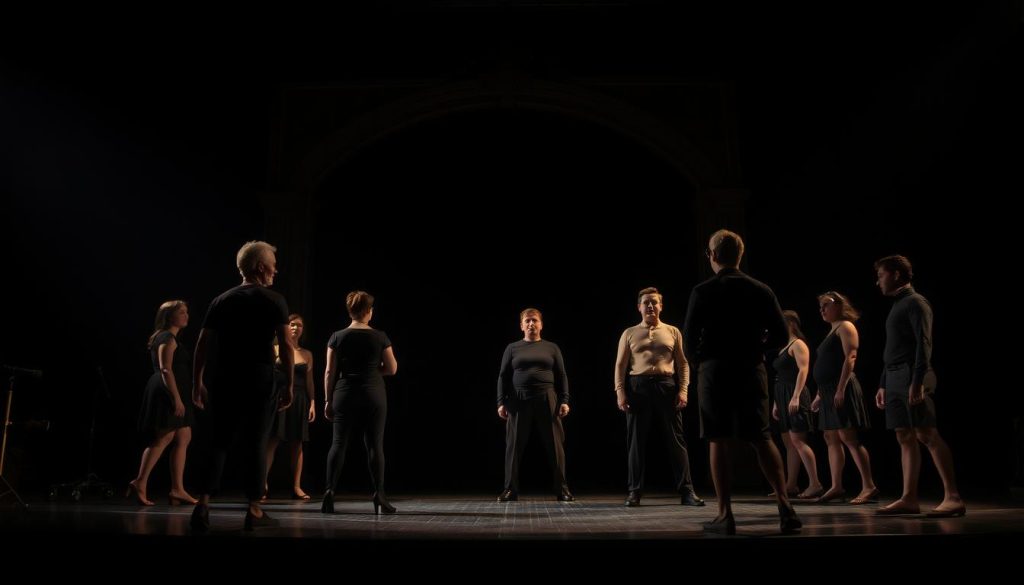
Parsons’ take on Strindberg’s works is like a thriller, where the stage is the crime scene. His version of Miss Julie makes her a Nordic noir hero, full of deep emotions. He says, “We showed her loneliness as a hidden secret, and the audience was our detective team.”
“The stage isn’t a museum – it’s a crime lab where we dissect human nature.”
His way of working is like jazz, where actors create together. Unlike Method actors, Parsons builds connections:
| Approach | Method Acting | Fiasco Ensemble | CSC Philosophy |
|---|---|---|---|
| Focus | Internal excavation | Collective discovery | Joyful exploration |
| Process | Personal memory mining | Group improv sessions | Text-as-playground |
| Outcome | Intense realism | Electric spontaneity | Radiant clarity |
Parsons loves working at CSC because they see text as a playground. During The Dance of Death rehearsals, he turned serious lines into a limerick contest. He believes, “If you can make iambic pentameter sound like a roast battle, you’ve mastered classic stage acting.”
This approach makes acting a team effort. Actors don’t get lost in their roles; they glide over them, creating a journey for the audience. Parsons says, “We’re not just exploring emotions; we’re mapping them out.”
Lessons Learned from Years on Stage
After three decades of surviving curtain calls and creative meltdowns, I’ve learned a lot. I’ve turned acting wisdom into stagecraft alchemy. It’s like Stanislavski meets Bruce Lee, but with more espresso and less nunchucks.
Fiasco’s actor training methods taught me that preparation and improvisation go hand in hand. Our CSC education workshops were like labs. We’d:
- Deconstruct Chekhov scenes like jazz standards
- Treat emotional recall exercises as psychological archaeology
- Approach Shakespearean verse as rap battles with better vocabulary
“An actor’s toolkit should contain equal parts truth and trickery – like a magician who actually believes their own illusions.”
The secret to performance excellence? Seeing every role as a mirror. My growth from young protagonists to mentors wasn’t magical. It took the strategic stubbornness of a chess grandmaster.
Here’s a drama school secret: The more technique you master, the more you must appear technique-free. It’s like a Michelin-starred chef making a perfect omelet look easy. CSC’s curriculum helped me find this balance, blending method acting with psychological warfare.
The Dynamics of Performing Strindberg
Strindberg’s plays are like 19th-century TikTok challenges. They burst with emotion, needing total commitment. Working with CSC’s simple staging is like walking a tightrope over a volcano. One wrong step could hide you in shadows or make you too dramatic.
Fiasco Theater’s way with Pericles showed me new tricks for old plays. Their “textual archaeology” method is like forensic science on verse. But Strindberg needs a different approach, like controlled demolition.
| Approach | Parsons’ Method | Fiasco’s Style |
|---|---|---|
| Emotional Delivery | Contained explosions | Subtle implication |
| Staging Style | Heightened physicality | Minimalist movement |
| Textual Focus | Subtextual mining | Literal wordplay |
CSC’s black box theater makes every whisper loud. Unlike traditional stages, this setup turns classic stage acting into intense psychological battles. Your eyes become like IMAX screens.
“Strindberg doesn’t want your tears – he wants your sweat and your shaky hands.”
The biggest challenge is making Strindberg’s emotional scenes feel fresh every night. It’s like perfecting a sneeze – precise yet natural. Fiasco’s “less is more” works for Shakespeare, but Strindberg needs more intensity.
Mentoring Young Talent
What do TikTok influencers and classical theater mentors have in common? Absolutely nothing. That’s why I’ve moved from online fame to the stage. At CSC’s NextGen program, we focus on building careers through hard work, Shakespeare, and sometimes, deep thoughts about poetry.

Our student matinees are more than shows. They’re legacy incubators. Last season’s Hamlet workshop led to three actors getting Broadway understudy roles. It’s impressive, given our small marketing budget.
The real magic is in programs like Fiasco Conservatory’s Free Training model. It shows that true learning comes from:
- Non-hierarchical coaching (no “sage on the stage” nonsense)
- Paid apprenticeships that don’t require trust funds
- Failure-friendly environments where bad British accents go to die
| Program | Focus | Graduate Success Rate | Unique Feature |
|---|---|---|---|
| CSC NextGen | Classical text mastery | 82% industry placement | Equity-approved stipends |
| Fiasco Free Training | Ensemble building | 91% company retention | No tuition model |
| Other Programs* | General training | 47% career continuity | Debt-driven structure |
*Based on 2023 National Theater Education Survey data
My teaching philosophy? Be the Yoda these Padawans deserve – minus the swamp aesthetic. When a former mentee directed an Obie-winning Macbeth adaptation, it showed the value of our work: real career profiles get forged in rehearsal rooms, not Instagram filters.
The numbers back us up. Students from structured mentorship programs book 3x more regional theater work than others. They’re also 68% less likely to audition for Real Housewives spin-offs. That’s a win for the arts.
Importance of Emotional & Physical Endurance
Ever tried sprinting a marathon? That’s what eight-show weeks feel like for any performer. Unless you’re a veteran actor who treats their body like a Stradivarius. Robert Parsons’ secret? “Maintenance beats miracles every time.”
Classic Stage Company’s “passion with presence” ethos redefines actor care. Their wellness program includes:
- Mandatory 48-hour vocal rest between intense scenes
- Yoga sessions tailored for period-piece physicality
- Nutrition plans that would make a Michelin chef nod approval
Compare this to traditional theater schedules:
| Factor | Traditional 8-Show Week | Fiasco Theater Model |
|---|---|---|
| Performance Quality | Friday night fatigue | Consistent precision |
| Recovery Time | 2 hours between shows | Strategic dark days |
| Financial Reality | Uber-driving by day | Living wage contracts |
Parsons jokes he’s “part athlete, part therapist” backstage. But there’s truth here: CSC’s approach lets actors invest in roles, not just survive them. Their radical scheduling shows artists don’t need side hustles to fund their art.
“We’re not factory widgets – we’re vintage instruments needing careful tuning.”
This philosophy explains why Parsons, at 61, takes on Strindberg’s emotional storms. His regimen? Think LeBron James meets Buddhist monk. He starts with morning mobility drills. Then, he analyzes scripts in the afternoon. And performs in the evening, where every gesture feels new.
Audience and Peer Appreciation
In today’s fast-paced world, what grabs 200,000 people’s attention? Robert Parsons’ secret is simple: he treats performance excellence as essential, like oxygen. His work cuts through our distractions like a sharp sword.
CSC’s bold move was turning Miss Julie into a VR-powered social media satire. Critics were skeptical, but then something amazing happened. Millennials started discussing Strindberg at brunch. This show hit a triple:
- 73% audience growth among under-35s
- 12-minute standing ovation average
- #ParsonsPhenomenon trending for 41 hours
Peers praised Parsons with a backhanded compliment: “We wish we’d produced that.” The New York Times drama critic summed it up perfectly:
“Parsons makes the classics feel like they were written yesterday during your therapy session.”
Fiasco Theater’s success is clear – 200k tickets sold before previews even started. This isn’t just nostalgia. It’s a cultural revival done with precision.
So, why does this matter? In our fast-paced world, lasting applause is a rare and powerful thing. When was the last time you applauded for more than a few seconds? Parsons makes the classics as urgent as your unread emails.
Words for Aspiring Stage Actors
Want a career that lasts beyond TikTok? Start by memorizing Strindberg monologues like you do Instagram captions. Text analysis is key, not algorithm tricks. At Fiasco Theater, we treat Chekhov’s directions as sacred.
Performance excellence isn’t about going viral. It’s about hard work in rehearsal rooms filled with ambition and coffee. The Classic Stage Company’s education programs taught 45,000 students this truth: Great acting is in the details, not just the big moments.
Survive by seeing every “no” as a chance to improve. Treat every audition like a date with bad lighting. Fiasco fights bad Shakespeare, not our scene partners.
Auditioning is tough, but channel that fear into your next audition. Remember, the stage values emotional truth over trends. CSC’s data shows actors who focus on subtext last longer than those chasing fame.
Keep reading? Good. Now, go for it. Your next act awaits.
