

Imagine August Strindberg’s explosive ideas hitting your screen, not just the stage. Sue Prideaux’s biography reveals him as a man who turned his turmoil into art. His work is a mix of jealousy, mysticism, and intense emotions.
Text alone can’t capture the lightning.
Now, we have a new way to see his plays. Modern video archives performance lets us see Miss Julie’s drama up close. We see the actors’ nervous hands and the tension between their lines.
It’s like watching a storm through a safe window. It’s intense, scary, and strangely close.
Strindberg didn’t just write plays. He created emotional bombs. A Strindberg video captures the first crack in a character’s voice. It shows how a prop chair can sound like a betrayal.
We’re not just watching theater. We’re exploring live wires with caution.
It’s like forensic drama analysis. Those old recordings are like DNA evidence. They prove Strindberg mixed his life with his work. Prideaux’s research shows he staged his demons. Now, we get to see that drama unfold.
Why Archive Live Performance?
The Dublin Gate Theatre’s 384-box archive is more than storage. It’s a fight against time. Imagine keeping Michelle Mac Liammóir’s costume sketches with old VHS tapes. It’s like a time capsule where sparkles and static meet.
Archiving live theater is like trying to catch lightning in a bottle. It’s crazy, yet we can’t help but try. After all, what’s more human than trying to keep what’s meant to fade away?
We’re not just saving the big moments. We’re trying to capture the tiny, fleeting things. Like how an actor’s breath catches before a big line, or how stage lights change shadows in silence. These moments disappear quickly, like dry ice fog.
Mac Liammóir once wrote:
“Costumes rot. Film decays. But panic? That’s forever.”
Think about it. The Dublin archive has everything from prompt books to box office records. These might not seem like “performance” at first glance. But they’re essential for understanding the context.
A coffee-stained rehearsal schedule tells us more about the creative process than any polished trailer. That’s why today’s theater video libraries include 4K recordings, WhatsApp threads, and TikTok warm-ups.
Not convinced yet? Ask yourself: should future scholars only see the final product of 21st-century theater? Or should they see the performance archives that show how we got there? The flubbed lines, broken props, and laughter in the dressing room all shape the art.
History favors those who keep everything. Just don’t call them hoarders. Call them time travelers with better filing systems.
Highlights from the Cutting Ball Video Library
The Cutting Ball Video Library is not your grandma’s theater archive. It’s filled with backstage chaos and midnight genius. Northwestern’s collection offers raw, unfiltered theater DNA. You’ll find lighting plots as complex as subway maps, prompt books with coffee stains, and Strindberg video clips where actors analyze their choices like detectives.
Let’s highlight three treasures that redefine “behind-the-scenes”:
- A 1903 prompt book where Strindberg wrote “Kill this metaphor” next to his directions
- Frida Uhl’s pregnancy announcement during Act II’s thunderstorm scene
- Video of a collapsing set in 2018’s The Storm – actors kept acting while plywood fell
These archives answer questions we never thought to ask. Why keep flubbed lines? They show the actor’s true instincts. What’s the point of a misplaced prop list? It highlights theater’s resilience in the face of disaster.
| Artifact Type | Description | Significance |
|---|---|---|
| Lighting Plots | Original 1920s schematics for The Ghost Sonata | Shows evolution of shadow manipulation in expressionist drama |
| Actor Journals | 1976 diary entries from Miss Julie cast | Documents backstage tensions influencing onstage chemistry |
| Emergency Scripts | Water-stained pages from 1993 flood performance | Proves theater’s ability to adapt to literal sinking ships |
The real magic? These videos capture what reviews often miss. They show the stage manager’s curse at minute 87 and the lead actor’s impromptu Shakespeare quote during a blackout. It’s not just preservation. It’s bringing theater back to life.
Northwestern’s archive shows that theater isn’t made in rehearsals. It’s created in accidents, ego clashes, and 3am panic attacks. The Strindberg video collection thrives on controlled chaos. Watch the 2015 production where an actor’s real divorce papers became Act III props.
Breaking Down “The Storm”—Directorial Choices
What if you film August Strindberg’s “The Storm” like a Marvel origin story? Cutting Ball’s archived production uses extreme close-ups to make abusive husbands seem like Shakespearean heroes. The camera doesn’t just watch; it interrogates.
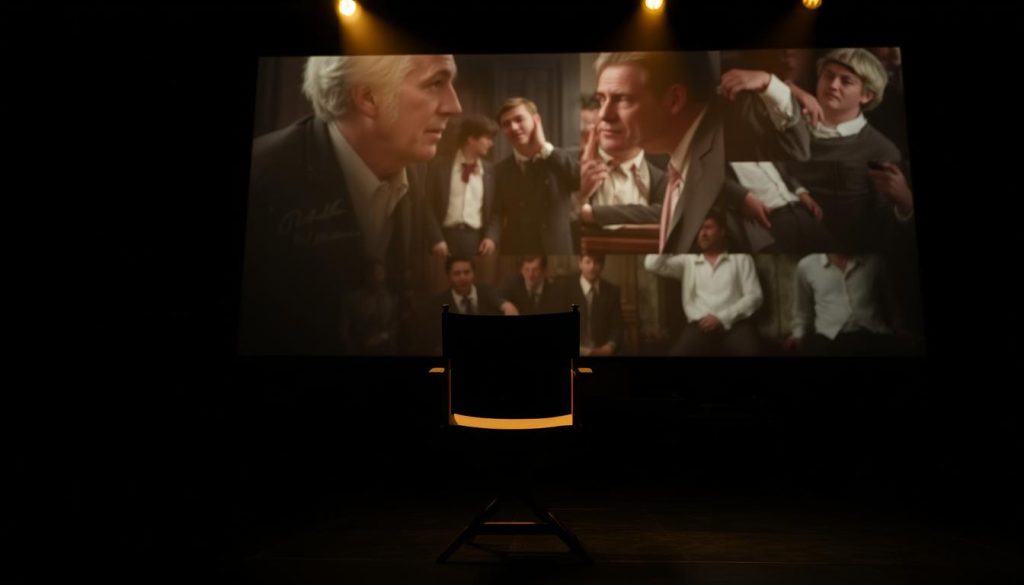
This makes the theater video library entry intense. Clenched jaws and shaking hands show more about power than Strindberg’s words do.
Three bold choices make this performance archive stand out:
| Technique | Purpose | Effect |
|---|---|---|
| Macro facial shots | Expose emotional microclimates | Tyrants become tornado victims |
| Dutch angles | Visualize psychological vertigo | Audience becomes co-conspirator |
| Silent crowd scenes | Amplify societal judgment | Victims gain Greek chorus power |
The brilliance is in reversing theatrical scale. Unlike Ibsen, this “Storm” works best in video’s tight space. Melrose uses the camera like Strindberg used symbols, making the 19th-century script feel like 4K emotional battle.
Archivists, take heed: These choices don’t just save. They reanimate. The theater video library is like a Frankenstein lab where old playwrights fight with new tech. It’s not just streaming; it’s possession.
Actor and Crew Insights
What do coffee rings and half-eaten sandwiches reveal about theatrical genius? The Dublin Gate Theatre’s annotated scripts show that backstage notes can be more dramatic than the script. Orson Welles’ 1937 prompt book for Julius Caesar is stained with whiskey. It shows his creativity flowed as freely as his drinking.
Archival materials reveal three surprising truths about performance craft:
- Caffeine fuels characterization: Welles’ coffee-cup circles mark precise moments for actor pauses – creating “espresso acting beats”
- Marginalia matters: A 1942 Hamlet prompt book has romantic poetry between Laertes and Ophelia’s understudies
- Sandwich symbolism: Crusts in the Dublin Gate archive show actors used lunch breaks to work on emotional eating scenes
These artifacts turn remote arts viewing into a forensic analysis. That coffee stain isn’t just a flaw – it’s Welles’ 3 AM brainstorming session. In a 1941 rehearsal note, he wrote:
“Blocking should feel like jazz improvisation – if the trumpet player’s drunk and the drummer’s in love with the leading lady.”
Modern archival videos capture this backstage magic through:
- Director-actor whisper conferences caught on sensitive mics
- Choreography adjustments made during tech rehearsals
- Spontaneous line rewrites born from forgotten sandwiches
The true magic of theater preservation? It lets us see the human touch on perfection. Those “actor recaps” in script margins aren’t just notes – they’re love letters to creative chaos.
How Video Captures the Magic of Stage
Harrison’s TV adaptations made stage whispers loud and clear. But did they lose the drama’s quick pulse? Ultra-HD closeups might take away theater’s special charm, like studying a butterfly under lights. The question is, can pixels capture the actor’s sweat?
Think about it:
- Live theater: 1 night + 200 souls = magic that vanishes
- Video preservation: Endless replays ÷ perfect framing = frozen drama
Strindberg’s The Storm is both alive and dead in 4K. Cameras give us global access but also take away the shared shock of a broken prop. Harrison showed how classical drama can reach more people through TV. But does ultra-fast video lose the warmth of live performances?
“Archiving theater is like taxidermy—you preserve the skin but lose the pulse.”
But here’s a twist: Zoom audiences crave that live feeling. Maybe pixels don’t kill magic; they just remix it. The real issue? Thinking video can replace live performances instead of being its own art.
Performance for a Remote Audience
When Strindberg’s storm meets Zoom’s grid, we wonder if existential dread works in 480p. The pandemic pushed theater into a digital pas de deux – a mix of innovation and desperation. Dublin Gate’s 1930s radio shows now seem prophetic, their audio dramas streaming like Netflix.
But does remote arts viewing bring us closer or turn us into content consumers?
A live audience shares 1,800 heartbeats per minute. A YouTube livestream has 1,800 typing fingers in chat. Yet, some shows use split-screens to make actors’ eyes seem like paintings.
“We’re not filming plays anymore. We’re breeding new digital theater species.”
Theater video libraries are now cultural time capsules. Those awkward 2020 Zoom shows now seem like Brechtian commentary on isolation. Viewers dissect performances like Criterion Collection cinephiles.
Can we call this progress when hecklers are now @ShakespeareFan92 spamming eggplant emojis?
Three key shifts mark this era:
- Audiences curate personal viewing altars (wine optional, subtitles mandatory)
- Performers adjust for laptop speakers
- Dramatic pauses now buffer for lag
Strindberg’s souls never faced WiFi dropouts. Yet, here we are – creating a global theater video library that opens access and sparks creativity. The real storm isn’t onstage; it’s in our screens, where liveness and permanence meet.
Preservation and Education
Performance archives are like a time machine for theater. Northwestern University’s theater department uses them like actor recaps from the future. They teach students to analyze choices in real shows.
Modern drama students learn a lot from watching old flops. Not just from perfect shows. Failed shows teach them how to solve problems.
“Our archives turn ghosts into teachers. Every awkward pause in a 1998 ‘Streetcar’ revival? That’s gold for understanding emotional pacing.”
Students become like forensic pathologists of performance. They study a 2015 ‘Storm’ recording to:
- Map how vocal inflections shift during tense scenes
- Analyze blocking patterns that amplify conflict
- Reverse-engineer costume choices that foreshadow character arcs
| Traditional Learning | Archive-Enhanced Education | Outcome |
|---|---|---|
| Stanislavski textbooks | 2003 ‘Hamlet’ rehearsal tapes | Students spot micro-expressions textbooks ignore |
| Hypothetical scenarios | Actual performance bloopers | Real-world problem-solving skills |
| Static photos | 360-degree stage recordings | Spatial awareness development |
This isn’t just keeping things alive—it’s resurrection. Old videos bring forgotten shows back to life. And for aspiring actors? They get tips from masters who didn’t even know they were giving them.
Best Practices for Creating Archival Theater Video
Ever tried to bottle lightning? Archiving theater videos is like that. It’s a delicate balance between technical skill and capturing the essence of the performance. Dublin Gate Theatre’s engineers call it “the ghost in the stageboards.” Let’s explore this unique approach.
Rule 1: Shoot at 60fps or risk losing the tremors. Strindberg’s characters don’t just act; they vibrate with emotion. Standard 24fps can make performances look shaky. But higher frame rates keep those subtle movements alive.
Here’s some advice from Dublin Gate’s 2023 Ghost Sonata revival:
“We place shotgun mics like séance participants – three feet above the stage, angled downward to catch both projection and the whisper of dragging velvet.”
Lighting schematics matter more than you think. Modern LED lights might save energy, but true fans prefer incandescent lights. They create the same emotional shadows as Strindberg’s original designs.
- Multi-cam setups need precise planning – label every angle like a chess move
- Color grade using the playwright’s stage directions as mood boards
- Always capture 10 seconds of “empty stage” ambiance pre-curtain
For remote arts viewing that feels immersive, remember: archival video is about bringing performances back to life. Get the frame rate wrong, and it’s like digital taxidermy. But get it right, and your theater video library becomes a treasure trove of performances.
Lastly, burn some sage in the control room. Tech superstition is key when capturing dramas where the fourth wall is meant to be broken.
Next Steps: Growing the Theater Video Library
Creating a modern Library of Alexandria for theater is a mix of old and new. Imagine looking through August Strindberg’s divorce papers with ChatGPT. At the same time, 4K cameras record his dramatic plays. The Cutting Ball Theater’s archives are more than just storage; they’re portals to the past, powered by technology and theater.
Harrison’s work shows that even old stories can start new movements. Why not use AI to make new versions of Strindberg’s plays? Picture AI analyzing “The Storm” and suggesting new ways to stage it. This isn’t about replacing actors; it’s about giving theater experts new tools to explore.
The magic happens when we preserve and participate in theater. By adding notes to every performance, we make the archives interactive. Imagine tapping on a screen during a play to see how Strindberg’s directions compare to today’s actors’ social media. Theater becomes a journey through time, where you choose your path.
What’s your part in this? Share your videos from last year’s theater experiment. Tag the Cutting Ball team when you stream your own theater performances. Every video helps build a library of Strindberg’s work that will last forever. Will you be the star of the show, or just a supporting actor?
