

What if I told you the real magic of theater happens after the house lights dim? While audiences admire Vermeer’s light-filled paintings in Amsterdam, another artist works in secret. Production designer Michael Moerman creates magic in the backstage world, using cables and lasers.
Last year’s Vermeer show at Rijksmuseum drew huge crowds. They were amazed by the meticulous light manipulation that took decades to perfect. Now, imagine that skill used in live shows, with fog machines and fly systems instead of paint. Moerman’s team works like 17th-century Dutch guilds, keeping old skills alive in a digital world.
We often overlook the backstage crew, who make the show possible. They use gaff tape, cue lights, and secret commands. It’s not just technical execution – it’s keeping culture alive through hard work.
So, why don’t we see the tech crew as artists? Maybe because their work is perfect and invisible. The real question is, how long will we ignore their artistry?
What is a Stage Manager?
Imagine a ninja librarian who also controls air traffic. Add a headset and a detailed script, and you get a stage manager. They are diplomats, drill sergeants, and keepers of sanity in the theater. These heroes don’t just call cues; they turn chaos into art.
The Human Operating System
Stage managers are like the Kubernetes of Broadway. Their prompt books are like detailed conversation analysis. Watching a Thai courtroom drama shows how SMs manage backstage. It’s all about recognizing cultural patterns in show logistics.
They have three main jobs:
| Tech Analogy | Theater Reality | Ethnographic Parallel |
|---|---|---|
| System Administrator | Maintaining show consistency | Documenting performance rituals |
| Real-time Debugger | Solving mid-show crises | Analyzing social interactions |
| API Interface | Translating director-speak to crew | Decoding cultural norms |
“Backstage is where you’ll find the real drama – and I don’t mean the kind that gets applause.”
Moerman’s work shows the poetry in stage management. The symbols in prompt books are more than stage directions. They are living documents of human interaction, full of nuance. And if Hamilton’s stage manager wrote a tell-all, it would be a blockbuster.
Early Inspirations in Technical Theater
What do an anthropologist studying Thai courtroom rituals and a stage manager have in common? More than you might think. Moerman, the anthropologist, found a new passion in technical theater. He traded his fieldwork for spike tape protocols.
From Anthropology to Fly Rails
Moerman’s academic skills helped him survive backstage. His “Talking Culture” method, used for Thai trials, now tracks actor entrances. “Both fields demand you listen to what isn’t being said,” he says, “except in theater, the subtext might literally crash on your head if you miss a cue.”
“Managing a show is like conducting real-time ethnography – except your subjects know they’re being watched and occasionally forget their pants.”
This career change shows surprising similarities:
| Anthropology Skill | Theater Application | Cultural Artifact |
|---|---|---|
| Ritual documentation | Prompt book maintenance | Gaffer tape instead of field notes |
| Conflict mediation | Actor-director diplomacy | Coffee runs as peace offerings |
| Time-depth analysis | Quick change calculus | Velcro as temporal bridge |
During a Miss Saigon production, a helicopter mechanism failed. Moerman’s crisis response was like his fieldwork: assess, mobilize, and document everything. This time, he used a wrench, not a pen. His calm under pressure was key: “Panic makes terrible field notes.”
This blend of disciplines created a new kind of backstage talent. They read light boards like sacred texts and treat prop tables as archaeological sites. It was more than a career change; it was a methodological evolution with better snacks.
Overcoming Challenges Behind the Scenes
Tech crews are more than just problem solvers. They turn chaos into art. Behind every show, they make quick decisions that can make or break the performance. I’ve seen wardrobe teams fix broken zippers fast, keeping everything looking perfect.
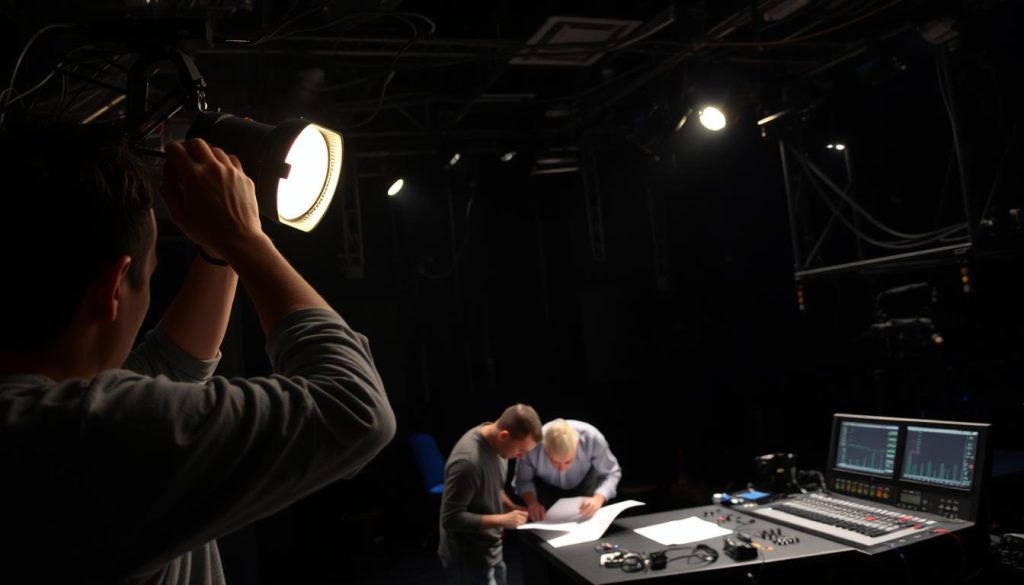
Crisis Management as Performance Art
Michael Moerman shows that backstage emergencies are like dialogue issues in a play. When a quick-change goes wrong, stage managers improvise. Here’s a backstage haiku:
“Lace snaps at Act Two.
Three hands, one corset, no light.
Curtain rises. Fixed.”
The real magic is in the emergency jazz they use. It’s like structured improvisation that turns problems into showstoppers. Here’s how they do it:
| Stage Crisis | Repair Tactic | Real-World Parallel |
|---|---|---|
| Corset malfunction | Silent hand signals + safety pin origami | Moerman’s “overlap resolution” in courtroom debates |
| Mic feedback loop | Frequency shuffle + actor repositioning | Emergency room triage protocols |
| Stuck turntable | Manual override + distraction lighting | Air traffic control rerouting |
These fixes aren’t just repairs—they’re performance enhancements. A well-handled crisis can create unforgettable moments. Ever seen how the best fight scenes come from unexpected prop failures? That’s the art of tech crews.
What makes a crew great? They treat every crisis as a chance for greatness. They don’t just solve problems—they curate them. As any seasoned dresser will say, “If you’re not sweating, you’re not doing it right.”
Collaborating with Cast and Crew
Working backstage is like a jazz quartet playing together. Everyone is playing the same tune, but no one is reading music. The magic happens when the spotlight operator and an actor’s pause match perfectly, or when a quick change becomes a silent dance between carpenters and dressers.
The Jazz Ensemble Model
Moerman’s “noticings” theory turns backstage chaos into a dance. Like jazz musicians, tech crews know when to expect changes. They watch for:
- Actors’ breathing before big speeches
- The sound of Scene 3’s wagon platform
- The lead actress’s wig adjustment before quick changes
Lighting designers are the rhythm section. They change colors like a saxophonist pauses, creating a perfect rhythm. Hamilton’s choreography was not just for the audience. It showed how well backstage teams work together at 120 beats per minute.
| Jazz Element | Theater Equivalent | Collaboration Insight |
|---|---|---|
| Walking Bass Line | Light Board Operator | Maintains foundational rhythm of scene transitions |
| Drum Fill | Fly Rail Crew | Accentuates dramatic moments with precision timing |
| Scat Singing | Stage Manager’s Calls | Improvised verbal shorthand during tech emergencies |
| Chord Substitution | Understudy Prep | Adapting blocking/spacing for new performer variables |
Broadway’s top crews could play at the Newport Jazz Festival. But they’re too busy creating emotional scenes with light and color. The real heroes are those who make it all work smoothly, without anyone noticing.
Innovation in Set and Lighting
What if lighting design wasn’t just about seeing things, but emotional syntax? Today, theater tech turns stagecraft into a visual language. Colors and shadows tell stories on their own. Moerman shows us that lighting grids are like cultural partners.
Engineering Emotional Palettes
Hadestown’s amber-to-azure changes are more than mood shifts. They’re like human conversations, as Moerman described. When Orpheus stumbles, the lights stutter in warm yellows, trying to reconnect.
“If Vermeer designed LED walls, he’d be arguing with the dimmer board operator.”
Today’s designers have tools that would amaze old masters:
- Smart lights that follow actor movements
- Projection mapping that changes with sound
- Color scripts with themes, like a play
This tech creates “emotional close-ups” in Broadway shows. It uses light to highlight a shaking hand or sudden blackouts. This makes the audience feel like they’re part of the story.
Keeping the Show Running: Day-to-Day Realities
Backstage work is like a silent Swiss watch – precise, interdependent, and invisible. Actors shine in the spotlight, while stage managers manage a complex ballet of clipboards and cues. They turn chaos into rhythm with their unseen work.
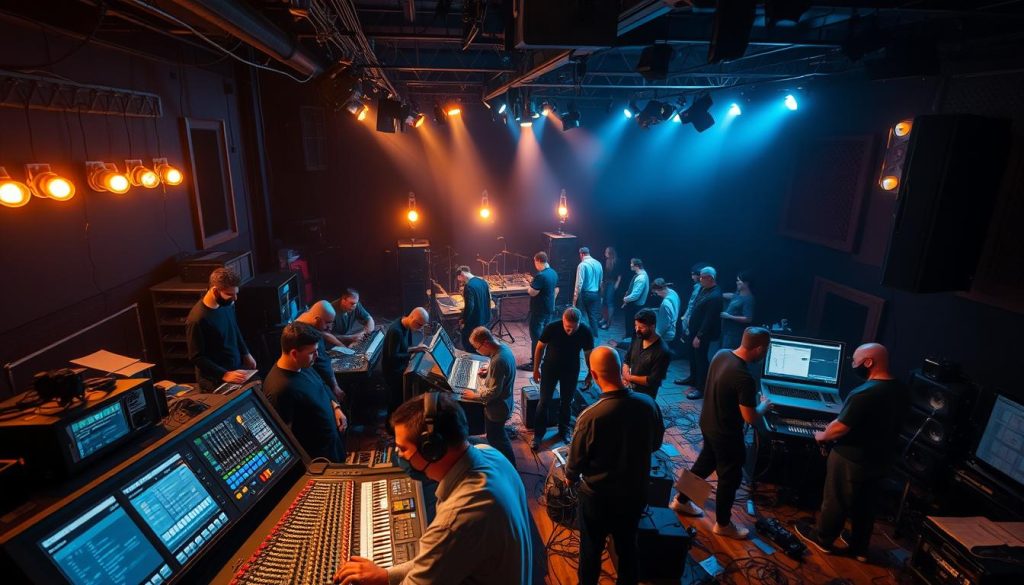
The Invisible Choreography
Moerman’s study on Thai rice cultivation shows a surprising link to backstage work. Stage managers use charts to track props, much like tracking grain distribution. Each mark on their charts is a form of “micro-temporal coordination” – aligning many parts across changing timelines.
There are parallels between theatrical logistics and cultural rituals:
| Stage Element | Cultural Parallel | Core Function |
|---|---|---|
| Prop Table | Balinese Water Temple Networks | Resource Distribution |
| Lighting Cues | Japanese Tea Ceremony | Ritual Timing |
| Scene Changes | Thai Rice Harvest Cycles | Coordinated Labor |
This isn’t just about moving furniture. It’s cultural infrastructure hidden in theatrical labor. The clipboard is a sacred text, and the headset mic a ceremonial mask. When the lead actor finds a letter in Act 2, teams have already:
- Planted it during the blackout
- Confirmed its placement via infrared
- Documented its position in four separate logs
Modern backstage talent works like quantum physicists – keeping multiple realities until the curtain chooses one. The real magic? Making this high-wire act seem automatic.
When Things Go Wrong (and Right)
Backstage chaos is like a Rube Goldberg machine. Every disaster has a solution ready. The real skill of tech crew artistry is turning mishaps into magic.
Planned Serendipity Systems
Moerman’s “motive mapping” is genius when things go wrong. He uses criminal trial speech patterns to help crews:
- Fix problems quickly
- Use backup systems smoothly
- Turn errors into stage magic
The understudy system is like anthropology’s backup plans. Crews keep knowledge ready, just like ethnographers. They prepare for any situation.
| Crisis Scenario | Theater Solution | Real-World Parallel |
|---|---|---|
| Lead actor loses voice | Understudy activation protocol | Ethnographic redundancy systems |
| Automation system crash | Manual override muscle memory | Courtroom emergency procedures |
| Costume rack collapse | Pre-staged quick-change kits | Disaster relief supply chains |
Preparation meets opportunity in amazing ways. During Les Misérables, a turntable broke. The crew fixed it, adding drama. People thought it was planned.
“Our emergency protocols aren’t Plan B – they’re Act II.”
This tech crew artistry shines when solutions appear fast. A pyrotechnic mishap was fixed with shadow play. The director kept it, praising the crew’s quick thinking.
Nurturing Young Tech Talent
Mentorship in theater tech is like looking into a haunted house mirror. It shows us our younger selves and the truth about leadership. Moerman’s “conversation among disciplines” framework is key here. It teaches new techs with patience and intensity.
Passing the Baton (and Gaff Tape)
Our apprenticeship model has three phases:
- The Observation Gauntlet: Newbies learn watching backstage is not like binge-watching Netflix. It’s about understanding Sacks’ membership categorization through lighting cues.
- Controlled Chaos Immersion: It’s like Jedi training with cordless drills. “Fixing that wobbling flat NOW” is their mantra.
- Ownership Crucible: They become audience members at their first called show.
Teaching Gen Z crew members to focus is tough. We use military-grade attention drills. It’s like teaching them to concentrate in a world full of distractions.
“The best stage manager profile combines chess grandmaster foresight with improv comedian reflexes. And yes, that duct tape better be within arm’s reach.”
Our secret is making veterans explain their work through Moerman’s lens. Suddenly, explaining the lighting grid is like a mix of engineering and poetry. The real magic is when teamwork becomes real. Saving a show stoppage requires teamwork like NASA mission control.
Young techs learn there’s no “undo” button in live theater. But our gaff-tape-and-grit model turns panic into precision. The final test is when they teach newbies using jokes we don’t get anymore.
The Artistry of the Backstage Team
Backstage crews are like living museums, keeping theater’s heart alive. Michael Moerman sees them as cultural archivists, protecting traditions and creating new ones. They do more than manage props and lights. They create entire worlds where magic feels real.
Curators of Ephemeral Magic
Imagine a stage manager guiding actors like a painter in Girl With a Pearl Earring. Each cue is like a brushstroke, creating art that lasts only a moment. Theater tech combines precision with improvisation, like Rembrandt and MacGyver.
These artists keep more than just scripts safe. They preserve the essence of live shows, making every moment count. Like jazz, they improvise while keeping the show’s structure intact. The real magic happens backstage, where safety meets creativity.
When the curtain goes up, remember the backstage team’s role. They’re the ones setting the stage for tomorrow’s magic. Their work may be unseen, but it’s forever etched in theater’s history.
