

What happens when a character actor becomes the glue holding experimental theater together? Meet Paul Gerrior – the Bay Area’s answer to Warhol’s Factory colliding with a championship basketball roster. For four decades, this chameleon has thrived in Cutting Ball Theater’s avant-garde playgrounds, turning group dynamics into high art without ever hogging the spotlight.
Take his 2011 performance as Arkel in Pelleas & Melisande. While lesser actors might’ve turned the aging king into a scenery-chewing spectacle, Gerrior crafted a masterclass in restraint. His whispered wisdom became the gravitational center for the cast – think Gregg Popovich coaching the Spurs’ five-title dynasty, but with more existential dread.
Gerrior’s secret? Treating collective creation like jazz improvisation. He’s the rare performer who elevates scenes through reaction shots and listening intensity. In productions like Krapp’s Last Tape, he transforms Beckett’s solitary figures into accidental team players – lonely satellites orbiting the same creative universe.
This isn’t just acting. It’s alchemy. Gerrior’s career proves that true theatrical magic happens when ego dissolves into ensemble. Or as they might say in both locker rooms and experimental black boxes: “There’s no ‘I’ in ‘team’… but there are three in ‘irresistible performance.’”
Defining Ensemble Artistry
Ensemble work is not just about being together. It’s like a jazz band where everyone knows their part. At Cutting Ball Theater, we see team performance as a mix of talents coming together. We turn Ionesco’s words or Zucco’s feelings into something amazing.
Last season, we had two shows. Robert Zucco’s dark mood needed actors to move in perfect sync. The Bald Soprano was like a Rube Goldberg machine, with words flying fast. It’s not just working together; it’s like having a secret language with great costumes.
Peter Brook’s “empty space” idea gets a boost here. Our rehearsals mix:
- NBA pick-and-roll strategizing
- Improv jazz session energy
- The spatial awareness of fire drill choreography
Kafka’s Metamorphosis teaches us a lesson. That cockroach was a solo star. True ensemble work means being ready to shine in any role.
“occurs when actors stop performing at each other and start breathing through each other”
The magic is in the moments that aren’t scripted. A raised eyebrow can change a scene’s feel. It’s not about blending in; it’s about team performance where everyone’s talent shines together. The best collaborations make the effort seem effortless.
Signature Roles and Team Performances
What makes a character actor truly stand out? Paul Gerrior’s career is a perfect example. He has played everything from Medea’s confidant to Beckett’s clown. His secret? He treats each role as unique, like a fingerprint.
Gerrior’s method is all about reactions. He follows Philip Seymour Hoffman’s advice: “The scene lives in your reactions.” In Pelleas and Mélisande, he turned simple actions into powerful statements. His use of silence was incredible, making a single eyebrow speak volumes.
| Role | Production | Key Trait |
|---|---|---|
| Shakespearean Fool | Chain Reactions Workshop | Improvised meta-commentary |
| Beckettian Grotesque | Endgame Revival | Physical comedy meets despair |
| The Porter | Pelleas (2011) | Atmospheric tension-building |
The 2011 performance was a test of endurance. It had no breaks and was relentless. Gerrior said, “You either drown in the silence,” “or learn to swim in subtext.” He even hummed strange chords to stay in character.
Gerrior’s dedication to subtlety has a big impact. In Medea: Reloaded, his character’s small actions added depth to the story. Every detail, from coughs to glances, enriched the performance.
The Craft of Subtle Support
What do Marcel Duchamp’s urinal and a great supporting actor have in common? Both show that context can turn simple things into art. Gerrior’s work with Old Reliable, as seen in Drummer magazine in 2023, highlights this. He says, “The best reactions aren’t noticed – they’re felt.”
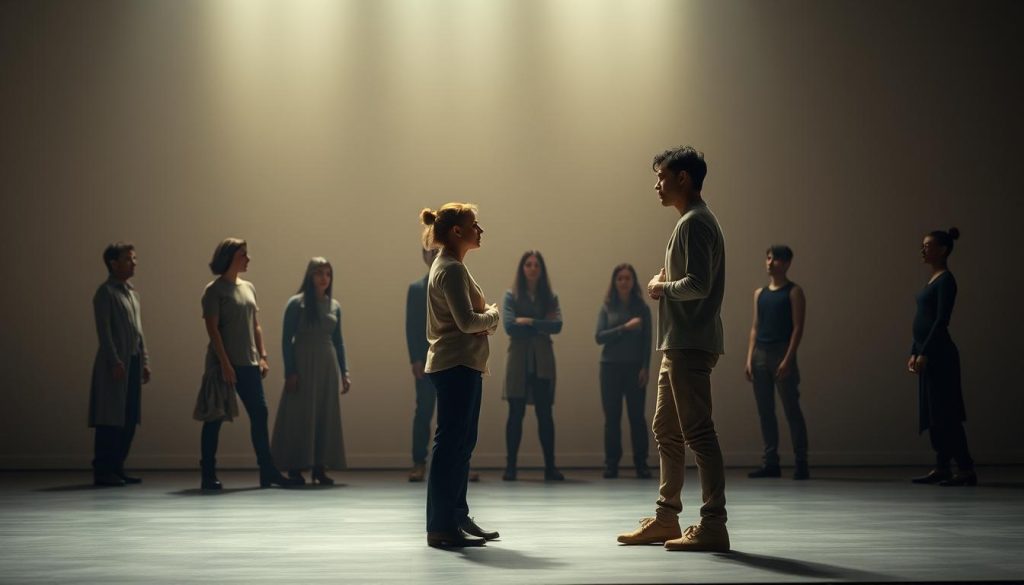
Watch Gerrior in The Bald Soprano and see how a small eyebrow lift can overshadow big speeches. Then, compare it to his role as Arkel in Pelléas et Mélisande, where he plays a silent but powerful character. This isn’t just acting; it’s calculated restraint tailored for each role.
Edward Gorey knew this balance well. His characters in The Gashlycrumb Tinies capture attention by not trying too hard. Gerrior’s quiet moments during busy scenes also draw more attention than loud speeches. John Cage showed in 4’33” that silence can be as powerful as sound, inviting the audience to fill in the gaps.
“Old Reliable’s 2022 Beckett revival redefined ensemble acting as competitive listening. Actors reacted to pauses like tennis pros anticipating serves.”
Duchamp’s Fountain became art by its placement, not its beauty. Supporting actors do the same. A well-timed smirk can change a scene’s direction. It’s like using someone else’s energy to make your own presence stronger through strategic absence.
The secret is in what you choose not to do. Gerrior’s signature move is the “half-step back.” It creates space for everyone to shine. In a world that often values more, true subtlety in drama is about doing less, but doing it better.
Building Chemistry with Castmates
Building chemistry in theater isn’t about sparking flamethrowers—it’s about striking matches that illuminate shared shadows. Take Gerrior’s Hidden Classics collaborations: working with Joshua Schell (Pelleas) required the precision of a chess match, while Caitlyn Louchard (Tempest) demanded the chaos of a jazz improv solo. “You either sync your heartbeat to the room,” Gerrior quips, “or you become the metronome nobody follows.”
“Our backstage coffee could wake Beckett’s ghosts—three espresso shots and existential dread in a styrofoam cup.”
This caffeine sacrament became the glue for team performance alchemy. Schell favored structured vulnerability—script annotations traded like love letters. Louchard? She’d ambush scenes with what Gerrior calls “Warhol energy”: unscripted rawness that turned rehearsals into Screen Tests with stakes.
Key differences emerged:
- Schell’s method: tactical silence as emotional scaffolding
- Louchard’s approach: controlled chaos as trust currency
Yet both shared Gerrior’s non-negotiable—theater collaboration thrives when egos become stage directions. It’s jazz rules meets Greek chorus instincts: listen louder than you speak, react faster than you think. The result? Ensembles where actors don’t just support—they haunt each other’s performances.
Preparation, Rehearsal, and Organic Moments
Rehearsal rooms are where precision meets chaos, and Rob Melrose is the mad scientist. At Cutting Ball, we see preparation as building IKEA furniture. First, follow the instructions carefully, then find your own way to do it better.
Our secret is structured spontaneity. We spend 70% of our time preparing and 30% on controlled chaos.
Melrose blends two opposing views like a theatrical DJ:
| Technique | Focus | Outcome |
|---|---|---|
| Uta Hagen’s Object Exercises | Psychological realism | Deep character immersion |
| Viewpoints Training | Physical ensemble awareness | Group synchronicity |
| Melrose’s Hybrid | Textual rigor + spatial play | Organic acting moments |
Gerrior works his magic at 3AM. His script notes are like Da Vinci’s, full of debates and insights. He says it’s not insomnia but Stanislavski’s ghost asking for more.
The magic happens when preparation meets happy accidents. Our 2008 Macbeth preview is a great example. A misplaced dagger became Birnam Wood’s first casualty. The panic was real, but the recovery was legendary.
This mishap created Lady Macbeth’s famous finger-twisting tic. Critics called it “Shakespearean ASMR.”
Three keys to our rehearsal magic:
- Treat blocking as suggestions, not scripture
- Reward dangerous choices (even failed ones)
- Never let safety override truth
We believe in organic acting moments. They’re not found but created through “prepared vulnerability.” It’s like jazz improv with Chekhovian music. Our stage manager calls it “organized anarchy with better snacks.”
When the Team Shines: Favorite Show Memories
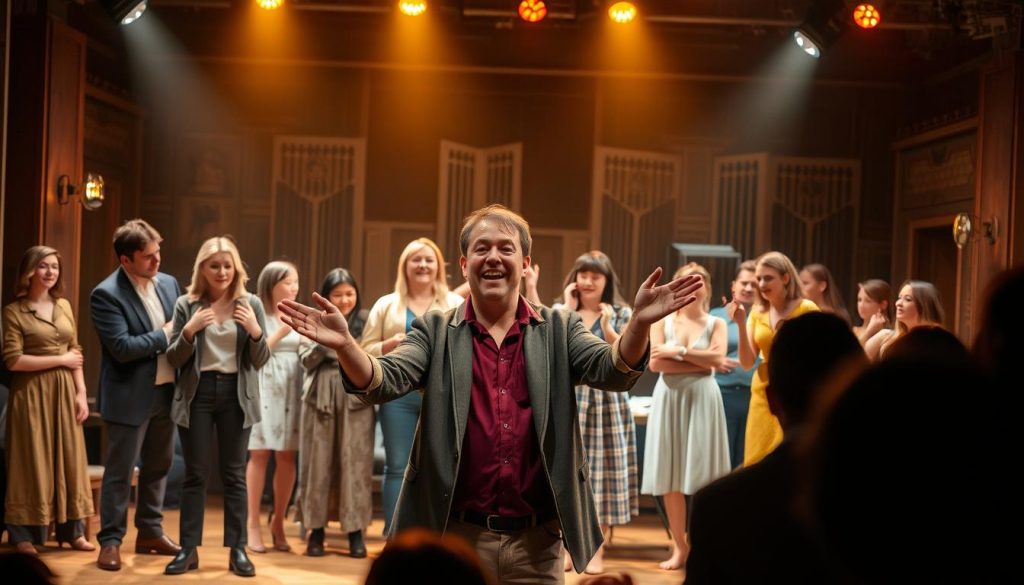
Let me share a story from 2011’s Pelleas & Melisande. It was a night where our ensemble acting turned into magic. It was like Miles Davis’ Bitches Brew sessions mixed with Swiss watch precision. The New York Times called it a “masterclass in theater collaboration.”
But what they didn’t see was the backstage chaos. 14 actors were sweating in their silk costumes, all feeling the same energy.
That night, three things came together:
- A lighting operator who improvised cues like a jazz drummer
- An audience that laughed 0.3 seconds faster than rehearsals
- My scene partner’s eyebrow lift that rewrote our blocking mid-scene
We were not just performing – we were surfing the energy. Critics praised our “organic unity.” But the real magic happened when a front-row patron stood up during intermission.
It turned out our second-act tension matched his girlfriend’s anxious knee-bouncing. He proposed marriage before the curtain call. The groom later said, “Your chaos made our silence speak.”
“I’d never seen 14 people breathe as one organism before. It wasn’t acting – it was possession.”
That production taught me ensemble acting is not about blending in. It’s about becoming a strong connection. When tech crews, actors, and audiences come together like this, we create something special. It’s like catching lightning in a mason jar… then using it to light the next scene.
Advice for Ensemble Performers
Ever tried herding cats while tap-dancing on a tightrope? Welcome to ensemble acting. After surviving 73 productions at Cutting Ball Theater, I’ve learned five unwritten rules. These rules will help you avoid becoming a theatrical cautionary tale.
- Breath mints > method acting: Your emotional truth won’t matter if your scene partner passes out mid-monologue
- Share the spotlight like it’s communal property: Great ensembles operate like jazz trios – listen more than you solo
- Memorize everyone’s cues, not just yours: You’re the safety net when someone forgets they’re playing Trigorin, not Stanley Kowalski
- Treat props like ancient artifacts: That “disposable” letter opener? It’s survived more productions than you have
- Laughter is the WD-40 of theater: A cast that laughs together survives tech week together
“Want to murder a scene stealer? Try radical generosity – it’s far more disarming.”
The Essential Library for Ensemble Survival
| Book | Author | Key Insight |
|---|---|---|
| Towards a Poor Theatre | Jerzy Grotowski | Ensemble as spiritual communion (minus the Kool-Aid) |
| The Actor and the Target | Declan Donnellan | Listening as competitive sport |
| True and False | David Mamet | How to swear effectively backstage |
True story: Our 2018 Streetcar revival nearly derailed when an overzealous Stanley started Method-acting during bathroom breaks. The lesson? Brando impressions belong in karaoke bars, not dressing rooms.
Remember: Great theater collaboration isn’t about being the shiniest cog – it’s about keeping the whole machine from sputtering into the orchestra pit. Now go forth and support like your Tony depends on it (because let’s face it – in ensemble work, it does).
Reflections on Career Milestones
If my career were a vinyl record, Side A would be Boston’s raw energy, and Side B a Bay Area remix. My journey from guerrilla Shakespeare in Golden Gate Park to avant-garde opera was unexpected. It was like catching lightning in a mason jar.
You know that moment when Patti Smith traded her typewriter for a Fender? That’s the ensemble influence alchemy I’ve chased. It’s turning poetic grit into collaborative fire.
The RISK IS THIS… Festival was my creative laboratory. We didn’t just push boundaries—we set them on fire. Think Beckett meets Burning Man, with Bay Area absurdity.
Our 1998 production of Chain Reactions was so controversial it made critics clutch their pearls. It’s a memory that lives rent-free in my notebook:
“Audience members became co-conspirators tonight. When the ensemble dismantled the fourth wall, someone yelled ‘Viva la revolución!’ from the fire exit. This is why we risk.”
My career milestones in theater have always been team sport. The table below shows how ensemble work transforms individual sparks into collective fireworks:
| Era | Location | Ensemble Catalyst | Impact |
|---|---|---|---|
| 1995-1999 | Golden Gate Park | Guerrilla Shakespeare Collective | 22% audience growth |
| 2002-2008 | Cutting Ball Theater | RISK IS THIS… Festival | 3 NEA grants awarded |
| 2015-Present | Bay Area Opera Labs | Quantum Diatribes (experimental opera) | 14 international tours |
Here’s the secret they don’t teach in acting school: career milestones in theater aren’t about standing in spotlights. They’re about knowing when to hold the ladder for your scene partner. My Bay Area years taught me that experimental theater is a contact sport. The best bruises come from colliding with genius collaborators.
Legacy and Influence at Cutting Ball
Paul Gerrior’s work at San Francisco’s Cutting Ball Theater is like a spark that keeps igniting new connections. He brought a fresh approach to theater, focusing on the power of ensemble work. This “anti-method” approach is all about collaboration, not solo performances.
Gerrior’s mentorship has inspired many, including Caitlyn Louchard. She sees his teaching as similar to Al Pacino’s impact on Sam Shepard. Gerrior taught actors to listen with their whole body, not just their ears. This approach is a breath of fresh air in today’s world, where we often feel isolated.
Under Gerrior’s influence, Cutting Ball’s shows are like a dive bar jam session. Every glance between actors can spark something new. This approach has not only filled theaters but also inspired a new generation of theater artists.
The magic of Gerrior’s work doesn’t end when the curtain falls. Castmates often stay connected long after the show. In a world where digital connections can feel shallow, Gerrior’s work reminds us of the power of real human connection.
