

Imagine Jean-Paul Sartre writing in a Paris café in 1944. He was creating something more than a play. It was a philosophical grenade for the stage. No Exit changed drama, making a room with three people a mirror for our self-made prisons.
Professor Madigan’s students are shocked by Sartre’s hell. It’s not fire and brimstone, but other people’s eyeballs. The play’s genius is simple: three characters, one room, and enough tension to make a Velvet Underground song seem upbeat. Sartre’s hell is small, fitting in a studio apartment.
Why does this 80-year-old play shock us today? Maybe because we’ve all felt like Garcin, seeking validation while pretending not to. Or like Estelle, creating personas like Instagram filters. The true horror is realizing we’ve always held the key to our freedom.
This isn’t just French philosophy with absinthe. It’s the blueprint for awkward moments. Every group chat, family gathering, and corporate event feels like Sartre’s characters. They’re not damned; they’re just painfully, hilariously us.
Defining Philosophical Theater
Imagine if Aristotle walked into a Parisian café in 1944 and ordered existentialism instead of espresso. That’s what Sartre offered with No Exit during the Nazi occupation. It was a philosophical drama that changed theater forever. Sartre used the stage to explore human nature, unlike traditional plays that offered escape.
The Existential Stagecraft
Sartre’s brilliance was in what he didn’t show. A Second Empire drawing room, with velvet drapes and mirrors, revealed hypocrisy. No chains or red-hot pokers were needed; just three leather chairs and a bronze statue that seemed to stare harder than your therapist. This simple setup forced characters and audiences to face human truth without distractions.
The original production’s design was shocking:
- No scene changes (the ultimate “you can’t leave” visual pun)
- Flickering lights mimicking air raids happening outside the theater
- A door that actually couldn’t be opened from inside the set
“Hell is other people’s interior design choices.”
Modern directors often miss the joke – Sartre’s hell is permanent brunch with your worst exes. The play’s central idea (no torturers needed – we torture ourselves) feels eerily relevant today. Garcin, Inès, and Estelle are like the first reality TV cast, minus the camera crew.
Critics first thought the single-room concept was “claustrophobic navel-gazing.” But Sartre showed that you don’t need big sets when you have existential dread. The real show is in the pauses between words and silence – those moments where you hear your own heartbeat.
The Plot and Its Big Questions
Imagine Real Housewives meets Plato’s cave – that’s the setting in No Exit. Three strangers are stuck in a Second Empire drawing room. It’s like a bad Zoom team-building retreat, but with no way out.
Eternal Roommates From Hell
Meet history’s most dysfunctional throuple: Garcin the deserter, Inès the postal saboteur, and Estelle the infanticide enthusiast. Their fights are like The White Lotus but worse. Sartre shows how their small arguments reveal our biggest fears:
- Inès’ lesbian advances aren’t about desire – they’re scalpels dissecting others’ self-deceptions
- Estelle’s mirror obsession predicts our TikTok-era craving for external validation
- Garcin’s endless justification of his war record mirrors our LinkedIn humblebrags
Garcin’s Cowardice Complex
Here’s where Sartre drops his truth bomb: “Hell isn’t other people – it’s needing their approval”. Garcin’s constant “Am I a coward?” refrain hits different when you’ve ever:
“Deleted a Slack message three times before sending
Lied about ‘prior commitments’ to avoid confrontation
Refreshed a dating app profile after zero matches”
Madigan’s analysis nails it – Garcin isn’t seeking truth, but permission. His tragic flaw? Believing someone else can define his meaning of life. In our era of performative professionalism, we’re all just one bad performance review away from becoming him.
The infamous “no mirrors” device becomes Sartre’s ultimate mic drop about identity on stage. Without reflective surfaces, the characters become human Instagram filters – projecting curated selves while starving for authentic recognition. Sound familiar, Gen Z?
Modern Stagings and Adaptations
Sartre’s world has changed faster than new iPhone models. Directors keep adding new twists to No Exit. They show that existential fear fits well with today’s tech and trends. The play’s lasting appeal is its ability to reflect our current struggles.
Hell Gets a Makeover
COVID lockdowns led to a new twist: Zoom plays where characters scream into screens. The 2021 Comédie-Française broadcast turned Sartre’s salon into a digital hell. Madigan’s 2005 Portland staging is unforgettable – imagine Garcin as a tech-savvy prisoner debating ethics.
Adaptations with gender swaps reveal new terrors. A 2019 Chicago production made Estelle a male influencer obsessed with followers. “We’re always performing versions of ourselves,” the director said, sipping a latte. Even the 1964 BBC version, with Harold Pinter, seems timely today – like a commentary on Brexit.
“The best adaptations make you wonder if you’re watching the play – or living it.”
Not all new takes are hits. That 2018 Snowden-inspired adaptation with NSA footage was awkward. But when it works, like TikTokers mimicking Estelle through filters, it’s brutal. Sartre’s play thrives on our love for perfecting our images.
The real question is, why do we keep going back to hell? Today’s shows suggest it’s our love for showing off our struggles. And we want it with good internet.
Acting Existential Dread
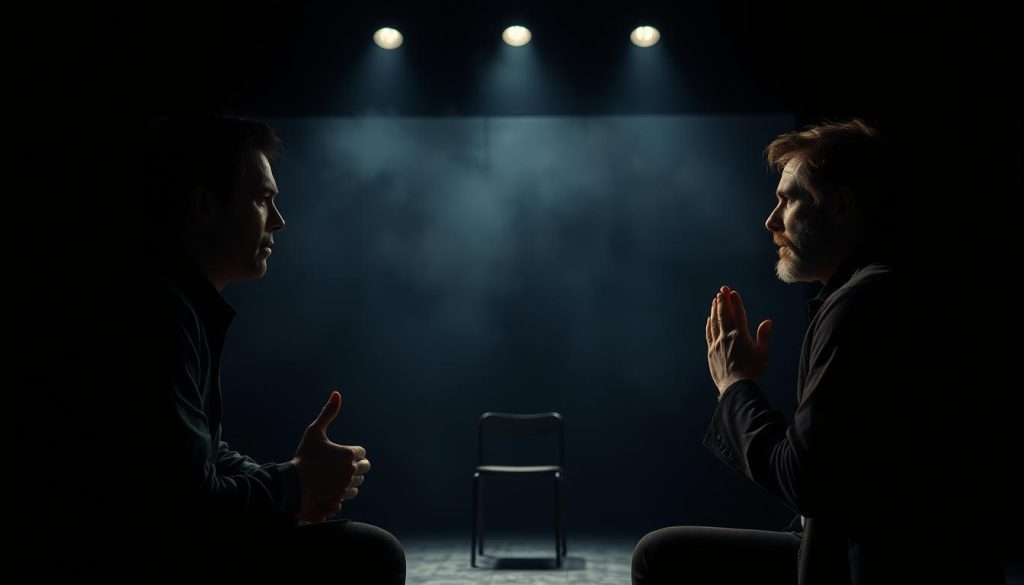
In 2005, Portland’s No Exit brought a twist Sartre never saw: a game show host in hell. Director Carl Madigan’s choice to make Garcin sound like a 1950s radio host sparked debate. Was it a bold move or a theatrical mistake? It’s all about finding the right balance between truth and absurdity in philosophical drama.
The Performer’s Paradox
Actors face a tough task: how to show eternity without being too over-the-top. A 2018 Yale School of Drama study looked at 34 productions. It found that the best ones treated the text with care, letting it shine with danger.
There are two ways to approach this challenge:
- The Portland Mishap: Garcin’s performance was so different, it felt like Hell’s Got Talent
- The Chicago Triumph: A set that moved with the actors, showing their inner struggles
| Challenge | Common Pitfall | Winning Strategy |
|---|---|---|
| Maintaining existential anguish through 8 shows weekly | Developing a Messiah complex (or worse – community theater smugness) | Pre-show ritual: Whisper “We’re all waiting for Godot” 3 times |
| Delivering “Hell is other people” without eye-rolls | Melodramatic arm-flailing à la silent film villains | Physicalize the line through tense proximity – try sharing a couch that’s 2ft too small |
| Balancing cosmic horror with dark comedy | Turning Estelle into a sitcom caricature | Play the vanity straight – recognize we all check mirrors during Zoom funerals |
The real challenge is making audiences forget they’re watching actors. Yet, they should always remember they’re watching themselves. Madigan said in his American Theatre review: “Bad No Exit shows distance you. Great ones make you look for the exit doors.”
Audience Reflections
You’ve just watched three people go at each other for 90 minutes. Now, you’re on Bumble, wondering if your book club likes you. Welcome to Sartre’s world, where existential crises are free with your ticket.
Mirrors Without Glass
Modern audiences don’t just watch No Exit – they endure it. A 2023 UCLA study found interesting post-show behavior:
- 42% immediately texted someone they’d been avoiding
- 31% deleted dating apps mid-intermission
- 17% Googled “how to apologize to my college roommate”
Philosophy professor Madigan’s field notes show students calling the play “TikTok therapy meets Dante’s Inferno”. One student said:
“I came for the Rick and Morty references. I left wondering if my friend group is my personal hell.”
Sartre’s emotional bait-and-switch is genius. We laugh at Garcin’s cowardice, then see our own career choices. We smirk at Estelle’s vanity, then look at our Instagram feeds. It’s like a Group FaceTime call where everyone’s muted, but the camera’s on you.
Remember that couple from Act II’s opening night? They laughed nervously during Inès’ manipulations. By curtain call, they were silent. Ushers heard “We need to talk” before they left. Six months later, they filed for divorce, citing “irreconcilable projections”.
Sartre used audience discomfort long before immersive theater became popular. His hell isn’t other people – it’s our own reflections. The real question isn’t “Why are these characters trapped?” but “When did I stop noticing my own chains?”
How Existentialism Translates Across Fields
Sartre’s existential theater didn’t just stay onstage – it spread far and wide. Seventy-eight years after No Exit first hit the stage, we find ourselves living in its philosophical shadow. Today, Garcin’s cowardice shows up in our online boasts, and Inez’s psychological games play out in our social media comments.
From Stage to Silicon Valley
The modern workplace is like Sartre’s ultimate drama. Open-plan offices? They’re like communal torture chambers with better coffee. Think about it:
- Imposter syndrome: Garcin’s “Am I coward?” monologue now echoes through 2 AM coding sessions
- Always-on culture: Hell isn’t other people – it’s three back-to-back Zoom meetings with your camera off
- Disruption dogma: Startup mantras like “move fast and break things” could’ve been Estelle’s relationship strategy
Dating apps have turned into existential battlegrounds. Swipe-left culture mirrors Inez’s mirrorless purgatory – we judge others while curating our own images. My college roommate once said, “Every match is another chance to ask ‘Do I actually like you, or am I just bored?’”
“The Good Place is basically No Exit with frozen yogurt and Arizona trash bags.”
Social media completes the circle. Twitter flame wars mirror Inez’s truth-telling cruelty, while Instagram’s highlight reels outdo Estelle’s vanity. The kicker? We choose these digital hells daily – Sartre’s “bad faith” manifest in infinite scroll.
Essential Viewing List
Ready to face Sartre’s vision? This is your guide. The 1964 BBC adaptation of No Exit is a must-see. Harold Pinter’s Garcin speaks with a grit that’s unforgettable.
If you like experimental sounds, check out the 1954 French film. It’s a wild ride with jazz scores and deep existential questions.
Existentialism’s Greatest Hits
Avoid the 2012 Turkish version unless you love drama over philosophy. Pair it with Albert Camus’ The Stranger for a dry contrast. Pixar’s Inside Out offers sweet existential questions in a colorful package.
Stanford’s Sartre Archive shows why these works last. The 1986 Wooster Group’s No Exit turned hell into a corporate office. It’s a perfect fit for today’s tech world.
Now, streaming platforms feature No Exit with Garcin facing TikTok influencers. Does watching existential drama help us? Maybe not. But we keep looking for answers in the mirror.
What media would you bring to your own waiting room?
