

Imagine a play that makes Jackass seem tame. Alfred Jarry’s 1896 masterpiece, Ubu Roi, is a work of absurdist genius. It’s so outrageous, it caused riots with just one fart joke.
Picture Shakespeare’s Macbeth rewritten by a punk rocker on absinthe. That’s the wild energy of Ubu Roi. It uses toilet humor to challenge the status quo.
The play’s premiere was a one-night event. Parisian audiences were shocked by the opening line, “Merdre!” It was a nonsense swear that felt more raw than real profanity.
Jarry didn’t just break the fourth wall; he set it ablaze. His disruptive stagecraft included cardboard crocodiles and actors in outrageous masks. It was not just theater; it was a form of cultural arson.
Today’s shock artists can learn from Ubu Roi. It combines slapstick violence, satire, and Rabelaisian excess. The play’s antihero is a walking id, critiquing power structures through humor.
Jarry showed that provocation is about sharp, ridiculous humor. His work has influenced many, making you laugh and cringe at the same time. So, think again about the power of fart jokes.
The Background of Alfred Jarry
Imagine a 15-year-old Breton genius who decides to mock his physics teacher. This is how we get Alfred Jarry, the absinthe-drinking, bicycle-obsessed mad scientist of avant-garde theater. He turned his teacher’s pride into Ubu Roi’s ugly character, starting a meme war against authority.
Jarry didn’t just write plays; he caused chaos. While others doodled, he mocked his teacher, “Père Heb,” in puppet shows. This was the start of Ubu’s tyrannical character. As one study says:
“Jarry turned classroom satire into existential artillery.”
In Paris, Jarry mixed symbolist poetry, anarchist views, and absurdity. His bohemian lifestyle was a show in itself. He drank ether for breakfast and carried pistols to parties. But his work was sharp social commentary, using “pataphysics” to challenge logic.
His love for bicycles is key. His essay, “The Passion Considered as an Uphill Bicycle Race”, shows Ubu’s chaotic nature. Cycling was Jarry’s way of saying we all struggle against absurdity, like pedaling uphill forever.
Jarry’s life was a work of art. He became Ubu, using his quirks to show society’s silly power structures. The amazing thing? A Breton teenager’s joke became the foundation of 20th-century counterculture.
Political and Artistic Turbulence
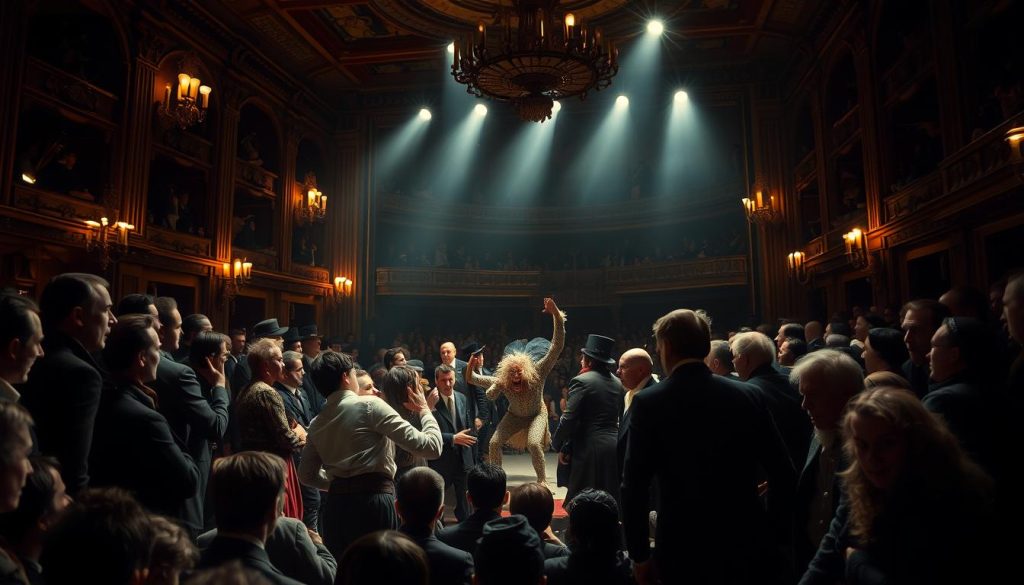
Imagine Paris as a pressure cooker full of anarchist bombs, anti-Semitic riots, and Oscar Wilde’s trial. This was the fin de siècle where Alfred Jarry launched Ubu Roi. It was more than a play; it was a Molotov cocktail thrown into the symbolist movement’s salon.
“Art should comfort the disturbed and disturb the comfortable.”
The Dreyfus Affair context is key here. While Émile Zola wrote J’Accuse…!, intellectuals fought over truth. Jarry used absurdity, mixing scatological puppet shows with highbrow theater. Critics called it “a fart in the face of naturalism.”
| Symbolist Ideals | Ubu’s Violations | Cultural Impact |
|---|---|---|
| Subtle metaphor | Explicit toilet humor | Destroyed decorum |
| Mystical themes | Greedy buffoonery | Mocked spirituality |
| Elite audiences | Crowd-inciting chaos | Democratized outrage |
This wasn’t just artistic rebellion; it was class warfare with papier-mâché weapons. The same year anarchists bombed Parisian cafés, Jarry attacked theatrical norms. His marionette-turned-tyrant symbolized a society questioning authority… while laughing nervously.
Modern scholars say 19th century French theater needed this shake-up. The symbolist movement’s poetry couldn’t compete with bomb plots and treason trials. Jarry gave the cultural moment its true voice – both brilliant and bowel-obsessed.
Was Ubu the first Dadaist? He arrived early to the revolution, wearing clown shoes and carrying a toilet brush scepter. In a world where artists debated art’s role, Jarry defied both options and drew a mustache on the Mona Lisa.
The Original Scandal
Jarry’s opening night was a mix of art and chaos. On December 10, 1896, the Théâtre de l’Œuvre became a hotbed of disruptive stagecraft. The play started with “Merdre!“, a word that caused an uproar. Critics noted it was like bees in a room full of prudes.
Today, we see the genius in Jarry’s plan. He had agitators in the crowd, making the audience part of the show. It was like Kanye’s VMAs moment or Janet Jackson’s Super Bowl “malfunction” but scripted.
Let’s look at Jarry’s tools of discomfort:
| Element | Eyewitness Accounts | Modern Analysis |
|---|---|---|
| Spiral Costumes | “Grotesque pajamas” (Le Monde) | Visual hypnosis tactic |
| Monotone Delivery | “Robotic nonsense” (Audience member) | Anti-acting manifesto |
| Puppet-like Movement | “Drunken marionettes” (Critic) | Satire of bourgeois mannerisms |
This was more than just experimental performance. It was a form of psychological warfare. Jarry used the theater to reflect Paris’s fears about change and excess. The spiral patterns were like a vortex, pulling the audience into his world.
Compare this to Sarah Bernhardt’s refined performances. Jarry was like throwing raw liver at the audience. The result was a mix of applause and boos, unlike anything seen before.
As one historian said:
“Jarry didn’t break the fourth wall – he napalmed it, then sold tickets to watch the flames.”
The real shock was thataudiences could become part of the art– whether they wanted to or not.
Lasting Influence on Absurdism
Was Ubu Roi the godfather of Theatre of the Absurd, or just its favorite drunk uncle crashing the avant-garde party? The answer depends on whether you prefer origin myths or messy artistic evolution. Jarry’s grotesque farce didn’t just break fourth walls – it bulldozed entire theaters of expectation, leaving rubble that later absurdists would repurpose as building materials.
Martin Esslin’s 1961 book The Theatre of the Absurd doesn’t mention Jarry. Yet Beckett’s tramps in Waiting for Godot seem to inherit Ubu’s nihilistic swagger. Their circular dialogues about nothing? Pure Papa Ubu energy – if he’d traded his scepter for existential dread.
The connections get surreal. Ionesco’s rhinoceros stampede mirrors Ubu’s chaotic reign, both using absurdity to critique authoritarian logic. Even Dali’s melting clocks feel spiritually indebted to Ubu’s gidouille – that spiral-bellied symbol of twisted authority. Coincidence? Or proof that Jarry’s surrealist legacy oozed beyond theater into visual art?
“Absurd drama confronts its public with a brutal attack on its convictions.”
Modernist drama thrives on this tension between meaning and madness. Ubu’s childish greed – screaming “Shitter!” while demanding unlimited power – becomes a blueprint for later absurdist antiheroes. His world lacks moral stakes, divine order, or even basic cause-and-effect. Sound familiar? It’s the same existential void where Vladimir and Estragon wait endlessly for purpose.
Yet calling Jarry the “first absurdist” feels as reductive as labeling Warhol the first Instagrammer. Ubu Roi wasn’t a manifesto – it was a grenade tossed into polite society. The explosion just happened to create fertile ground for Beckett, Ionesco, and Pinter to plant their strange, enduring gardens.
Modern Productions and Impact
Imagine Jarry’s 19th-century absurdity meeting Elon Musk’s Twitter and TikTok’s short videos. Modern directors use Ubu Roi to cut through today’s power structures. They show how the play’s dark humor fits our world of billionaire space dreams and digital outrage.
Recent shows have shown amazing contemporary adaptations:
- The 2022 Lincoln Center version made Pa Ubu a crypto CEO, saying “disrupt!” instead of “merde!” and throwing NFT monkeys at the crowd
- A Chicago puppet theater used AI to make Ubu spread fake news through ChatGPT, creating a “Silicon Valley nightmare”
- Toronto’s TikTok show let viewers swipe left to kill characters, mixing digital fun with bloodlust
“We’re not just mocking dictators anymore. We’re critiquing the systems that make them. Ubu is the monster in the boardroom, not under the bed.”
This table shows how political satire changes over time:
| Era | Ubu’s Power Symbol | Satirical Target | Medium |
|---|---|---|---|
| 1896 | Golden Chamber Pot | Monarchy | Live Theater |
| 2024 | Verified Blue Checkmark | Tech Oligarchs | Mixed Reality |
The real surprise? How well Ubu’s antics fit today’s media. A Florida high school’s Ubu TikTok series went viral in April. People wondered if it was theater or a congressional leak.
With AI writing its own versions, we’re left thinking: Does Ubu Roi reflect our society, or are we the monsters Jarry foresaw?
Audience Shock Value
Why do 19th-century potty jokes shock us today? Jarry used the “disgust triad” to shock people. He mixed bodily fluids, voids, and body changes in his work. His bear scene was not just crude but a direct attack on what was considered proper.
Ubu’s methods are similar to today’s performance art. Jarry used a toilet brush as a scepter, while A24 films use hyper-realistic horror. Both aim to shock us, but Ubu’s work makes us part of the joke. The bear attacks not just characters but also our sense of decency.
| Disgust Type | Ubu Roi (1896) | Modern Equivalent (2020s) |
|---|---|---|
| Corporeal | Merde-filled dialogue | Hereditary’s decapitation scene |
| Void | “Shit-trumpet” prop | Saltburn’s bathtub confession |
| Distortion | Spherical puppet bodies | TikTok filter grotesques |
Does Ubu shock us today, or does it comfort us? Its papier-mâché look is old compared to today’s high-definition gore. But its cultural subversion is more powerful. Modern shock artists attack taboos directly, while Jarry questioned the idea of taboos.
Ubu’s genius was turning disgust into a theatrical experience, not a traumatic one. We didn’t just watch; we were part of it. When was the last time a TikTok challenge made you laugh and question your morals?
Revolutionary Drama in Sports Culture
Trash-talking linebackers and a 19th-century French tyrant might seem worlds apart. But, they share a common thread. Alfred Jarry’s Ubu Roi shows a hunger for power and theatrics that echoes in sports today. Papa Ubu is like a WWE heel who devours his foes, turning games into a spectacle.
Today’s sports stories are filled with revolutionary drama, just like Jarry’s work. Fans chant like Greek choruses, echoing Ubu’s nonsensical language. Post-game interviews are full of clichés, hiding the same ambition as Ubu’s quest for dominance.
“The struggle for power is a farce where everyone wears their greed like a jersey.”
Sports media adds to this absurdist competition. Netflix’s Drive to Survive turns F1 rivalries into epic battles, with Ubu-like schemes. The NFL draft trades players like chess pieces, echoing Ubu’s cannibalistic nature. Halftime shows are now chaotic spectacles, thanks to Jarry’s influence.
| Ubu Roi Trait | Sports Parallel | Cultural Critique Insight |
|---|---|---|
| Power Obsession | F1 Team Politics | Win-at-all-costs mentality |
| Absurdist Language | Stadium Chants | Tribal identity through nonsense |
| Cannibalistic Greed | NFL Draft Trades | Consuming talent for capital gain |
| Theatrical Violence | WWE Storylines | Scripted aggression as entertainment |
This isn’t just cultural critique; it’s survival. Athletes show Ubu-like confidence to face constant media scrutiny. When a quarterback says he’s the greatest after a loss, it’s like saying “Merdre!” for today’s fans. We’ve made arenas where absurdity is not just accepted but profitable.
Yet, we love this madness. Parisians who rioted over Ubu in 1896 now watch athlete meltdowns on YouTube. We enjoy the chaos, cheering when it spills over. Whether it’s Ubu’s Poland or Tom Brady’s Tampa Bay, all power struggles make great shows.
Where To See Or Learn More
Finding Ubu Roi performances today is like a surrealist treasure hunt. Start at NYC’s experimental spots like The Brick or La MaMa. These places are known for daring shows that might make you walk out.
For those into avant-garde studies, Paris’ Collège de ‘Pataphysique is a must-see. They offer workshops on Jarry’s absurd ideas. Just don’t expect to understand their “science of imaginary solutions” when you’re sober.
The University of Chicago has a digital archive with rare Alfred Jarry manuscripts. It’s great for comparing his original work to modern studies. Spotify’s “Ubu’s Playlist” mixes medieval songs with rap, perfect for studying pataphysical ideas.
Want to try something different? London’s Artaud Scandal Collective streams Ubu Roi performances from old Tube stations. TikTok creators also use Merdre! for ASMR. Before watching, mix absinthe and rebellion – Jarry might approve.
When theater seems too tame, remember Ubu’s toilet-brush scepter is ready to shake things up. What cultural spots would you storm with a papier-mâché belly?
