

Imagine a family feud that rivals Succession in drama. Sophocles’ Antigone is rooted in a deep family conflict. Emily Ward shows how the 1566 Jocasta adaptation highlights these Theban tragedies. They were like the first prestige TV, filled with power struggles and moral dilemmas.
What keeps these stories alive? Timothy Pollard’s study on Homeric transmission patterns offers a clue. These tales were more than entertainment; they were cultural DNA passed down through generations. The Athenian stage became a place to debate civic duty versus personal loyalty, a debate as timely as today.
The true brilliance is in how these stories are told. Playwrights wrapped complex political messages in family drama. When Antigone challenges Creon, she’s not just defying authority. She’s questioning the role of conscience in society, a question that resonates in courts and Congress today.
- Family dynamics as political microcosms
- Cross-era appeal of moral complexity
- Oral tradition’s role in shaping cultural narratives
Drama and Athletics: Community in Ancient Greece
Long before stadium tailgates or Broadway intermissions, Athenians mastered cultural multitasking. They could literally run from chariot races to tragic performances. This was the original work-hard-play-hard ethos.
The Dionysian festivals were like Coachella, but on a grander scale. They combined athletic skill with poetic release.
Chorus Lines & Starting Lines
The Pericles playbook was not just a dusty manuscript. It was a blueprint for turning military strategy into spectator sport. Their Marathon battle reenactments were as tense as a Super Bowl overtime.
I believe the strophe-antistrophe chorus structure was more than poetic rhythm. It was like the baton passes of relay races.
Think about it: 50 men moving as one unit in the theater, their voices rising and falling like sprinters approaching the turn. The same coordination required to execute a perfect tragic chorus? Identical to the teamwork needed for Olympic team events. We’ve been confusing art and athletics ever.
This fusion created something modern audiences might recognize: emotional cross-training. Citizens didn’t just watch stories – they lived them through physical and metaphorical competitions. When Euripides’ characters debated fate, it hit differently after you’d just seen humans push their limits in the pentathlon.
Plot, Characters, and Olympic Parallels
What happens when ancient tragedy meets modern sports drama? Sophocles’ Antigone shows us a lesson in dramatic structure. It feels like watching a sports dynasty fall apart. Imagine LeBron’s Decision, but with ancient Greek drama.
Meet Creon, the leader of Thebes. He’s like a sports commissioner, but much harsher. Ward’s analysis shows Creon’s ban on Polyneices’ burial is a huge mistake. It’s like a team focusing on image over people’s lives.
Creon’s hubris is as real as a player ignoring their doctor’s advice. Taplin’s work shows how Creon’s pride leads to disaster. Antigone’s bravery is like a last-ditch effort we all root for, even knowing it’s doomed.
Now, let’s explore why tragic hamartia is as impactful as a hard hit in sports. It teaches us about the power of human actions, no matter the time period.
Legacy of Greek Theater in Modern Productions
Move over, Hamilton—the original drama queens were wearing ivy crowns and leather sandals. Ancient amphitheaters didn’t need Tony Awards to prove their staying power. Today’s stages borrow more from Aeschylus than you’d guess while doomscrolling through TikTok interpretations of Oedipus Rex.

Wrigley’s research shows how Anouilh turned Antigone into a WWII resistance manifesto—proof that tragedies aren’t just dusty museum pieces. Fast-forward to 2023: choruses now manifest as viral hashtags, and catharsis happens when your hot take trends. Latham wasn’t joking when he claimed “every generation gets the Antigone it deserves.” Ours just swaps prophetic warnings for subtweeting.
From Epidaurus to Broadway
What do Twitter pile-ons have in common with Sophocles’ choruses? Both weaponize collective judgment. Modern directors ditch masks for Instagram filters, but the core remains: humanity’s messy choices under pressure. Whether it’s a political protest reimagined as street theater or a TikTok Medea parody, the DNA of Athenian drama thrives.
Next time you see a celebrity’s downfall trending, remember: Euripides invented the cancel culture playbook. Some things never change—they just get better lighting.
The Role of Competition
Let’s settle this once and for all: fantasy leagues weren’t invented by your beer-guzzling college roommate. The sports in ancient Greece scene perfected competitive strategy games centuries ago. Imagine Pericles huddled with his strategoi, placing olive oil bets on hypothetical naval battles like a Bronze Age Bill Belichick. Spoiler: They’d crush your fantasy football group chat.
Agon as Ancient Esports
Greek dramatists turned competition into high art. Sophocles’ plays weren’t just tragedies—they were live-streamed agons where audiences rooted for their favorite poets like modern Twitch subscribers. Porter’s analysis shows choruses trash-talking rivals through iambic pentameter. Sound familiar, esports fans?
Oddsmaking in the Orchestra
Delphi’s oracle didn’t just predict crop yields. She was the original oddsmaker, consulting divine algorithms to set lines on everything from Spartan boxing matches to tragic hero survival rates. If best offshore sportsbooks existed in Thebes? Creon’s political overreach would’ve had a -3.5 spread faster than you can say “hubris.”
Modern betting markets owe more to Aeschylus than Wall Street. The real question: Would you take the over on Antigone’s tragic deaths at 3.5? I’m betting yes—the house always wins, when Dionysus is running the numbers.
Teaching Ancient Drama: Student Takeaways
Think modern educators invented interactive learning? Think again. Long before TED Talks and escape rooms, Athenian drama classes had students stabbing cloth dummies during Medea rehearsals. This wasn’t theater – it was political boot camp disguised as entertainment.
Stabbing Lessons: Edutainment BCE
The Pericles playbook’s “Ostracism of Thucydides” scenario makes today’s corporate team-building exercises look like finger painting. Demetriou and Pollard’s pedagogy analysis reveals how these classical origins of role-play taught everything from siege mathematics to crowd psychology. Who needs virtual reality when you’ve got live-action betrayal simulations?
Euripides’ plots functioned as multidisciplinary textbooks. Students didn’t just memorize lines – they calculated supply chains for fictional sieges and practiced rhetoric to avoid fictional executions. The ultimate STEM/arts mashup? A 5th-century BCE playwright cracking the code on engaged learning.
Next time someone claims “gamification” is revolutionary, remind them Athenian audiences cheered for protagonists who literally invented plot twists while dodging actual spears. Some teaching methods age like wine – others like Dionysian mystery cults.
Modern Revivals: Keeping the Game Alive
What do Mussolini, blockchain, and AI have in common? They’ve all tried to understand ancient dramatic structure but mostly failed. Van Steen’s research shows how 1930s directors made Creon seem like a fascist. Savinio’s Alcesti gave the Greek heroine a jazz-age twist.
These plays are not just old stories. They are intellectual property with more reboots than Marvel movies.
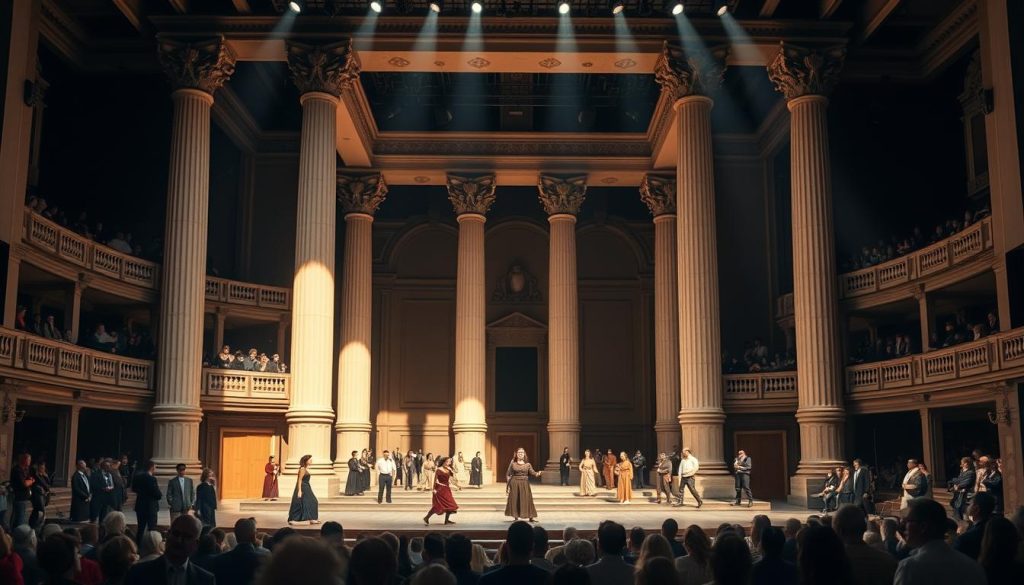
Today, algorithmic choruses can write dialogue faster than Euripides could drink wine. But, AI can’t quite capture that emotional punch. I’ve seen AI create Antigones that are too politically correct, even for Brecht.
Blockchain NFT productions are better at making tokens than touching hearts.
Algorithmic Choruses & AI Dramaturgs
But when humans use these tools, magic happens. Imagine an AI that analyzes 2,400 years of audience reactions to improve dramatic structure. Then, watch playwrights mess with its plans. This mix of old and new is where the real art is.
If chatbots could truly understand human experiences, wouldn’t they have written a good Westworld finale by now?
Key Figures and Artifacts
Before Marvel’s multiverses, Sophocles created the first big universe. It was where Oedipus faced destiny and Jocasta’s story rivaled Netflix shows. This empire was built on pottery and debated in Athenian coffeehouses.
The Sophocles Cinematic Universe
Ward’s analysis shows Jocasta’s story in Antigone was more than poetry. It was algorithmic. Through texts and vase paintings, we see themes that would impress Marvel.
Pollard’s research shows these stories spread fast, adapting for local tastes.
Masked Influencers of Antiquity
Those big actor masks were like ancient Instagram filters. Made from linen and plaster, they showed emotions across theaters. The comedy mask didn’t just show joy – it branded it, making emotions clear from far away.
Looking at these artifacts, we see a pattern. Antigone‘s defiance was like ancient clickbait. And we’re using their strategies today.
Why Antigone Matters Today
What does a 2,500-year-old play about burial rights have to do with TikTok activism and tear gas at protests? Everything. Sophocles’ classic drama isn’t just collecting dust. It’s trending like celebrity feuds. When Creon’s rule “No burial for traitors” sounds like today’s protests, we see ancient wisdom.
Imagine Antigone live-streaming her brother’s burial on Instagram. It’s like 2020s activism. Scholar Adrienne Ward shows how #CivilDisobedience2.0 mirrors Antigone’s stand. From Hong Kong to Minneapolis, conviction can topple power.
MacColl’s WWII-era “Operation Olive Branch” shows the story’s timeless power. One person, one unjust law, one choice that lasts through time. As contemporary retellings show, the tragedy is replaying Creon’s errors. The stones of Thebes fall on today’s protesters. The burial shroud becomes a protest banner. The question is: Which side of history’s hashtag will you land on?
Further Resources for Enquisitive Minds
Ever thought about what Pericles might have bet on the Peloponnesian War? Today, we don’t need ancient tools like olive oil lamps and papyrus scrolls. We have crypto wallets and offshore betting sites for betting on global events like the Olympics.
The gap between ancient military strategies and today’s political bets is surprisingly small.
From Papyrus to Podcasts
GMT Games’ guides show us something interesting. Today’s top offshore sportsbooks work like digital markets. That old book on Pericles? It’s a guide to betting on global conflicts while enjoying nitro cold brew.
Who needs ancient warships when you have algorithmic odds?
I’ve spent many nights comparing Thucydides’ stories to live odds on current conflicts. It turns out, both need you to weigh risks against rewards. The real challenge isn’t knowing about ancient battles. It’s whether your crypto can survive today’s equivalent of the Siege of Syracuse.
Where Togas Meet Tripadvisor Reviews
Forget generic European tours – Greece’s classical origins demand an itinerary where Sophocles competes with your Instagram feed. Imagine sipping Assyrtiko at Epidaurus’ moonlit theater, the same stones vibrating under your sandals that once amplified ancient choruses. Modern productions at this UNESCO site prove Euripides’ trauma dramas hit harder when cicadas provide the soundtrack.
Airbnbs With Agamemnon Ambiance
Skip cookie-cutter hotels for stays blending antiquity with modern quirks. Delphi’s slope-side guesthouses offer oracle-adjacent yoga retreats, while Athens’ Plaka district serves Dionysian cocktail bars across from Herodion Theatre. Pro tip: The Athens Epidaurus Festival’s “Pericles Playbook” theater maps reveal hidden acoustics spots – perfect for covertly judging amateur Oedipus portrayals.
Cultural purists can debate whether adding augmented reality headsets to the Theatre of Dionysus counts as heresy. But when your AR visor overlays live odds on which audience member will sob during Antigone’s burial scene, even Aristophanes might chuckle. Just avoid betting sites not vetted by the Hellenic Ministry of Culture – the house always wins harder than Creon.
Classical performance tourism isn’t just sightseeing. It’s standing where masks once amplified political dissent, then arguing over spanakopita at intermission. As you exit the amphitheater, ask yourself: When your Uber driver quotes Aeschylus unprompted, have you vacationed… or been schooled?
