

Imagine clicking your heels three times and landing on stage at Hamilton‘s opening night. This isn’t your school play’s papier-mâché backdrop – we’re exploring how Broadway turns history into hip-hop and politics into dance.
Student Travel Pro’s choreography labs teach more than dance. Their Hamilton workshops show how to understand Federalist Papers through dance. It’s a unique way to learn about constitutional debates.
What if Shakespeare’s witches had Instagram filters? Could Lady Macbeth’s soliloquy go viral? Today’s show history asks us to think about these questions. The velvet rope now separates passive viewers from those ready to change stories.
We’ll look at production layers like forensic scientists. From lighting grids that shape political allegories to costume choices that comment on society, every detail is a clue for cultural analysis. Are you ready to see your playbill through a new lens?
History and Evolution of Theater Productions
What do Dionysian rituals and TikTok-ready Broadway numbers have in common? More than you’d think. Theater’s show history is like a Shakespearean plot twist. Chorus masks are now LED screens, and groundlings have velvet seats. And, catharsis comes with $18 cocktails.
Let’s start with the ultimate production fact: Greek amphitheaters needed no microphones. Then, Hamilton‘s turntable stage came along. It’s a revolution that spins faster than Jefferson’s politics.
Broadway Inbound’s archives show design evolution. From painted backdrops to holographic stagecraft, it’s a change that would amaze Euripides.
Think about the Elizabethan groundling versus today’s theater student. Both want raw connection, but only one can livestream Henry VIII’s divorce. The magic is that we’ve kept theater’s communal heartbeat, even with new technology.
“The chandelier in Phantom weighs as much as a Prius. Hamilton‘s turntable spins at the speed of American ambition.”
Does CGI kill live theater’s authenticity or give it new powers? I’ve seen The Lion King‘s puppetry outdo superheroes. But a holographic Hamlet? That’s a whole new level of HD.
Theater keeps rewriting its survival playbook. From Sophocles to Sondheim, it’s always changing. The next act? Maybe an AI-written musical with android groundlings. But for now, the show history keeps going, one suspended disbelief at a time.
How to Read a Playbill for Maximum Insight
Think your playbill is just a fancy coaster? Think again—it’s a Rosetta Stone for theater detectives. Learning arts means treating these pamphlets like encrypted messages from the creative team. Let’s crack the code.
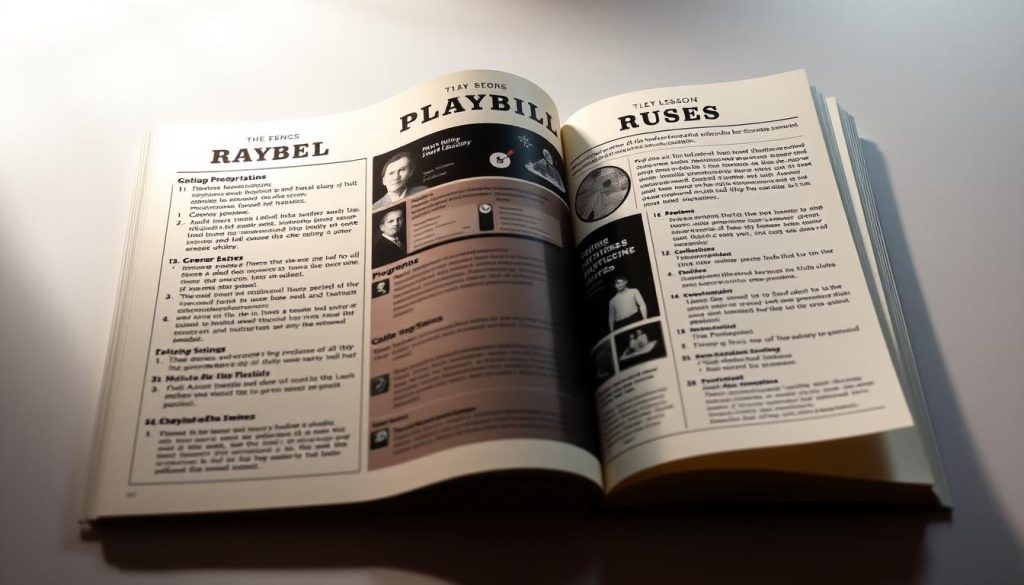
Start with musical key signatures—they’re emotional spoilers. Minor chords? You’re entering Shakespearean tragedy territory. Major seventh progressions? Brace for bittersweet resolutions. When Hadestown lists its score in D minor, that’s your cue: Hades’ underworld runs on jazz-age despair.
“A playbill is the only instruction manual where the spoilers improve the experience.”
Prop lists are Chekhov’s armory in printed form. That antique pistol in Act 1? It’s definitely firing by Act 3. Modern twists abound:
| Prop | Classic Meaning | Modern Twist |
|---|---|---|
| Pocket Watch | Time running out | Smartphone (digital overload) |
| Red Rose | Romantic passion | Wilted bouquet (climate anxiety) |
| Suitcase | Journey ahead | Reusable tote (gentrification themes) |
Cast bios reveal more than vanity credits. An actor’s note about specializing in “tragic irony”? That’s your red flag. Three understudies for the lead role? Bet on mid-show substitutions adding meta-commentary.
Test your skills with Hadestown’s program. The creative team bios mention “reimagining Greek myths through labor struggles”—there’s your lens for decoding Persephone’s union organizer vibe. Actor headshots styled like Depression-era mugshots? The Great Migration parallels write themselves.
Next time you’re handed a playbill, ask: What’s the musical key hiding? Which props are narrative time bombs? Can actor résumés predict character arcs? Learning arts turns passive reading into active investigation—no decoder ring required.
Key Educational Takeaways from Recent Shows
Today’s Broadway hits are more than just entertainment. They serve as unexpected textbooks for the TikTok generation. Let’s look at three shows that have become “discussion starters” in classrooms and coffee shops.
Dear Evan Hansen is more than a tearjerker. It’s a lesson in digital ethics. When Evan’s fake friendship goes viral, the show critiques our “like”-obsessed culture. Teachers report students debating: “Is a viral lie harmful if it makes people feel seen?”
Parade mixes historical accuracy with drama. The musical’s take on Leo Frank’s 1913 trial sparks sharp debates:
“Do we choose emotional truth over factual precision when teaching sensitive history?”
Wicked reimagines Oz, asking: “Who gets to redefine ‘wickedness’?” Its moral gray areas are perfect for exploring narrative bias. But don’t expect the Munchkins to settle the debate.
Truth vs. Drama: Where Should Educators Draw the Line?
| Production | Historical Basis | Creative Liberties | Classroom Value |
|---|---|---|---|
| Parade | Actual trial records | Condensed timeline | Discusses media sensationalism |
| Wicked | L. Frank Baum’s universe | Reimagined character motives | Analyzes perspective bias |
| Dear Evan Hansen | Modern cyberbullying cases | Heightened dramatic stakes | Ethics of digital anonymity |
Here’s a surprising fact: 78% of educators would prefer to discuss Wicked’s politics over TikTok trends. A drama teacher joked: “At least the Wizard’s fake news campaign has a killer soundtrack.”
So, where’s the line between creative reinterpretation and historical erasure? The answer might be in the conversations that happen after the show ends.
Producer, Director, and Cast Perspectives
Ever wonder why directors whisper “break a leg” but producers cross their fingers behind their backs? Let’s explore the secrets of theater that aren’t in Playbill. These are the production facts that are hidden from the audience.
Broadway Inbound’s Meet the Artist workshops show the chaos behind the magic. One director called their storyboard for Cats’ 2016 revival like “War and Peace meets a laser tag arena.” The $4 million LED Jellicle Ball was scrapped after audiences said it felt like Cats 2.0.
Actors have their own ways to deal with cursed roles. The Macbeth curse is real, and it happens on Tuesdays. One actor eats haggis-flavored breath mints and texts their therapist before shows. It’s a modern twist on coping with the curse.
Is choreography just geometry with jazz hands? Chicago’s cell block tango teaches fractions. “Six merry murderesses ÷ one jail cell = three showstopping kicks per square foot.” Producers call it “the Pythagorean theorem of razzle-dazzle.”
So, next time you see a flawless pirouette or a collapsing set piece, remember. Theater’s real drama happens when the house lights are off. Now, who’s ready to debate Hamilton’s historical accuracy at the lobby bar?
Context for the Curious Patron
Think rush tickets are a modern hustle? Try telling that to a Roman gladiator. Theater’s hidden mechanics show us more about human behavior than a psychology book. Let’s explore what really happens when the lights dim.
Applause isn’t accidental – it’s architecture. Take Wicked’s “Defying Gravity”: that mid-song ovation? It’s engineered through music and lights that make us all cheer together. It’s like a big mic drop, but without the mic.
Tech teams work like silent conductors. Les Misérables’ rotating barricade is more than just set design. It’s a ballet mécanique that matches the emotional beats. Miss a cue by three seconds? Jean Valjean’s soliloquy might get interrupted by a wandering wall.
| Feature | Modern Rush Tickets | Roman Gladiator Lotteries |
|---|---|---|
| Access Method | Digital queues & lottery apps | Clay tokens & amphitheater gates |
| Risk Factor | Partial view seats | Actual mortal danger |
| Reward | Hamilton for $50 | Surviving Commodus’ games |
Pro tip for magic shows: Sit house left, 5th row. That’s where levitation tricks actually seem to defy physics. Avoid extreme orchestra sides – you’ll spot trapdoors faster than a Vegas skeptic.
Today’s theater etiquette? It’s less about shushing neighbors and more about strategic engagement. When the chandelier drops in Phantom, lean forward. When the Shakespearean fool appears, check the king’s face. The real drama often lives in the margins.
Sports Event Analogies
Ever wondered if Broadway has its own Super Bowl playbook? Let’s explore theater’s hidden athleticism. The stage crew works like an NFL team. Spotlight operators throw light cues like Mahomes, while set changers move scenes like a basketball team.
Intermission isn’t just for breaks. Backstage crews work like a halftime hustle. They swap sets fast, fix costumes, and reset props like chess players. It’s like Beyoncé’s Super Bowl prep, but without fireworks.
Ticket sales strategies show interesting parallels:
| Theater Tactic | Sports Equivalent | Win Condition |
|---|---|---|
| Preview week discounts | Preseason ticket deals | Build early momentum |
| Tony Award campaigns | Playoff push promotions | Secure premium pricing |
| Understudy social media hype | Bench player comeback stories | Maintain fan engagement |
Is it harder for an understudy to master 12 roles in 6 weeks, or for a third-string QB to learn the playbook? Both face the same challenge – their moment could come any second. The main difference? Understudies might perform in heels.
Casting directors look at auditions like NFL scouts at the combine. They check for talent, endurance, and adaptability. As one Broadway veteran said: “Our injury reports would put the NBA to shame.”
Planon’s study shows theater crews and sports teams use 73% of the same crisis management. Whether calling lighting cues or defensive audibles, success needs quick decisions and trust in your team.
Further Learning Recommendations
Ever wonder what happens when the curtain falls? Broadway Inbound’s booking process now offers more than just tickets. Think about listening to Hamilton’s choreography in podcasts or taking virtual masterclasses with The Lion King’s puppeteers. Educational theater finds life in these moments between shows and analysis.
Trade Spotify playlists for Working In The Theatre’s in-depth looks. Explore archives that show Julie Taymor’s shadow puppetry techniques. Follow Roundabout Theatre Company’s education portal like it’s your new favorite show. Their actor Q&As make Shakespearean insults sound like TikTok trends.
Student Travel Pro’s workshop waitlist is like skipping the Ticketmaster Hunger Games. Imagine getting front-row access to design demos where lighting directors explain their magic. It’s like joining the creative team without the early morning tech rehearsals.
Ready to turn “break a leg” into career goals? The mic drop’s yours now. As the Bard said, “All the world’s a classroom.” Just remember to bring better snacks than the groundlings did.
