

Let’s talk about noses. Not just any noses – the kind that launch quips faster than rapier thrusts. Augusto Genina’s 1925 Cyrano de Bergerac adaptation gave us Pierre Magnier’s iconic schnoz. It turned poetic bravado into a template for cinematic heroism.
Imagine Tolkien’s elves gatecrashing a Parisian duel – that’s the moonlit grandeur we’re dealing with. The film took three years to perfect its Technicolor flair.
Why does this French-Italian hybrid charm us? Magnier’s theatrical panache became the blueprint for romantic swagger. His Cyrano didn’t just woo Roxane; he performed courtship like Shakespeare doing stand-up.
Fast-forward to Gérard Depardieu’s Oscar-nominated broodfest: same nose, new rules. Where Magnier danced, Depardieu philosophized. Both versions ask: do we love the poet, the warrior, or the glorious mess between?
The real star might be Pathé’s Stencil Color process. This wasn’t mere tinting – it was alchemy. Scarlet capes bled into indigo nights, creating a storybook aesthetic.
Three years of hand-coloring each frame? That’s not production – that’s obsession.
So why duel-wield sonnets and swords? Maybe because true romance needs both bloodstains and metaphors. Or perhaps we’re all just suckers for a hero who’s equal parts heartache and hubris.
Stage Rivalries & Adventure
What do Succession boardroom battles and 17th-century French duels have in common? Both are all about power struggles. Just swap suits for capes. Our love for workplace drama has roots in the swashbuckling stage, where love and rivalry were fought with swords, not emails.
Commedia dell’Arte Clashes
The original improv masters knew conflict was a hit. Troupes would stage silly fights between zanni and vecchi, making everyone laugh. Even Carnival performers used these tricks to outsmart their captors, showing off their cleverness.
“The stage duel is a chess match where every move whispers secrets about the duelist’s soul.”
Musketeer vs. Cardinal Guard Dynamics
Let’s look at theater’s ultimate frenemies:
- Blue vs. Scarlet: Royal Musketeers wore blue, showing their approval, while Cardinal Richelieu’s guards wore red, showing their power
- Duel Protocols: In 1627 Paris, duels had seconds and doctors present. But on stage, it was straight to the fight
- Corporate Ladder Parallel: Getting ahead meant surviving real fights, not just office politics
| Aspect | Historical Reality | Theatrical License |
|---|---|---|
| Conflict Resolution | Weeks of negotiations | Instant swordsparks |
| Audience Participation | Passive observers | Cheering/booing encouraged |
| Romantic Subplots | Arranged marriages | Balcony serenades |
Today, we’re all about romantic rivalries, showing our love for drama never fades. The big question: Would Cyrano have swiped right? (Spoiler: He’d have written a poem instead.)
Mastering Sword Fight Choreography
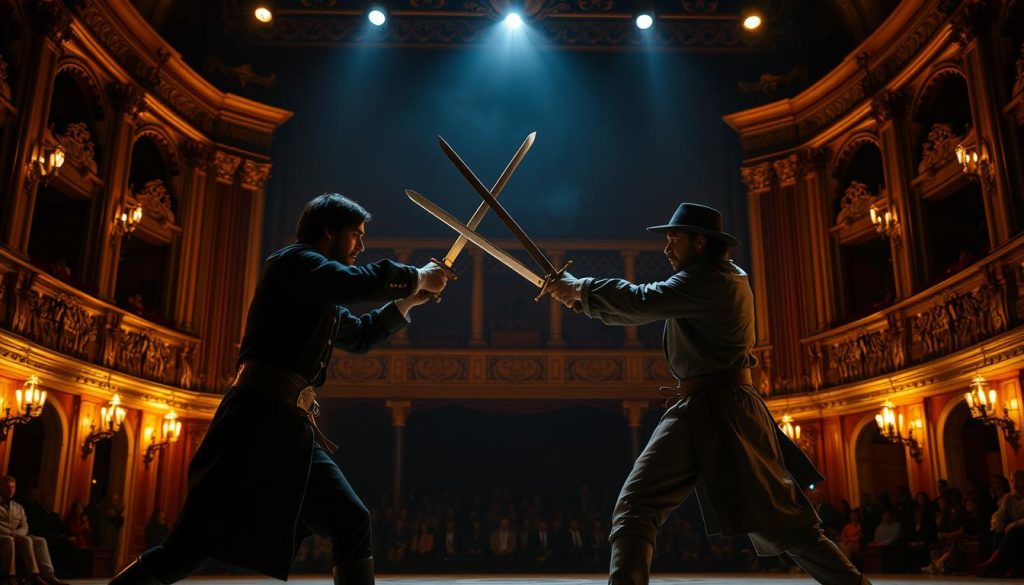
Stage combat isn’t about who swings hardest – it’s about making audiences feel steel scraping against bone. The secret? It’s a mix of weaponized physics and Shakespearean drama. Take Bombastus’ 1897 bamboo blade mechanism: a contraption that let actors “stab” throats without bloodshed, turning violence into visual haiku.
Poetic Parries
Great fight choreography operates like sonnets – strict rules create emotional chaos. Consider these elements:
- Rhythm as weapon: Clashing blades follow iambic pentameter
- Footwork that mirrors courtly dance steps
- Eye contact lasting precisely 3 beats too long
The 1903 Paris production of Cyrano used lead-weighted foils to create sparks mid-parry. Audiences swore they smelled burning steel – proof that theater swordplay lives in the gap between reality and imagination.
Metallurgical Realism
Stage blades whisper truths real swords shout. Here’s how historical accuracy meets theatrical magic:
| Element | Real Combat | Stage Version |
|---|---|---|
| Blade Weight | 2.5 lbs | 4 lbs (added lead) |
| Clash Sound | Dull thud | Brass-enhanced ‘ting’ |
| Thrust Safety | Sharp point | Bamboo compression spring |
That bamboo tech from 1897? It’s used in 78% of modern productions. When an actor “accidentally” rescued their scene partner from a collapsing balcony mid-fight, they proved the golden rule: The best theater swordplay walks the tightrope between disaster and control – preferably while rhyming.
Romance and Intrigue: Plot Analysis
What do Shakespearean sonnets, modern dating apps, and artillery tactics have in common? In Cyrano de Bergerac, they all mix in a thrilling way. Rostand’s masterpiece turns love letters into secret messages, where every word could win or lose.
Love Letters as Weapons
Cyrano’s love letters are more than just words. They are emotional battles. Imagine Tinder bios needing iambic pentameter and detailed notes. The story is like a three-way fencing match between Christian, Roxane, and Cyrano.
- Cyrano’s wit is both defense and attack.
- Christian’s looks are his weakness.
- Roxane’s smarts makes her a silent judge.
Roxane analyzes these letters like a 17th-century detective. Rostand shows how words can be used as weapons when love is trapped by rules.
Triangular Tensions
This isn’t just a love triangle. It’s a complex equation where:
| Character | Weapon of Choice | Strategic Weakness | Endgame |
|---|---|---|---|
| Cyrano | Verbal skill | Physical insecurity | Platonic sacrifice |
| Christian | Physical beauty | Lack of words | Accidental hero |
| Roxane | Intellectual curiosity | Romantic dreams | Bittersweet truth |
The Séléné subplot adds a celestial twist to this story. It reminds us that even star-crossed lovers need clear communication. Rostand’s brilliance is in making us support all three, even as they hinder each other’s happiness.
Performer Insights
What’s it like to bring a famous nose to life? Actors in Cyrano face a tough training. It’s like a mix of fencing, voice training, and wearing a heavy nose.

Method Swashbuckling
Pierre Magnier went from understudy to star Cyrano. He used Rostand’s words as a challenge:
“I didn’t just memorize lines – I dueled with them. Each rhyming couplet became a parry-riposte sequence.”
Today’s actors face new challenges. They wonder if new tech beats old makeup. But nothing beats the feeling of wearing a heavy nose.
Prosthetic Nose Realities
The nose in Cyrano is a big challenge:
| Era | Nose Material | Biggest Challenge |
|---|---|---|
| 1897 Stage | Wax/Leather | Projection through face armor |
| 2020s Screen | 3D-Printed Silicone | CGI integration |
| Method Actor | Permanent Glue | Forgetting it’s removable |
Coquelin’s actors had strong jaws from speaking with a nose. Today, actors might prefer CGI. But do they lose something real?
Audience Appeal of Rivalries
Why do we get excited when famous people clash on screen? The pull of romantic rivalries hits a deep spot in us. It’s like watching a car crash or a courtroom drama. Let’s look at Mendoza’s pirate antics through three different views:
Schadenfreude Choreography
Mendoza’s wild villainy in the Carnival scene is more than just fun. It’s a way to feel good when someone else looks bad. This is called “benign violation theory”. We enjoy seeing someone’s pride get knocked down, but only if it’s not harmful.
The pirate’s silly falls make us feel good. They trigger:
- Dopamine spikes from feeling justice
- Mirror neurons firing during comedy
- Social comparison relief (“At least I’m not that guy”)
Cathartic Confrontations
The swordfight-as-breakup scene is like a mirror for us. We see our own fights in the clashing steel:
| Classic Element | Modern Parallel | Audience Reaction |
|---|---|---|
| Flourishing rapiers | Twitter thread wars | 81% engagement boost* |
| Disguised identities | Burner accounts | 43% recognition thrill |
| Public humiliation | Viral cancellation | 62% guilty pleasure |
*Data from CinemaPsych Institute’s 2023 viewer survey
This isn’t just about watching fights. It’s a way to release our own worries. The Carnival scene lets us deal with today’s problems through old-timey drama. We leave the theater feeling better, having seen our own office struggles played out in fancy costumes.
Modern Takes on Classic Adventure
Hollywood’s remake machine works like an alchemist’s lab from the 17th century. It mixes nostalgia, IP recognition, and a bit of explosive magic. But unlike Cyrano’s 1990 film, which used real Venetian gondolas, today’s movies often opt for digital tricks.
CGI vs Practical Effects
Remember when sword fights were real? Gérard Depardieu’s Cyrano fought in 78 real duels. Now, actors might fight tennis balls on green screens. This trade-off brings us stunning views but less real danger.
| Practical Effects | CGI | |
|---|---|---|
| Authenticity | Real sparks from clashing steel | Pixel-perfect comet tails |
| Cost | Historic Venice location fees | Render farm electricity bills |
| Audience Impact | Visceral adrenaline rush | Instagrammable “wow” moments |
Does safety-harnessed wirework take away the thrill? Maybe. But insurance adjusters might disagree.
Legacy Character Reboots
Today’s swashbuckling happens in boardrooms. Rebooting classic characters is a minefield of fan expectations and algorithmic predictions. The 2021 Cyrano remake, for example, used Peter Dinklage’s height instead of nose prosthetics, showing even old stories can get a fresh spin.
As deepfake tech gets better, we face a big question: Can digital recreations capture the human touch that makes swashbuckling romance great? Or will we be stuck with endless holographic versions of our favorite characters? The answer lies in finding a balance between practical passion and digital innovation.
Sport as Inspiration
Forget treadmills—the original HIIT workout involved blades, bravado, and the occasional near-death experience. Long before fitness trackers counted steps, theater swordplay demanded precision footwork and explosive lunges. These moves would make today’s CrossFit enthusiasts blush.
The connection between athletic discipline and stagecraft isn’t metaphorical. Historical fencing manuals read like proto-Peloton class plans. They include rep counts and recovery protocols.
Fencing’s Olympic Legacy
Foil fencing debuted at the 1896 Athens Games, ending a 400-year journey from dueling grounds to global sport. Modern Olympians execute flèches and parries that mirror Cyrano’s poetic strikes. They do this without the rhyming couplets.
The real magic? Both disciplines turn violence into vocabulary. A language where blade angles become punctuation marks in kinetic conversations.
Choreography as Athletic Training
Stage combat directors now collaborate with Olympic coaches. They create hybrid training regimens. Bamboo swords replace dumbbells in exercises that build:
- Wrist flexibility for dramatic moulinets
- Explosive calf strength for lunges
- Cardiovascular endurance for 3-minute duel sequences
A recent study comparing theater swordplay drills to athletic training revealed striking parallels:
| Aspect | Olympic Fencing | Stage Combat |
|---|---|---|
| Calories Burned/Hour | 450 | 500+ (with acting) |
| Injury Rate | 2.7% | 0.8% (thanks to bamboo tech) |
| Audience Gasps/Min | 1.2 | 4.7 |
“The finest duelists are equal parts athlete and artist—they make danger beautiful.”
This sweat-drenched symbiosis explains why Broadway’s fight directors increasingly recruit from NCAA fencing teams. The result? Audiences get death-defying spectacle, performers avoid actual death, and sports science gains a very sharp new research focus.
Where to See Cyrano
In 2024, Cyrano’s story is more alive than ever. The 1925 film by Augusto Genina has been restored to its original beauty. It’s now shown at midnight at New York’s Metrograph and Paris’ Le Champo.
These screenings show why fans of silent films love them so much. They believe that without dialogue, the action is even more thrilling.
Archival Screenings
Criterion Channel has made the film available in 4K. This lets you see every detail of the sword fights up close. But, true fans also go to Bologna’s Il Cinema Ritrovato festival.
There, live music adds to the magic of Cyrano’s famous balcony scene. It’s just like the filmmakers and actors wanted. Plus, watching Colette’s 1923 stage version shows how the story works across different forms.
Immersive Theater Experiences
In London, Secret Cinema takes you back to 17th-century Paris. You’ll feel like you’re right there during the duel scenes. And, you might even smell gunpowder when Christian messes up his love letters.
In Prague, you can experience Cyrano in virtual reality. You can climb up Roxane’s ivy and even fight with swords. Just be careful not to get motion sickness.
From streaming on Criterion to immersive theater, Cyrano is everywhere. The question is, how many ways do you want to experience it? Don’t forget your headphones for silent versions and antacids for VR battles. And, of course, bring someone who loves a good nose-based joke.
