

Imagine taking one of the oldest devil deals in Western literature and putting it through a language blender. That’s what Gertrude Stein did in 1938 with Doctor Faustus. It’s like watching Picasso paint over Michelangelo’s Sistine Chapel. This isn’t your great-grandfather’s morality play.
Stein’s avant-garde adaptation changes Goethe’s fiery tale into something new. It features a Mephisto with dreadlocks and a Faust who loves Christmas lights more than souls. The magic is in making language itself the protagonist.
Stein uses repetitive phrases like “A bargain is a bargain is a bargain” to turn damnation into jazz. This 85-year-old work is shocking today because it challenges our views on tradition and reinvention. The play’s use of gender-fluid casting was radical in the 1930s and feels even more relevant today.
This modern take on old themes is like Duchamp’s urinal – both familiar and groundbreaking. Stein’s version of Faust’s story is a wink at our performance of self. It makes us wonder if we’re watching a play or seeing a reflection of our cultural deals.
Avant-Garde Techniques: Shining New Light
Forget everything you know about stage lighting – this production treats illumination like a co-star with union demands. Director Brett Adam transforms the Scruffy Bunny’s concrete bunker into a dystopian disco. Here, theatrical technology isn’t just supportive, it’s confrontational.
Physical Poetry in Motion
Miners’ lamps strapped to actors’ foreheads become thought bubbles made literal. Performers orbit each other in a kinetic ballet, their shadows stretching across raw concrete like inkblot Rorschach tests. When Mephisto’s LED collar pulses crimson during Faustus’ moral crises, you’ll swear your own neck hairs are wired to the dimmer board.
The color palette here isn’t subtle – it’s psychological warfare. Sickly green fluorescents bathe contract negotiations between Faustus and hell’s HR department. A sudden shift to ultraviolet during the Seven Deadly Sins montage reveals hidden body paint that’d make a Coachella artist blush. It’s Hamilton meets Home Depot’s lighting aisle on acid.
Three radical lighting choices redefine experimental theater:
- Tubular LED strips that snake across the floor like electrified serpents
- Audience members rotated 180 degrees mid-scene via movable platforms
- Strobe effects synchronized with Elizabethan verse rhythms
| Element | Traditional Approach | Experimental Twist |
|---|---|---|
| Light Sources | Fixed spotlights | Body-mounted miners’ lamps |
| Audience Position | Static seating | Kinetic rotating platforms |
| Color Usage | Mood enhancement | Narrative driver |
The result? You’re not watching Faustus’ downfall – you’re getting shock therapy via colored lights. When the house lights rise, you’ll need three business days to process what you’ve seen. Was it art or an aesthetic assault?
Power, Gender, and the Sporting Life
Imagine Dante’s Inferno meeting Monday Night Football. Stein’s work mixes gender politics with sports, showing Faustian deals through sports. It’s not your old morality play but corporate hell meets fantasy draft night. Power is grabbed quickly, like a bad pass in football.
Mephisto’s Makeover
The Prince of Darkness has a new job and a new set of pronouns. Our modern Lucifer walks through locker rooms like a Wall Street executive. Her power suits are as sharp as a linebacker’s cleats. “Why settle for tempting men,” she says, “when you can own the whole damn stadium?”
This new Mephisto doesn’t just break the glass ceiling. She grinds it into turf pellets. Her:
- Contract talks are like salary cap debates
- Infernal meetings use play-clock countdowns
- Temptation plans are like free agency strategies
Gridiron Metaphors
Stein turns Goethe’s words into first-down markers. The famous “Why this is hell” speech is now a halftime pep talk. It includes Gatorade showers and jockstrap symbols. Look out for these smart changes:
| Traditional Element | Reimagined Sports Parallel | Gender Commentary |
|---|---|---|
| Faust’s study | Team film room | Male-dominated analysis spaces |
| Infernal flames | Stadium floodlights | Visibility politics |
| Book of forbidden knowledge | Playbook with redacted pages | Information control tactics |
The choreography of the scrum isn’t just for show. It’s corporate hierarchy made visceral. When Mephisto’s receivers run through Faust’s conscience, you’ll see why NFL coaches call timeouts during tough moments.
Actress and Director Interviews
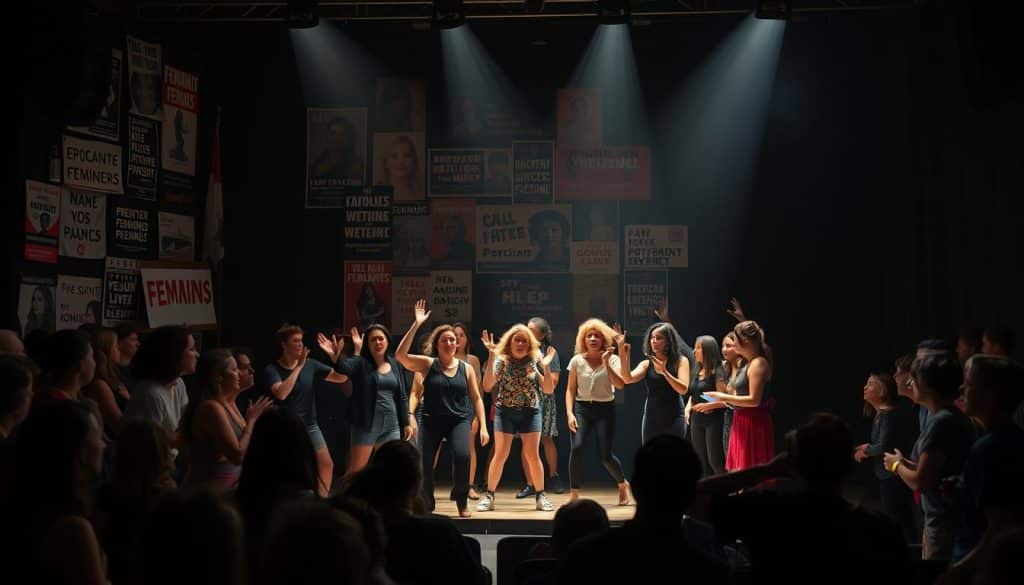
Behind every radical theater production is a team fueled by caffeine and creativity. At Long Cloud Theatre, director Brett Adam was surrounded by Stein scripts and espresso cups. He joked, “Directing Stein is like herding cats at a rave—you think you’ve got rhythm until the lasers hit.”
Decoding Stein’s Wordplay
Adam sees Stein’s words as jazz. He told actors to find the rhythm in Stein’s repetition. Actor Angus Long turned “rose is a rose is a rose” into a powerful gesture, like a corporate power play.
When an LED screen failed, the actors improvised with body language and grunts. This became the show’s most talked-about moment.
Feminist Revisions
Jack Arbuckle’s Mephisto is a mix of myth and politics. Adam said they aimed for Medusa’s stare and Michelle Obama’s composure. Act II critiques patriarchy through TikTok influencers.
“Stein’s words become weapons when spoken through clenched teeth and power suits.”
| Traditional Element | Reimagined Approach | Feminist Lens |
|---|---|---|
| Mephisto’s malevolence | Corporate lobbyist charm | Systemic power critique |
| Faustus’ study | Glass-walled tech startup | Academic gatekeeping |
| Chorus of scholars | Gen-Z content creators | Digital age conformity |
The show’s boldest feminist critique is in its anachronisms. A neon-lit contract scene has Faustus deal with holographic CEOs. Mephisto quotes Sheryl Sandberg’s Lean In with irony. It’s corporate hell seen as a Silicon Valley pitch.
Stage Design and Theatrical Technology
Scruffy Bunny’s concrete playground is like IKEA’s showrooms on steroids. It’s not minimalism; it’s architectural asceticism. Every exposed pipe and unfinished surface adds to the story of Faustus’ downfall. The space feels like a psychological dig site, as if we’re seeing a raw excavation.
Concrete Canvas
Paper blackout curtains flutter like origami ravens, adding to the sound of Faustus’ moral decay. Platforms change from pulpits to prison cells with a simple pivot. This theatrical technology is so clever, it would impress Houdini. Even electrical cords become part of the story, weaving across the floor like Mephisto’s temptations.
Lighting as Language
Lighting is more than just a backdrop; it’s the story itself. A single bulb hanging from a cord symbolizes Faustus’ wavering soul. That self-illuminating umbrella is not just a prop; it’s visual iambic pentameter, casting shadows that rewrite Goethe’s text in real time.
The tech team uses darkness like punctuation. Blackouts come like semicolons, making you feel the regret before the next bad choice. When fluorescent tubes buzz to life, you feel Faustus’ epiphany in your teeth.
“We’re not illuminating scenes – we’re wiring synapses.”
This stage design turns emptiness into something real. The space between platforms isn’t just empty; it’s the void of Faustus’ ambition. You’ll leave wondering if the dust in your shoes is from the theater or your own moral decay.
Audience Impact: Daring to Challenge Old Rules
Ever felt like actors pretend you’re invisible? This show shatters that illusion. It doesn’t just break the fourth wall – it turns the shards into sparkles and tosses them at you. It’s theater turned into a physical challenge.
No Fourth Wall Left Standing
Forget about clapping between scenes. Actors use you as a prop, leaning on you or asking you to hold something. The standing room setup isn’t just about saving money. It’s to keep you on your toes. You’re not just watching – you’re part of the show.
Kinetic Participation
Scenes burst out around you like live grenades. One minute, you’re watching Mephisto; the next, Helen of Troy appears behind you. It’s not just audience interaction – it’s a battle of culture. Here’s how the show uses your presence:
- Proximity warfare: Actors speak right in your face, fogging your glasses
- Environmental storytelling: Scenes play out in four areas at once – pick your path
- Guerrilla choreography: Dance numbers pop up unexpectedly, like flash mobs
You leave not just having seen a play, but having lived through one. It’s like getting a tattoo – it’s uncomfortable, unforgettable, and strangely appealing.
How the Play Influences Young Performers
TikTok-raised actors often think multitasking means lip-syncing and checking Instagram. Stein’s play is a creative detox for them. Long Cloud Theatre’s youth program turns Faustus into a leadership development tool.
Gen Z performers learn to handle gender identities, poetic rhythms, and big questions. They do this all at once.
Leadership Through Chaos
Imagine reciting Shakespeare backward while riding a unicycle in Times Square. That’s what cast members face with Stein’s dialogue. “You stop seeing chaos as the enemy,” says 23-year-old understudy Jamal Chen.
He used to be famous for a Euphoria parody. “The script is like a Rubik’s Cube. We solve it together.”
“We’re training theatrical first responders. Artists who do well when everything’s chaotic.”
Confidence in Complexity
The play’s radical approach shows how avant-garde theater and creative education are similar:
| Traditional Training | Stein Bootcamp | Real-World Application |
|---|---|---|
| Monologue memorization | Simultaneous role-swapping | Adaptive teamwork |
| Script analysis | Semantic jiu-jitsu | Crisis management |
| Character development | Identity flux navigation | Cultural fluency |
Cast members get better at debating, analyzing politics, and explaining complex topics. “After surviving eight costume changes and three existential crises per act,” laughs Priya Nakamura, “college auditions are easy.”
Gender on Stage and On the Field
Fashion-forward football pads meet glowstick couture in this show. It’s like a social studies lesson set to RuPaul’s Drag Race. The gridiron turns into a runway where gender norms are challenged.
Costume as Commentary
The shoulder pads here could bench-press the patriarchy. Designers mixed rugby armor with neon-lit scaffolding. This creates wearable manifestos that shout “identity is performance.”
That glowing umbrella Mephisto twirls? It’s like Paris Is Burning meets WWE championship belt.
Fabric choices mock traditional binaries:
- Glossy latex meets matte football jerseys
- Fluorescent tutus over compression gear
- Cleat stilettos that could stomp stereotypes into turf
Athletic Archetypes
Rugby-inspired choreography turns scrum formations into queer line dances. When Faustus’ team lifts her overhead in a glowing pyramid, it’s both a touchdown and a coronation. These bodies reboot sports clichés—less “locker room bros,” more gender-fluid gladiators rewriting rulebooks mid-game.
What’s more radical? The way a linebacker’s neck roll turns into a Elizabethan ruff during Faustus’ soliloquy. Or how goalpost-shaped accessories frame actors like living Where’s Waldo? pages searching for societal acceptance?
Critics’ Response and Feminist Commentary
When this Doctor Faustus revival hit the stage, critics were shocked. The “woke Faustus” debate was huge – like Mephisto had traded his deal for a gender studies book. But, it turned into a big debate in academia, seen as a test of modern theater.
Academic Reappraisals
Now, scholars see it as a link between old cabaret and RuPaul’s Drag Race. A Cambridge Companion analysis says it “queers the Faustian bargain itself”. It turns Marlowe’s story into a celebration of changing identities.
Stein’s Queer Legacy
Gertrude Stein’s work is seen as joyful and open here. Her “continuous present” style is used to create a space that exists in all times at once. It’s like Beckett meets ball culture, full of hidden meanings.
Feminist scholars love how it flips power around:
- Faustus’ desire for knowledge is seen as a quest for self-discovery
- Mephisto’s changing forms reflect the hard work of gender performance
- The contract’s details hint at debates on marriage equality
Dr. Lila Montague of NYU’s Performance Studies department said during a panel:
“This isn’t your great-grandfather’s Faust – it’s what happens when you let Marlowe crash a voguing session at the Stonewall Inn.”
Planning Your Visit: When to Experience the Spectacle
Seeing Scruffy Bunny Theatre’s Doctor Faustus requires planning. It’s not just watching a show—it’s an immersive experience. You’ll see Beckett’s absurdity and physical feats. Your preparation is key, just like the actors’.
Timing the Epiphany
Scruffy Bunny Theatre’s performance schedule is smart. Wednesday nights attract those who love discussing Stein’s words. Matinees give better views but might show Mephisto’s sweat stains.
Venue Survival Guide
The venue is not fancy. It has concrete floors that make you think about life. Get there early for the best spots. The graffiti door is your entrance to the immersive experience.
Wear comfy shoes and don’t bring big bags. Space is limited, like Faustus’ choices. Tickets sell out fast—get yours early.
