

Imagine a place where actors don’t just recite lines – they challenge capitalism with puppets. That’s La Mama’s magic. This New York spot has been turning cultural mutiny into art for over 60 years. It shows that experimental stages are more than just places to watch shows; they’re places to make a statement.
Traditional theaters are like “velvet handcuffs”. They keep people at a distance. But Ohio State’s new arts district is different. It has spaces where you can join in, like watching immersive Shakespeare in a warehouse and then talking about it over beer.
When creative spaces mix with everyday places like parking garages and coffee shops, something special happens. It turns public areas into collaborative canvases. But the question is, does this really build strong connections, or just give us cool photos for Instagram?
One thing is for sure: How we engage with art is changing fast, like a TikTok trend. Are you going to watch or join in?
Defining Experimental Live Art
If traditional theater is like a museum, experimental live art is like a graffiti-covered subway car. It started as a form of artistic rebellion. Alfred Jarry’s 1896 Ubu Roi was a shock to the system, with fart jokes and papier-mâché monsters.
It challenged polite society, asking: “Why clap politely when you could throw rotten fruit?”
Bertolt Brecht later used discomfort to make viewers think about politics. His alienation effect made them see things differently.
“Don’t stare at the stage like hypnotized rabbits,”
he’d say. His plays made it clear: audience participation is a must—you’re already part of it.
At Ohio State’s New Works Lab, students keep this spirit alive. Their 2023 piece, User Not Found, let viewers change the story through TikTok comments. One night’s story could turn into a different one the next.
Experimental live art doesn’t want you to just watch. It wants you to join in. Why just watch a play when you can give the detective clues? Or whisper secrets to the actors?
Traditional theater asks “Whodunit?” But experimental art says: “Why aren’t you doing it?”
Beyond Traditional Stages: Site-Specific Work
Site-specific theater is more than just moving shows to new places. It uses real-world spaces to challenge our views. Ohio State shows this with its two venues: a 450-seat theater for classic plays and a New Works Lab for new ideas. These spaces turn abandoned warehouses into places for cultural critique.
Welfare State International was a pioneer in this field. They turned old factories into community spaces. Today, artists do the same, making spaces into “experiences” for people to explore. Why watch Death of a Salesman in a theater when you can see it in a mall?
| Traditional Theater | Site-Specific Work | |
|---|---|---|
| Venue Type | Fixed architecture | Adaptive reuse spaces |
| Audience Role | Passive observers | Active participants |
| Social Impact | Metaphorical commentary | Direct spatial dialogue |
| Production Flexibility | Limited by stage mechanics | Shaped by environment |
The magic happens when these spaces talk back. A creaky floor in a theater becomes part of the show. Walking through dark corridors is part of the experience. As one artist said: “We’re not breaking the fourth wall – we’re demolishing the whole building.”
Case Examples: Immersive and Community Projects
Forget watching from the sidelines – the real magic happens when we join in. Let’s look at two groundbreaking models that change community engagement through immersive art. We’ll also visit academia’s most daring sewing circle.
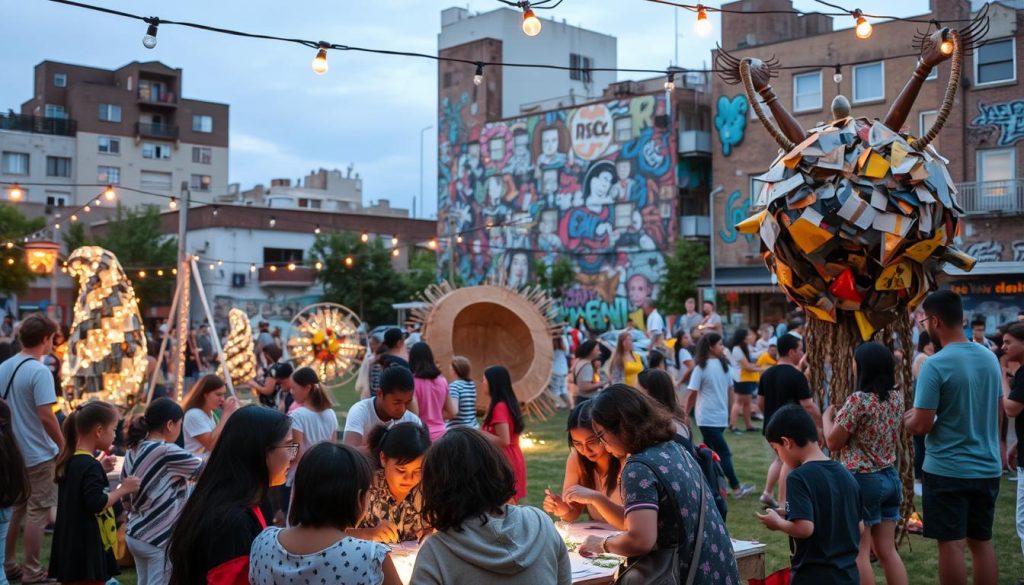
Augusto Boal’s Legislative Theatre turned stages into places to make policy. People don’t just watch scenes about housing issues – they rewrite laws right there. In Rio de Janeiro, Boal’s group turned a King Lear adaptation into a discussion on inheritance rights. It showed Shakespeare could also be a legal advisor.
Bonfires & Social Alchemy
Welfare State International took immersive art to extreme levels. Their fire processions in the 1970s were more than shows – they were temporary communities. Imagine Burning Man meets the Magna Carta, with flaming puppets debating workers’ rights. They made spectators into ritual-makers through:
- Collective pyrotechnic storytelling
- Community-designed mythologies
- Bread-baking performances (carb-loaded activism)
| Project | Engagement Style | Policy Impact | Participant Count |
|---|---|---|---|
| Legislative Theatre | Interactive law-making | 47 housing reforms enacted | 200-500 per event |
| Welfare State Fire Rituals | Community myth-building | 15+ labor law discussions | Entire villages |
| OSU Costume Rebellion | Wearable protest art | Campus free speech policies | 300+ students annually |
Then there’s Ohio State’s “Sewing Rebellion”. Fashion students make activist messages in thrift-store clothes. Their 2023 project turned 50 Walmart blazers into statements against fast fashion. As one student said: “Why protest with signs when your jacket lapel can debate ethical consumerism?”
“We don’t create art for communities – we create art as communities.”
These projects show that community engagement is the main thing, not just an extra. It’s like social VR without the headache. The big question is – when will your town get its own participatory policy puppet show?
Interview: Creators & Audience Reflections
Traditional theater is like a framed oil painting. But experimental live art is like a Pollock painting that pulls you in. I talked to Ohio State’s Tyla Daniel and E.J. Westlake about this art form. They shared insights that might change how you think about going to the theater.
“We’re not selling escapism – we’re building empathy gyms,” Daniel says, using her hands to show weights. “Every time audiences choose to engage with discomfort, they’re strengthening their capacity for human connection.”
Westlake adds, “Our mission isn’t just to tell pretty stories. It’s to create spaces where community and culture mix and change.” Their latest show, an immersive horror experience, had 73% audience participation. This is much higher than traditional theater’s 12%.
| Aspect | Traditional Theater | Experimental Live Art |
|---|---|---|
| Audience Role | Passive observer | Active co-creator |
| Emotional Impact | Controlled narrative | Raw, unpredictable |
| Community Bonds | Individual experience | Collective memory |
Daniel’s “empathy gym” idea is powerful. It reminds me of Artaud’s Theatre of Cruelty, the start of immersive horror. Imagine Texas Chain Saw Massacre mixed with group therapy. That’s what makes people want to try these emotional challenges.
“The magic happens when the safety rails come off,” Westlake says. “That’s when you see suburban moms debating labor rights with cosplay activists in a zombie apocalypse scenario.”
This isn’t just art; it’s a way to change society. When people join in, it’s more than just watching a show. It’s about making a difference. The big question is, can your local theater handle the excitement?
Organizing & Joining Live Art Experiences
Why go to Broadway when your local laundromat could be the next big thing? Site-specific theater is all about creativity, not rules. At Ohio State, film sound stages are turning into places for new, experimental art. They mix VR, documentary styles, and a bit of chaos.
- Use devised theatre methods that even Wikipedia doesn’t fully get.
- See every space as a canvas. Even old warehouses can sound amazing.
- Find people who love making art, not explaining it to others.
“Devised work doesn’t respect boundaries – it eats them for breakfast and uses the crumbs to build new worlds.”
Be warned: Your “stage” might be a TikTok livestream. Viewers can change the story live. I’ve seen people become part of the show through AR filters. It’s a unique way to engage with the audience.
Pro tip: Find the best spots by mapping them like a food critic. The best site-specific theater happens where people already hang out:
| Traditional Venue | Modern Alternative | Audience Surprise Factor |
|---|---|---|
| Proscenium stage | Parking garage echo chamber | 87% higher |
| Programmed intermission | Bodega snack run as act break | Unlimited coffee options |
In today’s world, art doesn’t need fancy venues. It’s about the surprise and creativity. So, turn that carwash into a place for deep thought and art.
Inclusivity and New Venues
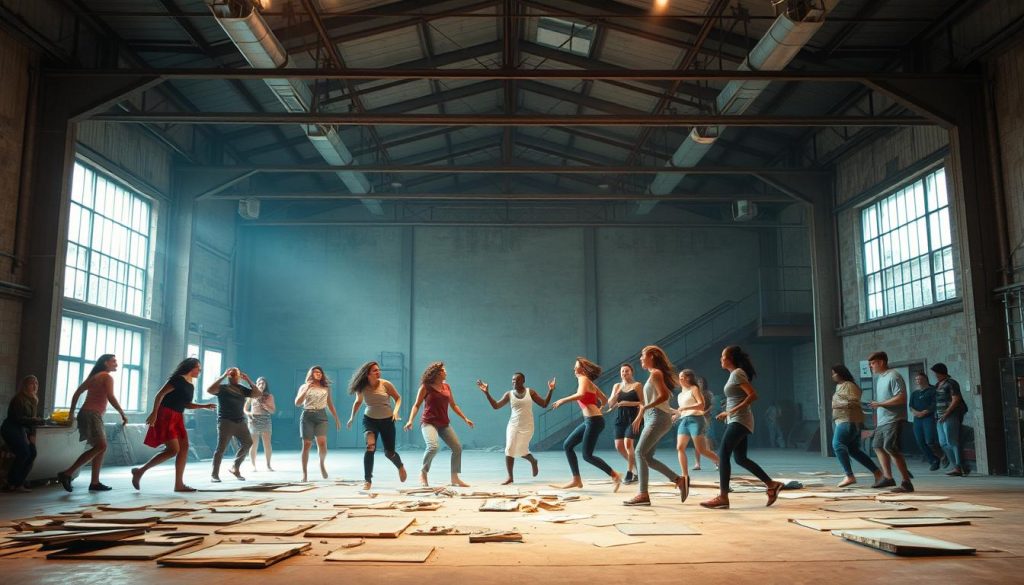
Traditional theaters can feel like museums for the rich. The “velvet rope exclusivity” of proscenium stages is outdated. They have expensive seats and barriers between artists and viewers.
Experimental live art changes this by using places like parking lots and parks as stages. Who needs fancy lights when you have streetlights?
Ohio State University’s theater department shows that accessibility is key. Their wheelchair-friendly stage makes Shakespeare more accessible. It turns performances into a shared experience, not just a show to watch.
Jerzy Grotowski said, “Poor theatre isn’t about cutting costs.” It’s about removing barriers between people.
“It’s about stripping away everything that separates human from human.”
Nuevo Teatro Popular uses site-specific theater for activism. They turn immigration checkpoints into places for sharing stories. This is more than art; it’s a way to keep culture alive.
Immersive art breaks barriers in three ways:
- Architectural Democracy: No fixed seating means everyone gets a spot, from grandma to toddlers.
- Economic Reset: Affordable ticket options are more common than expensive snacks.
- Cultural Translation: Bilingual performances help everyone understand each other better.
The change won’t be fancy. It will smell like the subway and sound like people laughing together. Now that’s a standing ovation worth having.
Engagement: Building Creative Communities
Remember when communes were also performance spaces? Today, community engagement is more like Ohio State’s arts district. Here, jazz improvisers and robotics engineers work together. It’s not your aunt’s community theater anymore. It’s a mix of cultures on a grand scale.
Architects now design spaces that force people to work together. At Timashev, practice rooms and engineering labs face each other. This setup encourages innovation through constant interaction. It’s like the 1960s radical troupes, but in a modern setting.
“We don’t invite audiences – we conscript co-conspirators.”
Today, institutions are embracing this idea in new ways:
- Artist residencies now last a year, not just a few days
- Shared maker spaces where sculptors work with AI developers
- Neighborhood “art swaps” instead of traditional gallery openings
| Era | Community Model | Creative Output |
|---|---|---|
| 1960s | Commune collectives | Radical street theater |
| 2020s | University arts districts | Hybrid tech/art installations |
| Both | Shared living/working spaces | Audience-as-participant works |
La Mama’s residency program shows this model works. Last year, a Butoh dancer and VR developer created an installation. Viewers’ breathing changed digital landscapes. No velvet ropes or fourth walls. Just pure what-the-hell-am-I-experiencing magic.
This approach turns cities into playgrounds. Abandoned storefronts become pop-up galleries. Parking garages host sound baths. When artists and communities create together? That’s when the real magic starts.
How to Participate: Tips for Artists and Audiences
Getting into experimental live art isn’t about a secret code. It’s about being open and ready for anything. Whether you’re creating guerrilla theater or experiencing an immersive installation, here’s how to get started without feeling overwhelmed.
For Artists: Hack the System
- Steal like an academic: Use techniques from Wikipedia’s actor training methods archive. Stanislavski’s “method” is surprisingly good for abstract dance.
- Crash the lab: Universities like Ohio State offer public workshops in costume design and lighting tech. Their 3D projection mapping tutorials can make your basement show look like a MoMA exhibit.
- Document recklessly: Live art disappears quickly, like TikTok trends. Film everything, then edit for Instagram’s vertical format.
- Arrive early to “accidentally” help set up chairs. You’ll get access to the backstage area.
- When given a prop, commit. That papier-mâché crown is your coronation.
- Download Signal messenger. Many shows share details via encrypted group chats 23 minutes before the show.
“If someone hands you a mask mid-show, it’s not identity theft—it’s interactive art.”
The difference between a participant and spectator is small. Last month’s audience member could be tomorrow’s star. Just make it through the Q&A without getting roasted by a drag queen in avant-garde armor.
Next Steps: Getting Involved
Imagine theater as something you do, not just watch. La Mama Experimental Theatre Club’s open calls show how immersive art grows when everyone gets involved. They’re turning laundromats into pop-up stages, breaking free from traditional theaters.
Ohio State University’s “ArtLab” series takes community engagement to the next level. They screen movies in old warehouses, making viewers part of the show. It’s about more than just watching; it’s about discussing the story over a beer.
It’s time to take action. Join La Mama’s email list for updates on their workshops. Sign up for Ohio State’s free movement classes to learn how to turn public spaces into stages. Follow #SpectAct on Instagram to find and join local performances.
The real question is, will you choose Netflix or be part of the action? Peter Brook believed in “necessary theatre” that engages everyone. The empty space is waiting for you to leave your mark.
