

What happens when old rituals meet modern stages? New Orleans is showing us. Avant-garde groups are changing how we tell stories. This is cultural fusion stage at its best, full of energy.
The Fire Weeds took Streetcar Named Desire to a new place. They set it in a old brake-tag shop. Blanche DuBois’ spirit isn’t just there; she possesses the space.
This mix of Creole traditions and downtown weirdness is unique. It’s not just theater; it’s cultural magic. Hoodoo beats clash with Tennessee Williams’ words.
These artists are not just using folklore theater traditions. They’re mixing them up. Imagine jazz and ritual drumming together. Or Mardi Gras Indians meeting Brechtian monologues.
The outcome is like a dream your great-grandmother might have warned you about. It’s real, urgent, and sometimes hard to watch. But that’s where the best art lives.
As one performer said during a break: “We’re not just keeping traditions alive. We’re making them relevant.” That’s a show worth seeing.
Defining Folklore and Non-Western Theater
Non-Western drama is all about community, not just telling stories. It reanimates ancestral contracts through everyone’s participation. Imagine “Hamilton” but with a whole village involved.
Where Performance Begins Off-Broadway
Long before theaters, people performed in natural settings. Non-Western theater has three key elements:
Cultural and Historical Contexts
Kabuki is tied to Edo-period politics, just like Hamilton is rooted in hip-hop. African Ubuntu philosophy makes audiences part of the story. Junebug Productions in New Orleans showed how theater can heal after trauma.
Western directors might envy Yoruba Egungun, where performers channel actual ancestors. Malian Dogon mask dances are more than shows; they’re arguments about the universe. Scholar Zora Neale Hurston said, “Ritual is theater’s elder sibling.”
“When we resurrect Katrina stories through parades, we’re not creating art—we’re doing emergency spiritual surgery.”
| Aspect | Western Theater | Non-Western Drama |
|---|---|---|
| Audience Role | Passive observers | Active participants/co-creators |
| Temporal Focus | Linear narratives | Cyclical/ancestral time |
| Sacred/Profane Divide | Strict separation | Fluid integration |
This table shows survival, not superiority. Broadway focuses on awards, but Togolese Ewe dances keep languages alive. Global theater is a constant dialogue between memory and today.
Traditions and Performance Styles Worldwide
The world’s stages are more than just places to perform. They are time machines that show us the past. From ancient rituals to modern theaters, global theater keeps alive the stories of many cultures. These traditions are not just old relics but living, changing stories.
Asian Theatrical Traditions: Where Gods Text Back
Kathakali performers in Kerala do more than act; they evolve. Their performances are like 3D IMAX movies, with detailed costumes and precise movements. But here’s the surprise: today, they mix ancient Sanskrit verses with modern beatboxing. This blend is a hit in Mumbai clubs.
African Performance Practices: The Original Hip-Hop
Griots are not just storytellers; they are cultural DJs. In Mali and Senegal, they weave history and social commentary into their performances. Their bodies become instruments, adding rhythm to their words.
“We don’t recite history, we become it,”
This tradition is very much alive. When Senegalese troupes mix griot techniques with Brooklyn drill music, they create powerful protest art. It’s a form of drama that surpasses anything seen on Broadway.
Indigenous American Performances: Ritual as Resistance
Native American sun dances have evolved. Modern groups like Spiderwoman Theater blend ancient stories with slam poetry and VR. This creates a non-western drama that innovates beyond Broadway. It also keeps alive languages once banned by the U.S. government.
Why is this important? Every time a Balinese mask meets a Bronx beat, we see survival strategies from the past. These traditions are not seeking approval; they are redefining what theater means.
Case Study: Tontlawald & Folk-Based Shows
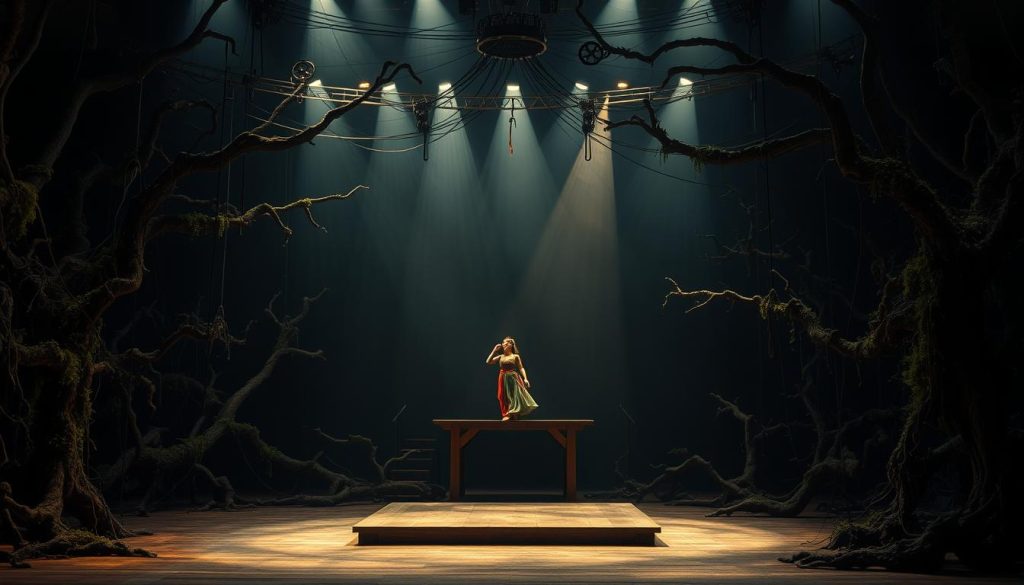
Imagine Tennessee Williams sipping absinthe with Estonian forest spirits – welcome to Fire Weeds’ Tontlawald. This show mixes Southern Gothic drama with Baltic mythology. It’s not just theater; it’s folklore as a live-action remix.
Director Jaclyn Bethany puts Blanche DuBois in a real closet. Estonian folklore’s “Forest of the Dead” comes through the walls. This turns Williams’ subtext into supernatural text.
As one critic said:
“It’s like watching Georgia O’Keeffe paint over a medieval tapestry – disturbing, beautiful, and utterly necessary.”
Let’s look at three key changes in this cultural mix:
| Traditional Element | Fire Weeds’ Twist | Cultural Impact |
|---|---|---|
| Estonian forest spirits | Manifest as decaying Southern gentry | Reveals colonial rot in both cultures |
| Williams’ alcoholism themes | Absinth rituals replace cocktail hours | Connects addiction to spiritual possession |
| Proscenium staging | Audience becomes the encroaching forest | Breaks Western spectator traditions |
Goat in the Road Productions also challenges us with their shows. Their 1811 Slave Rebellion Reckoning uses West African griot storytelling. It makes audiences part of the revolt.
These shows are not just reviving old traditions. They’re grafting them onto today’s forms. Tontlawald makes Estonian spirits haunt Williams’ characters. It asks: Whose ghosts are we really exorcising in 21st-century theater?
Integrating Ritual, Dance, and Myth on Stage
Modern theater uses an ancient trick. Directors mix old traditions with new stories. It’s like opening a cultural piñata. The magic is when old symbols meet today’s tales.
Movement and Gesture
Kathakali performers in Kerala have complex hand gestures. They use 24 basic hand gestures, called hastas. These gestures tell epic stories through finger movements.
Each gesture holds a story, from Krishna’s adventures to Ravana’s defeat. New Orleans’ Junebug Productions also uses dance to tell stories. Their “second line” parades mix Congo Square’s rhythms with protest themes.
Performers move like hurricanes or stagger like flood victims. They’re not just dancing; they’re exploring history. Director Chakula cha Jua says, “Our feet write history books the state tries to burn.”
Masks and Puppetry
Masks reveal truths, not hide them. Bali’s topeng dancers change characters quickly. Their wooden masks show royal drama and peasant wisdom.
In Brooklyn’s HERE Arts Center, Chinese shadow puppets tell new stories. They stage battles at Amazon warehouses. Goat in the Road Productions also uses puppets in museums. Their Time Machine series turns visitors into time travelers.
| Element | Traditional Use | Contemporary Adaptation |
|---|---|---|
| Hand Gestures | Kathakali’s divine storytelling | Queer reinterpretations in drag shows |
| Masks | Balinese spirit channeling | Augmented reality ancestor dialogues |
| Puppetry | Wayang shadow plays | AI-powered protest puppets |
These methods aren’t just for nostalgia. They’re survival tools. Minneapolis’ Mixed Blood Theatre used Anishinaabe water drums in Water Spirits. The drums moved the set, making a big impact.
Artistic Voices: Choreographers and Directors
Today’s theater magic comes from directors, not just playwrights. They’re changing global theater with bold ideas. They use parking lots and Southern charm to shake up non-western drama.
Monica Harris’ Venue Revolution
In New Orleans, Monica Harris turned brake-tag stations into stages for Dracula. It was more than saving money; it was mixing cultures. Her NOLA Project turns:
- Vehicle inspection bays → Transylvanian castles
- Parking garages → Haitian voodoo temples
- Auto shops → Creole storytelling circles
“We’re not just adapting stories,” Harris says. “We’re grafting them.” Her vampire tale mixed Romanian tales with Louisiana magic, earning praise.
Jaclyn Bethany’s Feminist Folklore
Jaclyn Bethany is rewriting characters. Her Fire Weeds company gives Tennessee Williams’ women a modern twist. Recent works include:
| Classic Character | Modern Reboot | Cultural Lens |
|---|---|---|
| Blanche DuBois | Afghan war veteran | Pashtun creation myths |
| Amanda Wingfield | Queer matriarch | Appalachian ballads |
| Maggie the Cat | Tech CEO | Yoruba fertility rites |
Bethany’s method? “Southern Gothic meets non-western drama with a riot grrrl twist.” Her shows blend Mongolian singing with Williams’ words, showing global theater is about mixing cultures.
Audience Involvement in Cultural Productions
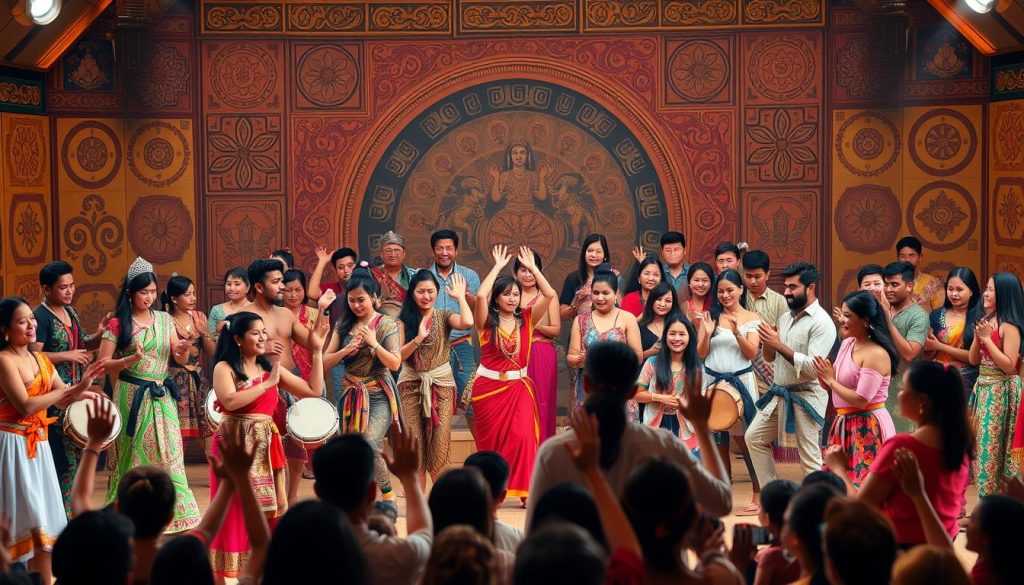
Have you ever literally run through a play? Modern theater is like Netflix’s “choose your own adventure” but with blisters and tough choices. The cultural fusion stage doesn’t just want you to watch – it wants your sweat, your decisions, and sometimes your money (all part of the fun, sweetie).
Participatory Ritual Formats
New Orleans’ Goat in the Road Productions makes theater a real challenge. Their Tontlawald doesn’t just break the fourth wall – it tears down the whole theater. You become a detective, solving mysteries through courtyards while holding old union pamphlets.
This isn’t just watching a show. It’s being part of it. You’re not just watching a strike – you’re negotiating labor rights with the ghosts of workers. The program is a working loom, and the intermission is a group decision about crossing picket lines.
Immersive Historical Reenactments
Intramural Theatre’s works are like nothing you’ve seen before. Their Blood Moon Harvest drops you into 1692 Salem with three rules: 1) Stay in character 2) Don’t reveal your true religion 3) Good luck explaining this to the NSA’s facial recognition software.
The magic is in the details – cultural fusion stage meets creativity. Baroque dance lessons turn into TikTok hits, and witch trial parodies become the talk of the town. You’ll leave wondering if you saw history or became part of it.
“We’re not recreating history – we’re letting it bite people in the ass.”
Folklore and Contemporary Practice
Folklore is no longer just a dusty relic. Today, it’s been updated with modern tech. Storytellers now use VR headsets, mixing old wisdom with new art. At Catapult’s Brooklyn warehouse, Zulu poets meet New Orleans crews in hologram sessions. TikTok shamans share “algorithmic ancestor work” with young fans.
This isn’t your great-grandfather’s folklore theater. It’s culture merged with technology.
Digital Mythology Mashups
Imagine joining a Lakota vision quest with Meta Quest 3. GitR turns Mississippi Delta blues into AR hunts. VR shows Māori myths, letting you explore digital starfields.
These creators aren’t just keeping traditions alive. They’re remixing them for today’s world. A Catapult designer said: “We’re not making time capsules. We’re creating cultural lightning rods.”
These projects make culture more accessible. When you experience a Cherokee stomp dance through headphones, you’re not just watching. You’re carrying it. Even critics agree, as Indigenous VR stories beat superhero movies in some libraries.
Diaspora Storytelling Networks
Globalization has a secret ally: WhatsApp groups. Here, Haitian griots and Nigerian playwrights swap stories. These global theater networks create new forms like:
- Bengali folk operas with Detroit techno scores
- Zoom-based Yoruba dramas
- AI-made Anansi tales read by deepfake elders
The “Diaspora Download” collective in Brooklyn shows it works. Their Epic of Gilgamesh retelling in 14 languages got 2 million streams. Director Amara Kouyaté says: “We’re not losing our roots. We’re growing new ones in digital soil.”
The challenge is avoiding cultural exploitation. But when Haitian drum circles mix K-pop beats with Seoul producers, we might find a way to collaborate ethically. It’s like open-source heritage—folklore 2.0 with version control.
Importance of Global Theater Exchange
Global theater is more than just costume swaps. It’s a complex dance of cultures, where every step can stir up old wounds. We’ve learned from Peter Brook’s 1985 Mahabharata controversy. But the big question is: who profits when cultural traditions become commercial?
The answer is a mix of Wole Soyinka’s sharp words and the creativity of NOLA artists. They’re reimagining Tennessee Williams plays with a Haitian twist.
Postcolonial Performance Theory
Consider that Balinese mask on Broadway. Is it a cultural exchange or a spiritual rental? Postcolonial theory asks us to question: “Does the program credit the village elder who carved it, or just the prop master?”
Soyinka once said Western use of African rituals is like wearing a stolen crown. He called it erasing the true origins of cultural symbols.
“Theatre becomes crime scene when it erases provenance.”
Today, directors are changing the game. Take last year’s non-western drama hit Salt City. It was made by Korean masters and Chicago playwrights together. They split the profits and creative decisions 50/50. They even paid for spiritual advice. That’s true decolonization.
Ethical Fusion Frameworks
The new rules for cultural fusion stage work are like old-school community organizing:
- Credit lines are deep and meaningful
- Profit-sharing is fair and tight
- Consultants are listed before actors
Brook’s work laid the groundwork for today’s more thoughtful collaborations. The Royal Court Theatre’s Global Drafts brings writers from around the world together. They create scripts via Zoom, blending stories for a global audience.
This isn’t just about being nice. It’s a survival strategy. Soyinka said in a TED Talk last year: “Theatre that doesn’t share will suffocate in its own nostalgia.” Now, everyone has a place in the spotlight.
Guide: Discovering More Folklore Productions
Where can you find real tontlawald energy today? It’s not hard to find. Just look for global theater in real-life events and online. This way, you can feel the true spirit of folklore.
Global Festival Circuit
Festivals are more than just fun. They offer a chance to learn about different cultures. For example, WOMAD Festival mixes Senegalese drumming with Finnish myths. It’s a great way to learn about the world.
In New Orleans, the Marigny Opera House combines vodou rhythms with ballet. It’s a unique experience. Keep an eye out for shows like “Van Ella Bordella” at The AllWays Lounge. It turns sex education into a bayou mythos cabaret.
Digital Archive Deep Dives
Can’t make it to Java for Wayang Kulit shadow plays? The British Museum’s online collection lets you explore Balinese puppetry from home. But for real discovery, look at NEA grant lists. They show which Cherokee stories are turned into immersive theater.
Want to really dive deep? Follow @GlobalTheaterAlerts on Instagram. Their Stories reveal more living traditions than any school syllabus.
Here’s a secret: global theater thrives outside of algorithms. Next time Spotify suggests “world music,” look up Wikipedia instead. Or, join a second line parade until your shoes get muddy. That’s where you’ll find the tontlawald’s true heartbeat.
