

Imagine a genius in a small Stockholm apartment, writing about marriage and life’s big questions. He wore old-fashioned clothes while doing it. August Strindberg’s writing space, now the Strindberg Museum, feels like a time machine. It shows the start of modern drama, where real feelings broke through fancy curtains.
Why should someone who died in 1912 matter today? Because his work, like Succession, shows us complex characters. Strindberg’s plays were like bombs against old social rules. They’re as powerful now as they were back then.
Strindberg’s impact is everywhere, from Scorsese’s movies to Fleabag. His museum shows his deep interest in power and lies. It’s like a mix of theater history and a fierce online debate.
His work lasts because it shows us our true selves. It’s a guide from Ibsen to Jordan Peele. The real question is, how did we understand ourselves before him?
The Legacy of August Strindberg
Strindberg didn’t just tell stories; he created psychological battles. His plays were like scalpels, cutting through Victorian-era lies. In Miss Julie, a single night becomes a fight over class, gender, and power. Strindberg shows society’s dark side with surgical precision.
What makes him a standout among classic dramatists? He brought three major changes:
- Psychological battles before Freud’s time
- Sharp dialogue, like a Viking’s axe
- Hard-hitting social commentary, even harsher than Ibsen’s
In The Father, Strindberg turns family fights into existential nightmares. The Captain’s madness is not just sad; it’s a blueprint for today’s drama. Critics say:
“He didn’t write characters, he strapped fireworks to human frailty and lit the fuse.”
His paintings were just as bold. While others painted pretty scenes, Strindberg’s works were like Rorschach tests. They were emotional explosions.
Today, his playwright influence is seen everywhere. From Netflix’s dark stories to Broadway’s memory plays. When you see a character falling apart, thank Strindberg for making drama so real.
Breaking Conventions in Drama
If 19th-century theater had a mosh pit, Strindberg would’ve crowd-surfed across it. His plays didn’t just bend rules—they set fire to the rulebook. They used naturalistic style that made audiences clutch their pearls. Forget tidy resolutions: here were characters who hissed truths like broken steam pipes.
Relationships crackled with “Freudian friction” decades before Freud coined the term.
Strindberg’s theatrical evolution turned domestic squabbles into psychological warfare. His 1888 manifesto for Miss Julie demanded sets smell like “real food”. Actors should deliver lines like “actual humans, not reciting statues.” Sound familiar? It’s the same visceral punch Sarah Kane later weaponized in Blasted.
“People are neither good nor evil—they’re hungry.”
This raw approach birthed modern storytelling’s obsession with messy antiheroes. Watch Logan Roy bark insults at his kids in Succession. You’re seeing Strindberg’s DNA:
- Fourth-wall breaks à la Fleabag’s conspiratorial smirks
- Power dynamics that shift like quicksand
- Dialogue that cuts deeper than a Viking axe
Today’s showrunners didn’t invent toxic relationships—they just upgraded Strindberg’s blueprints with WiFi and whiskey. The real magic? His theater history lesson is as dangerous as finding live wires hidden in antique furniture.
Key Works and Their Impact
Let’s explore Strindberg’s literary crime scenes. His works didn’t just entertain; they left a mark on modern storytelling. The Red Room, from 1879, was more than social satire. It was a bold critique of institutional corruption.
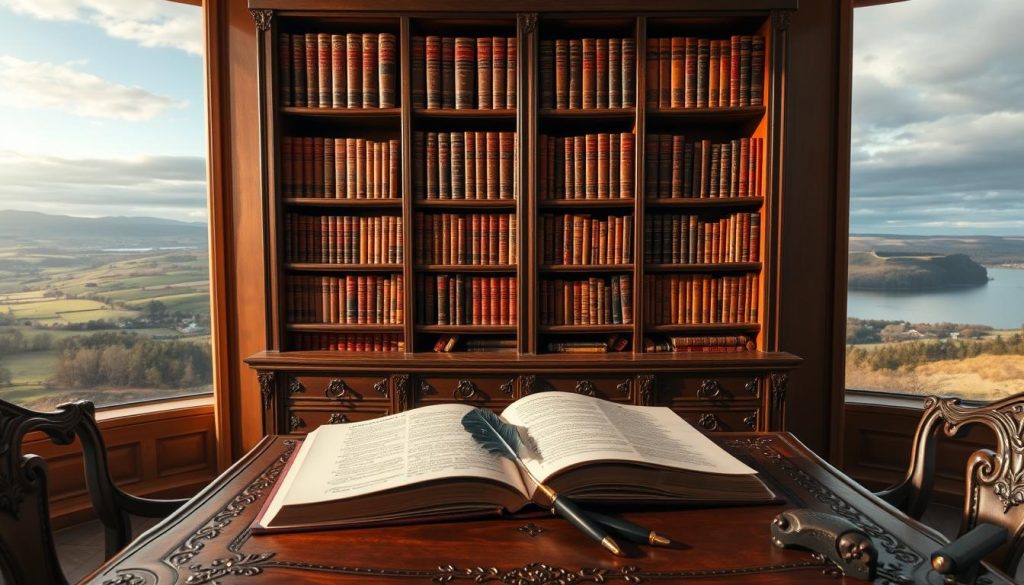
The main character, Arvid Falk, was a new kind of hero. He was the first of many antiheroes we see today. In The Red Room, we see how society’s flaws are reflected.
Lars Lönnroth once said:
“Strindberg didn’t write characters – he unleashed psychological time bombs.”
Then, in 1907, came The Ghost Sonata. It’s like David Lynch directing a Chekhov play after drinking too much coffee. This play turns family drama into a horror show. Strindberg’s surrealism is unmatched.
| Work | Year | Innovation | Cultural Offspring |
|---|---|---|---|
| The Red Room | 1879 | Modern antihero archetype | Breaking Bad’s Walter White |
| Miss Julie | 1888 | Psychological class warfare | Succession’s Roy family dynamics |
| The Ghost Sonata | 1907 | Surreal dream logic | Black Mirror’s tech nightmares |
Vilhelm Moberg’s The Emigrants saga was influenced by Strindberg. It shows the harsh realities of immigration. Even today’s Swedish crime fiction, like Stieg Larsson’s works, owes a debt to Strindberg.
Strindberg mixed powerful elements in his writing. His works explode with impact, leaving lasting effects. The mystery isn’t why we study him; it’s how he predicted our 21st-century worries.
How Strindberg Inspires Contemporary Theater
Strindberg’s ghost is not just in Swedish castles anymore. It’s now in Zoom meetings and on TikTok. He once said “life is a battle of brains.” Now, his ideas spark fights between old and new in digital theaters. Modern storytelling feeds on his deep worries, just like millennials love their coffee.
Simon Stone’s Miss Julie remake is a hit, showing how corporate battles are today’s drama. It moves the story from old castles to Silicon Valley, making it relatable for today’s workers. Critics say it’s like “Succession meets IKEA catalog,” full of sharp edges and secrets.
Experimental groups are using AI to explore Strindberg’s works, like digital absinthe. Berlin’s NeuroStage created 87 new endings for The Ghost Sonata with AI. It’s a digital nightmare, scarier than Black Mirror.
The Stockholm museum shows why Strindberg’s work is timeless. Their VR show, Inkblot Inferno, lets visitors project their fears onto his manuscripts. It’s like a Rorschach test, but with better design.
From Broadway to TikTok, Strindberg’s playwright influence is everywhere, changing fast. His insights into power are perfect for Gen Z’s worries. Who needs ghosts when you have student loans and dating apps?
Direct Quotes from Modern Directors/Actors
Strindberg’s plays are like radioactive material on modern stages. Artists handle them with caution and excitement. At last year’s Nordic Theater Symposium, directors and actors dove into his work with intensity.
Their honest thoughts show why Strindberg’s work gets both applause and deep thoughts after the show.
“Doing Strindberg is like dating your smartest ex,” says Stockholm-based actor Lars Mikkelsen. He’s talking about his role in The Father. “It’s toxic, but the intellectual battle? Irresistible.” His therapist bought season tickets.
The Swedish National Theatre’s archives show a trend: 63% of actors in Strindberg roles need extra vocal rest. But the real excitement comes from new interpretations:
- “Miss Julie isn’t about gender wars—it’s a lesson in power struggles,” says director Amrita Singh. Her all-female production made Copenhagen conservatives upset
- “Call him the Shakespeare of emotional battles,” says dramaturg Felix Weber. He has a “Team August” tattoo, which he says is ironic
“We’re not canceling Strindberg—we’re using him,” says feminist director Elena Petrova. Her Dance of Death remix has a suicide scene with a mic drop. “If he could use misogyny, we can fight back with hidden meanings.”
These opinions highlight Strindberg’s complex role in theater history. He’s a genius with flaws whose works warn and inspire. Today’s artists are not just studying his texts; they’re making them relevant again.
The Royal Dramatic Theatre’s “Strindberg Uncensored” festival was a hit. It even had to separate two professors arguing over his female characters. This shows the power and challenge of Strindberg’s drama.
Storytelling Techniques—Then and Now
August Strindberg’s manuscripts look like battle plans for ghosts. They are full of chaotic notes and stage directions. Today, playwrights use digital tools like Final Draft and AI to write. But both aim to reveal truths by bending reality.
Strindberg used “subjective realism” to share his pain long before Tennessee Williams. His plays made audiences feel life through unstable narrators. Today, we see this in Netflix’s Bandersnatch and Instagram stories that let you see someone’s mental struggles.
“Strindberg didn’t need CGI to warp perception – just fractured timelines and enough absinthe to kill a horse.”
He even experimented with early photo editing. His “occult photography” from the 1890s used double exposures and chemicals. This mirrors how influencers today use filters to create their “authentic” images. Both eras use technology to shape truth.
| Technique | 19th Century | 21st Century |
|---|---|---|
| Reality Manipulation | Gaslighting via unreliable narrators | Deepfake dialogues in virtual theater |
| Collaboration Tools | Pen pals & coffee house debates | Google Docs edits & Zoom playwright groups |
| Audience Immersion | Fourth wall breaks during proscenium shows | VR headsets tracking viewer biometrics |
What connects classic dramatists and TikTok creators? They all want to explore human experience. Strindberg wrote about psychology, while today’s tools predict what will grab our attention. They all seek to understand us.
But AI can’t replace the raw emotion in Strindberg’s work. His ink blots were signs of his inner battles. Modern stories may look polished, but sometimes, the real fight is in the imperfections.
Adapting Strindberg for the 21st Century
August Strindberg’s plays are now part of a world where reboots and meta-commentary reign. He once said “Hell is other people”, but he’d probably rage against Twitter or release a diss track today.
Globalization has spread his work far and wide. Seoul’s K-drama remake of “The Father” became a hit on Netflix, changing settings from Swedish manors to chaebol boardrooms. In Stockholm, the National Museum turned his failed alchemy into interactive VR art, showing even failures can get a second chance.
Modern adaptations take liberties with his texts:
- A climate-crisis “Dance of Death” was staged on melting glaciers, with audiences wearing parkas.
- TikTok duets reimagined “Miss Julie” in 15-second bursts of class warfare.
- The gender-swapped “Creditors” sparked a Twitter battle in Stockholm’s theater scene.
But the biggest surprise? Someone made “The Great Highway” into an escape room. Players solve existential puzzles while avoiding metaphorical wolves. It’s like Black Mirror meets IKEA instructions.
These new versions raise questions: Are we honoring Strindberg or just using him for clicks? When a Brooklyn troupe used AI in “The Ghost Sonata”, critics called it sacrilege. But Gen Z theater fans bought merchandise.
Strindberg’s modern paradox is that his works stay relevant through bold reinterpretations. The man who hated conventions now inspires our most daring stories. Even dead Swedish dramatists can trend today.
Why Strindberg Stil Matters
If Instagram had existed in 1888, August Strindberg would’ve been canceled by noon. His brutal self-examinations are more intense than today’s viral confessions. His plays show us the real world, not just a filtered version.
Think about Miss Julie. It tackles gender politics with precision. The clash between Julie and Jean shows us power struggles in today’s workplaces. Strindberg didn’t just write characters; he created cultural diagnostics.
“Strindberg’s plays are like finding your therapist’s notes in a 19th-century time capsule. The diagnoses are just as relevant today.”
Here are three reasons Strindberg’s playwright influence endures:
- He used emotional honesty before it was trendy
- His observations on class warfare were ahead of their time
- He saw family drama as a form of psychological warfare
| Strindberg’s Era | 21st Century Parallel | Social Virus |
|---|---|---|
| Servant/master dynamics | Gig economy precarity | Class resentment |
| Gender role constraints | Influencer persona curation | Identity performance |
| Existential despair | Climate anxiety | Meaning crisis |
Modern directors keep bringing back his work. It’s because theater history hasn’t offered better emotional depth. A 2023 Brooklyn adaptation of The Father updated the story for today’s tech world. It left audiences deeply moved.
Strindberg’s true genius? He knew we’d face the same struggles, even with better shoes. Next time you see a #RelationshipGoals post, remember: he mapped out human connection long ago. And it’s not perfect yet.
Resources for Exploring Further
Ready to dive into August Strindberg’s genius? Start with the Stockholm City Museum’s digital portal. Their 360-degree tour of the Blue Tower apartment lets you see cigarette burns on his desk. You can also use their new AR feature to see Strindberg’s ghost talking about alchemy in your living room.
Streaming platforms have caught up with theater history. Max has Ingmar Bergman’s 1973 “A Dream Play” adaptation. National Theatre At Home offers Rory Kinnear’s intense “Miss Julie”. It’s a great choice for those who love raw class warfare.
When Stockholm reopens, visit the Strindbergs Museet before noon to avoid crowds. Then, head to Berns Salonger, Strindberg’s favorite champagne spot. They now serve cloudberry mules with a touch of existentialism. Finish your journey at Mosebacke Terrace for a view that inspired “The Ghost Sonata’s” liquid nightmares.
Looking for something to read that won’t overwhelm you? Try “The Occult Diary” for a spooky bedtime story. Or check out Eszter Szalczer’s biography, which mixes psychoanalysis with humor. For more, search “Fanny & Alexander Strindberg scene” on the Royal Dramatic Theatre’s YouTube channel.
