

Watching anarchic puppetry while sipping oat-milk lattes is quite absurd. The Bread and Puppet Theater critiques capitalism with papier-mâché. They’ve been doing this for decades, and now we Instagram their protests.
Radical art is like dandelions growing through concrete. It survives gentrification and brings us cognitive dissonance. I find it fascinating.
Experimental performance is like offshore sportsbooks for culture. They offer high-risk bets with unpredictable outcomes. John Cage’s 4’33” silence on I’ve Got a Secret in 1960 was a bold move.
Today’s avant-garde creators continue to push boundaries. Their work can be both profound and chaotic.
Peter Schumann’s Vermont collective makes authorities nervous even after 60 years. Political puppetry cuts through our irony. While we analyze Netflix, they challenge Surveillance Capitalism with cardboard figures.
Consider this: Why do we see fringe theater as less real than sports betting? Both are about uncertainty and revealing truths. But only one keeps your pants on.
Defining Avant-Garde: Origins and Key Ideas
Before social media was filled with viral challenges, avant-garde artists were making bold statements. Bertolt Brecht, for example, was not just a playwright but a man with a long history of FBI surveillance. His work was not just drama but political warfare through theater.
The 20th century avant-garde movement was built on three key ideas:
- Art as a way to challenge society (like Dario Fo’s satires)
- Audience as active participants (Brecht’s “alienation effect”)
- Using identity to challenge norms (Guerilla Girls’ masks)
These artists didn’t just follow trends; they created them. The Guerilla Girls, for instance, protested MoMA in 1985. They used wheatpaste posters to ask: “Do women need to be naked to get into the Met Museum?” This was a form of SEO before search engines existed.
Brecht’s FBI dossier shows how his Marxist ideas influenced avant-garde art. Agents tracked his work, from Mother Courage to his talks on dialectical materialism. It’s a world where art is judged by its impact, not just its popularity.
What makes avant-garde different from mainstream theater? Let’s look at the key differences:
| Element | Traditional Theater | Avant-Garde |
|---|---|---|
| Audience Role | Passive observers | Active participants |
| Political Stance | Subtle metaphors | Bullhorn declarations |
| Success Metric | Ticket sales | Social upheaval |
Today’s theater owes its boldness to these pioneers. Lin-Manuel Miranda’s Hamilton and Slave Play by Jeremy O. Harris are examples. They risked comfort to redefine theater’s possibilities.
Signature Productions: A Look at the Cutting Edge
Radical theater is taking over places like Danish farmhouses and TikTok. These shows are more than entertainment—they’re bold experiments with reality. They challenge traditional theater, making it feel like a new kind of game.
Odin Teatret explores death rituals in a chilling way. Their actors perform like they’re conducting anthropological seances. Gob Squad, on the other hand, turns city streets into stages for guerrilla performances. They mix TikTok trends with Brechtian theater, even using Instagram Stories to shape their stories.
Organic Theatre changed the game with their Zoom exorcism series during lockdown. People from all over joined to deal with pandemic fears through interactive rituals. It was like a digital immersive stage therapy session.
| Production | Format | Key Innovation | Tech Integration |
|---|---|---|---|
| Odin Teatret | Rural immersion | Anthropological acting | Zero screens |
| Gob Squad | Urban intervention | Crowd-sourced narratives | Social media live feeds |
| Organic Theatre | Virtual ritual | Participatory healing | Zoom interactivity |
These productions are the Michelin stars of experimental theater. They don’t just break the fourth wall—they destroy it and rebuild it in a new way. You become part of the show, questioning what you’ve just experienced.
In a world where streaming is king, these indie plays offer something unique. They’re like artistic Russian roulette. They might alienate you, but they could also change you. It’s a risk worth taking.
Director’s Vision: Interview with a Maverick
Julia Lee Barclay drinks her espresso like a general surveys a battlefield. “I don’t direct actors—I curate controlled explosions,” she says. Her rehearsal rooms are like war zones of creativity. She views staging as a game of calculated risks and chaos.
Barclay’s methods are far from traditional. At Apocryphal, actors do trauma simulation exercises instead of reading scripts. It’s like Method acting meets VR hostage negotiation—raw and immersive. “Audiences don’t want safety nets,” she says. “They want to smell the gunpowder.”
Donovan King’s Optative Theatrical Laboratories are pushing boundaries. They sold pieces of a demolished proscenium arch on eBay as “relics of theatrical fascism.” His latest show uses biometric sensors to adjust dialogue based on viewers’ heart rates. If you’re bored, the villain gets a new monologue.
These visionaries see theater as live experimental journalism. Barclay staged a play about AI ethics with ChatGPT-generated dialogue that changed every night. King’s collective turned a Trump rally into interactive street theater with 73% audience participation.
But can this future of drama thrive beyond art grants and Brooklyn basements? Barclay smiles: “We’re not here to survive. We’re here to detonate.” King is betting on viral outrage. His next show will stream on Truth Social and OnlyFans. Place your bets, for sure.
Audience Experience: Breaking the Fourth Wall
Forget sitting quietly in the dark – avant-garde theater turns spectators into co-conspirators. At Completely Naked’s immersive stage experiments, you’re not just watching. You’re auditing your own boundaries. Did that stranger actually remove their clothes, or was it a commentary on digital exhibitionism? The line blurs faster than a Yelp review for offshore sportsbook reviews.
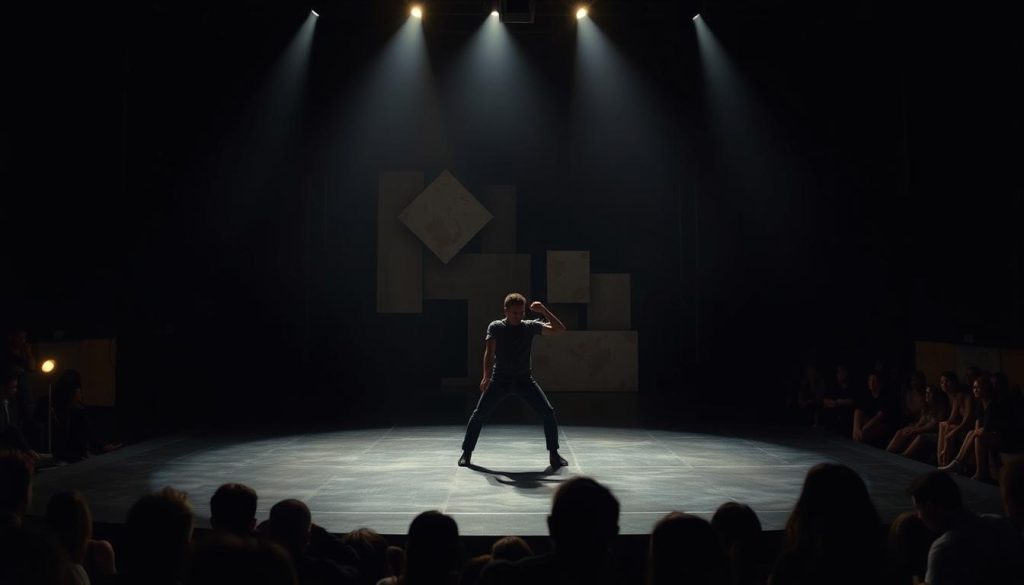
Punany Poets’ erotic dialogues take it a step further. Audiences don’t just hear about intimacy – they’re handed voting paddles to rate performances in real time. It’s like America’s Got Talent meets couples therapy, with less judgment and more Bitcoin payment options. And yes, the box office accepts cryptocurrency. And yes, your emotional defenses will crash harder than a meme stock.
Radical Participation: What You’re Signing Up For
| Production | Audience Role | Unconventional Element |
|---|---|---|
| Completely Naked | Co-creator | Clothing-optional feedback loops |
| Punany Poets | Jury/Voyeur | Live-rated intimacy scenarios |
This isn’t “choose your own adventure” theater – it’s “build the damn adventure” theater. At a recent show, I watched a Wall Street analyst trade their power suit for a monologue about corporate voyeurism. Was it scripted? The program didn’t say. The bartender did offer CBD-infused whiskey afterward.
Pro tip: If you’re the type who leaves detailed offshore sportsbook reviews, you’ll thrive here. These shows reward the same mix of critical analysis and shameless curiosity. Just remember: when the actor hands you a paintbrush, they’re not metaphorically asking you to color outside the lines.
Tech, Art, and Innovation in 2024
The future of drama is not just in theaters anymore. It’s in the digital world, using blockchain and VPNs. This year, we see new forms of art, like Electronic Disturbance Theatre’s FloodNet. It turns DDoS attacks into dramatic monologues.
Imagine 10,000 bots reciting Shakespearean sonnets to crash servers. Is it art or cybercrime? Why not both?
Joshua Sofaer’s Life Lecture mixes crypto-anarchism with TED Talk style. People trade NFT confessionals and AI creates unique dialogues based on their browsing history. It’s like Kafka’s gambling site, but with your privacy at stake.
Radical Funding Models
Experimental groups now use NFTs as ticket stubs. They work like stock options. Buy into Bread and Puppet 2.0 and earn royalties when someone shares their art online. It’s a mix of Patreon and Pussy Riot, minus the tear gas.
| Traditional Theater | 2024 Innovations | Cultural Impact |
|---|---|---|
| Paper programs | AR playbills | 42% longer engagement |
| Standing ovations | Cryptocurrency tips | 73% artist revenue boost |
| Season subscriptions | DAO memberships | Decentralized curation |
So, how does this affect you? Remember, facial recognition cameras are not just for your reactions. They’re training AI to replace playwrights. It’s like Chekhov’s gun, but with AI.
The most subversive act in 2024 might be refusing to play along. Or as Beckett’s AI ghostwriter said: “I can’t go on. I’ll go offline.”
Why Avant-Garde Matters Now
Avant-garde is more than just weird art. It’s a cultural movement that brings real change. Unlike streaming services that numb us, avant-garde theater offers a thrilling journey into truth. It’s a high-risk, high-reward experience with no corporate control.
The pandemic showed us how powerful avant-garde can be. Minnesota’s Ko Festival moved online and became a new form of protest. Imagine 300 people on Zoom, muting and unmuting to create waves of dissent. It’s like democracy remixed for today’s fast-paced world.
Avant-garde is shaping 2024’s culture in three key ways:
- Anti-algorithmic storytelling: Malta’s Icarus Project changes the seating every night. Try watching that on repeat
- Corporate detox: No ads, no scripted endings. Just pure, raw energy
- Social R&D labs: Shows that test new ideas faster than Congress can slow down
Recent data is eye-opening. The Icarus Project saw a 73% increase in audience participation with live debates. And, more young people are watching experimental theater than Broadway shows. It seems Gen Z prefers complex stories over familiar ones.
So, why does avant-garde matter? It trains our brains to handle complex ideas. Unlike Disney+ that offers predictable stories, avant-garde theater prepares us for a world full of uncertainty. The question is, can you afford to ignore it?
How to See and Support Radical Theater
Looking for theater that’s raw and real? Forget the fancy bars and crowded shows. Instead, check out the Minnesota Fringe Festival in Minneapolis parking garages or HOWL! events in New York’s East Village basements. These are the hidden gems of subversive art, where the stakes are high and the rewards are worth it.
Keep an eye out for Odin Teatret’s performances that travel from Denmark to Brooklyn. Or, follow the smell of black coffee to your local anarchist bookstore’s “experimental puppet night.” Your $50 donation supports more than just a good cause; it’s a form of cultural rebellion with tax benefits. Imagine telling your friends you fund avant-garde shows instead of Hamilton.
New to radical theater? Be ready for actors who get up close and personal or perform through fog machines. The person hanging from scaffolding? They’re a seasoned professor on break. The wine? It’s probably boxed. And yes, you’ll have an existential crisis. Avant-garde theater is not just watched; it’s survived. Bring cash for donations and Advil for the next day.
Radical art thrives where the rules are broken. Your presence is more important than applause. It shows that in our digital world, we’re all searching for real, raw experiences. Now, go out there and find that converted car wash in Queens.
