

Experimental theater loves to make us uncomfortable. Kevin Oakes’ latest new work is a prime example. It’s a play about bodily fluids and restless spirits that will make you squirm.
Imagine Romeo’s famous balcony scene, but written by a pathologist in the middle of an autopsy. That’s what this experimental drama is like.
Oakes turns personal trauma into grotesque poetry. He mixes iambic pentameter with medical terms. His characters don’t just talk; they vomit the truth.
Jeffrey Jones once said theater is like reality modeling. This play takes that idea to a dark place. It’s not about moralizing; it’s about dissecting the truth.
But does this play turn drama into a form of diagnosis? It’s structured like acid reflux, with sudden bursts of violence followed by calm. It’s a mix of Beckett and Gray’s Anatomy, with haunted hospital beds.
This new work doesn’t just break the fourth wall. It tears it open. Can intentional disorientation be a new form of theater, or is it just creative indigestion? The answer might be in the script’s experimental nature and our own reactions.
Playwright’s Vision: Games Unbound
Mainstream theater has become too real, a parody of itself. Mac Wellman mocks this in his manifesto, calling it “meretricious self-parody masquerading as emotional truth.” Playwrights like Wellman and Young Jean Lee see stages as places for surrealism and rule-breaking.
Lee moved from academia to New York’s experimental scene, like Wellman’s “theater of the normal paranormal.” They both reject simple stories. Lee creates chaotic character studies, while Wellman makes language a game. Their work is like Ionesco’s anti-play, mixing Rhinoceros with philosophy on speed.
| Playwright | Approach | Cultural Impact |
|---|---|---|
| Mac Wellman | Language games/absurdist syntax | Redefined American avant-garde |
| Young Jean Lee | Radical vulnerability meets Brechtian disruption | 21st-century identity deconstruction |
| Eugène Ionesco | Anti-play absurdism | Blueprint for surreal rebellion |
Wellman doesn’t just break rules; he shatters them. His characters speak in unexpected haikus, in scenarios that make Wonderland seem tame. Lee’s plays are like intellectual battles, where finding emotional truth is a challenge.
But what if this rule-breaking isn’t just experimental? What if it shows our reality better than traditional theater? The answer might be in the rehearsal rooms, but that’s for Section 3.
Rehearsal as Open Field Practice
Madelyn Kent’s Shufu Theatre turns living rooms into arenas for Japanese housewives to practice improv. They do it like athletes getting ready for a big game. Their talks show how they embracing imperfection with skill, like a soccer team practicing passes.
Kent’s “floating world” style isn’t fancy—it’s like a basketball team’s scrimmage. Actors repeat conversations like free-throw drills, making raw emotion shine with intentional roughness. Amber’s monologue, for example, is like a rookie quarterback calling an audible.
This method turns traditional rehearsals upside down:
- Drills replace scripts: Spontaneity becomes muscle memory
- Mistakes are strategic fouls: Planned imperfections create authenticity
- Collaboration mimics team huddles: Collective discovery over solo heroics
The magic is in the balance between structure and chaos. It’s where great athletes thrive. Watching Shufu Theatre is like seeing a group warm up for life’s unpredictable moments. Kent says, “Why rehearse lines when you can practice being human?”
Improvisation Techniques—Sports and Drama Parallels
Call an audible. Whether you’re a quarterback or an actor, the thrill is in the moment. Sports improvisation is mental agility at high speed. It’s like playing chess fast.
Theater rebels like Ionesco knew this well. His play The Bald Soprano turns a dinner party into chaos. It’s like a last-minute Hail Mary pass.

Offshore sports betting fans don’t just guess. They calculate risks like actors improvise. Both find patterns in chaos.
A quarterback’s audible is like Mrs. Smith’s sudden monologue in The Bald Soprano. It’s unexpected yet makes sense.
In theater and betting, the house doesn’t always win. But the audience might. Actors and bettors turn mistakes into opportunities. It’s like linguistic parkour.
Watch a basketball team score on a broken play. That’s sports improvisation. It’s about trust and instinct. When it works, it’s magic.
Or as gamblers say, “Chaos pays, if you know where to look.”
Artistic Collaboration and Freedom
What do a gnome-baby puppet and Silly String vomit have in common? In the wild world of experimental drama, they stand for creative freedom. Erin Courtney’s *Demon Baby* uses a gnome to challenge traditional stories. *Exorcistic: The Musical* uses foam and rap to shake up theater. Both are new work lessons in embracing chaos.
Courtney’s work is like jazz improv. Actors explore themes of motherhood and loss with a puppet that’s both cute and scary. The gnome-baby is more than a prop; it’s a symbol open to interpretation.
*Exorcistic* takes a different path. It uses Silly String vomit in a rap battle to break free from norms. This isn’t just camp; it’s a way to release emotions.
Which way leads to true creative freedom? The answer might be in the mix of both. Experimental drama is all about the clash of ideas. Whether through Courtney’s deep metaphors or *Exorcistic*’s sparkly moments, these artists show that rules are made to be broken.
Does making art need a demonic puppet? Let’s say: having a foam-spewing hellspawn as a co-star teaches you to trust the unexpected.
Audience Reception: Embracing Chaos
In today’s world, Netflix knows us better than our therapists. People are drawn to theater that breaks the mold. The Bald Soprano has had over 16,300 performances, showing we love watching actors say weird things. Critic Chris Jensen says, “Give me glorious weirdness over predictable plot armor any Tuesday.”
Modern audiences crave chaos. They love shows like Re-Animator with its puppetry of decapitated heads more than traditional Shakespeare. It’s not about shocking them; it’s the excitement of seeing artists push limits. When Merlin’s corpse sings showtunes, the crowd leans in, eager for more.
Why do we seek out this kind of theater? Maybe because our lives feel like a never-ending algorithm. Shows that refuse to explain themselves make us put down our phones. Eno’s severed heads in Tragedy aren’t scary; they’re a sign of life amidst chaos.
Experimental theater lasts longer than traditional shows. Parisians saw The Bald Soprano 16,300 times for its unique experience, not its plot. A Broadway producer said, “Chaos sells better than closure these days.”
Staging for Impact: Artistic Choices
In experimental drama, what you don’t see can be louder than what you do. This is shown in The Vomit Talk of Ghosts’ use of empty space. In Apparition, dark areas offstage become characters, making the audience feel uneasy.
The darkness doesn’t hide the action; it makes it more intense. It’s like looking into a haunted mirror. Who knew emptiness could feel so crowded?
Ajax features a white-tiled sex dungeon, a set that feels more cramped than dark. The bright lights make everything feel sterile, turning private moments into public scrutiny. It’s like a mix of IKEA and Eyes Wide Shut, showing how experimental drama uses visual shock.
Kent’s foggy scenes in Apparition build tension through mystery. Tuan’s “Dick Odyssey” uses wordplay as part of the set design. Both ask: when does subtraction reveal more than addition? The answer is in carefully crafted emptiness, letting viewers imagine their own fears.
Modern theater often thinks more is better. But Ghosts shows that sometimes, less is more. Strategic emptiness can spark a scene more than any special effect. Isn’t our imagination the greatest effect of all?
What the Critics Are Saying
Critics are as divided as a theater audience at intermission. Traditionalists hold their playbills tight, calling it “impenetrable absurdism.” On the other hand, fans of the new wave hail it as “theatrical liberation incarnate.” The gap between them is as wide as a spotlight in a dark theater.
Let’s break down the hot takes:
| Establishment Critics | Avant-Garde Champions |
|---|---|
| “A pretentious exercise in actorly indulgence” | “Drama that breathes instead of recites” |
| “Watching paint dry – if the paint screamed existential questions” | “A masterclass in controlled chaos” |
Jones’ “boredom as work” idea sparks a lot of debate. One critic called it: “I’d prefer watching an understudy rehearse Chekhov in slow motion.” But others say: “It uses monotony to show our addiction to instant gratification.” (Ever scrolled through a 3-hour play online?)
The new work’s reception reminds us of Ionesco’s The Bald Soprano. Both challenge us to think deeply. A TikTok critic noted: “It’s not confusing – you’re just not listening with your whole body.”
Three undeniable truths come from the critics:
- The production evokes strong reactions, even if they’re negative
- It’s starting conversations beyond the theater world
- It leaves no doubt that it’s not “regular” theater
Love it or hate it, this new work is a cultural mirror. The real question is: “What does your reaction say about you?” The curtain falls on our existential questions.
Why Rule-Breaking Drama Matters
What happens when playwrights challenge language itself? Mac Wellman rejects traditional realism for a new kind of speech. He uses broken words and odd patterns to shake up theater. That’s where the magic is.
Abe Oakes introduces an aphasic father, changing how we see characters. This breaks down power and communication. Rule-breaking drama challenges norms and changes how we see authority and connection.
Experimental theater shows us cultural shifts in three ways:
- Syntax as social contract: Messy dialogue shows how fragile our communication is
- Failure as freedom: Characters who can’t speak “correctly” break free from scripts
- Chaos as clarity: We find meaning through rhythm, not just words
| Traditional Drama | Rule-Breaking Drama | Cultural Impact |
|---|---|---|
| Linear storytelling | Fragmented narratives | Mirrors digital-age attention spans |
| Polished dialogue | Intentional linguistic breakdowns | Challenges elitist language norms |
| Clear character motives | Ambiguous emotional states | Reflects modern existential uncertainty |
When characters stop making sense, we start to understand more. Wellman’s “gibberish revolution” uses language’s flaws to speak truth. In a world of scripted speeches and jargon, chaotic dialogue is a form of honesty.
This isn’t just about theater. It’s about sparking change. By breaking rules, playwrights help us question and reimagine. They do it one messy word at a time.
Opportunities for Emerging Artists
New York’s underground theater scene offers a chance to see new and bold works. Unlike Broadway, which often sticks to familiar stories, these spaces push boundaries. For example, Exorcistic: The Rock Musical Parody Experiment shows how campy horror can be a fresh take on old ideas.
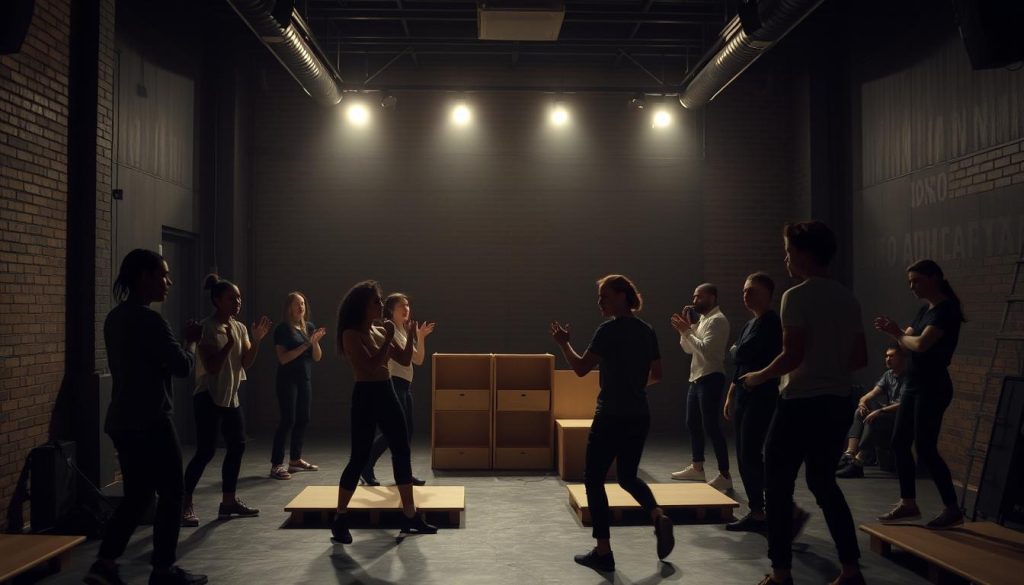
Young Jean Lee’s work challenges the status quo. For new artists, these spaces provide three key benefits:
- Low-stakes innovation: There’s no fear of taking risks
- Audience as co-conspirators: People here enjoy being surprised
- Collaborative speed: You can create quickly, like a fast-paced musical
The numbers show the difference between underground and Broadway:
| Underground Theater | Broadway | Creative ROI | |
|---|---|---|---|
| Average Ticket Price | $15-$25 | $150+ | ★★★★☆ |
| Development Time | 3-6 months | 2-5 years | ★★★★★ |
| Risk Tolerance | “Try anything” | “Proven formulas” | ★☆☆☆☆ |
This isn’t about rejecting tradition—it’s about rewiring expectations. Artists like Lee turn stages into playgrounds, opening doors for the next generation. The real horror is when talent is wasted on safe choices, leaving audiences hungry for more.
Future Directions for Experimental Theater
Imagine when experimental drama meets augmented reality and TikTok’s short, surreal clips. The future of theater might look like a live, glitchy stream. Picture Re-Animator’s puppetry mixed with AI dialogue, or Ionesco’s magic hat trick done with deepfake tech. The wild and unpredictable will become the norm.
Merlin once said, “Horror is where the unmarketable thrive.” This seems true today. As algorithms make creativity predictable, artists are using absurdity to fight back. Could the next big name in theater come from Twitch, not traditional theaters? Viral platforms might support the avant-garde by accident.
Surrealism is now all about TikTok’s filters. People who love fast edits and memes want theater that shocks them. The goal is to make this shock feel planned, not random. We’re talking puppetry and projection mapping, monologues remixed by AI. The stage is a place where rules disappear quickly.
Will we see another Tina Satter or Annie Baker in this hyperlinked world? Maybe. But the real question is: Can experimental theater survive when anyone can create content? When “radical” theater is just another hashtag, what’s next? Get ready for a theater experience like no other with your VR headset.
