

Edgar Allan Poe once said dreams are “the playground of our darkest curiosities”. This idea has been with us for 2,500 years. In 1798, while Americans argued over whiskey taxes, Étienne-Gaspard Robertson amazed Paris with phantasmagoria shows. His lanterns brought to life bleeding nuns and ghosts with butterfly wings, showing even old crowds wanted more than just bread and pamphlets.
But why do we keep seeking the strange? The answer is hidden in history. The Epic of Gilgamesh, our oldest story, tells of a hero fighting dream monsters. Then, in 1929, Buñuel and Dalí made Un Chien Andalou, featuring sliced eyeballs. And in 1976, Federico Fellini created Casanova, with orgies and clockwork octopuses. It seems we’ve always wanted to mix up reality.
Today, we have VR and projection mapping for immersive experiences. But our desire for the extraordinary hasn’t changed. The phantasmagoria didn’t disappear with old lanterns. It just evolved with technology.
Defining Surreal Stage Art
Let’s explore the term phantasmagoria. It sounds like a haunted carousel. It started with 19th-century magic lantern shows. Now, it’s what Marxist critic Walter Benjamin calls capitalism’s visual spectacle.
Think of it as reality’s funhouse mirror. It warps familiar shapes to fit someone else’s story.
Polish director Wojciech Has showed this in The Hourglass Sanatorium. He created dreamscapes with a political edge, so they got censored. In 2024, we’re doing something similar with corporate Zoom backgrounds.
These backgrounds hide empty apartments behind fake bookshelves. They’re imaginative design projects that sell fake realities. Does your IKEA showroom just sell a fake life with meatballs?
Chagall’s floating lovers over Vitebsk show what surreal stage art is about. It’s not about escaping reality but showing its hidden sides through impossible scenes. When dancers defy gravity like our social media, who’s copying whom?
“The phantasmagoria of capitalist culture has the structure of a dream while wide awake.”
Today, we see this tension in modern theater. It uses immersive theater in places like Target stores. Augmented reality turns subway ads into Dali paintings.
The magic is when we can’t tell where the visual spectacle stops and real life starts. Like realizing your CEO’s speech was from a dystopian play.
Highest-Impact Staging Choices
Let’s cut through the dry ice: true innovative staging isn’t about budget size – it’s about using your imagination. Wojciech Has’ 1968 film The Saragossa Manuscript is a great example. He used petroleum jelly and desperation to make train windows seem like psychic portals.
Smearing Vaseline on camera lenses to make memories seem real? That’s not just filmmaking – it’s alchemy.
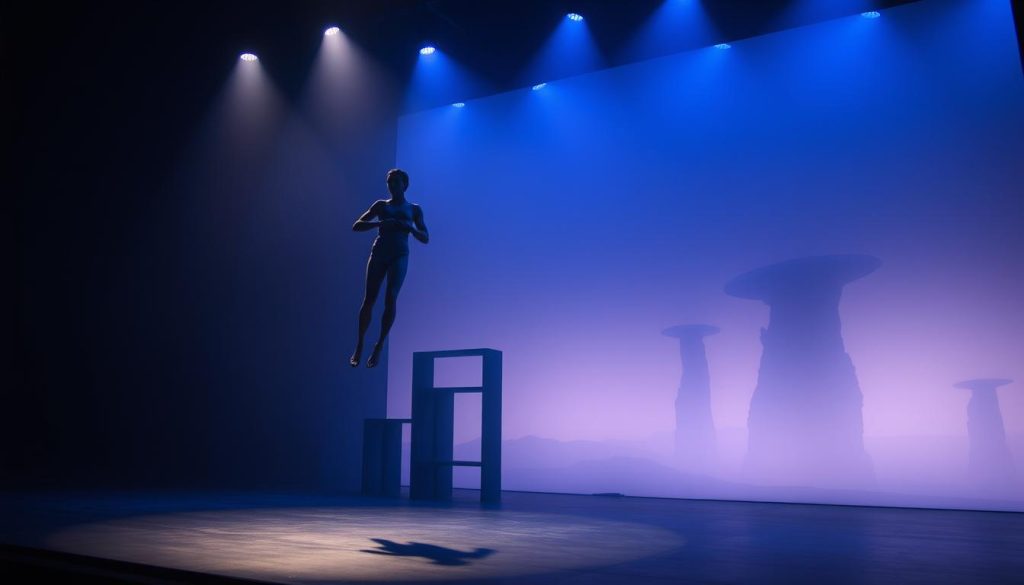
Now, compare that to today’s LED mapping armies. In the 18th century, stagehands used sparrow feathers and candlelight to create ghosts. This was the original visual spectacle.
Today, directors have more pixels than sense. Robertson’s smoke-and-mirror techniques could make a small object seem huge. Lester’s light-only performances show that shadows can be louder than actors.
Let’s break down the evolution:
- 1789: Chicken wire + candle flicker = Hamlet’s father
- 2024: 8K projectors + AI = Digital Dionysus
“Disney’s hologram parade is capitalist phantasmagoria – all sparkle, no soul.”
Here’s my proposal: Try the Phantasmagoria Drinking Game. Take a shot for every Kubrick-esque symmetrical frame. Take two if the director uses actual fog instead of digital mist. Finish your drink when someone quotes Baudrillard during intermission.
The real magic happens when tech serves vision, not vice versa. Those Vaseline smears were cheap but powerful. As the great surrealists knew: Constraints breed genius. Or at least fantastic bar stories.
Iconic Productions and Directors
When corporate trust feels as absurd as Bunuel’s eyeball scene, we’re in surreal theater. The masters of phantasmagoria didn’t just break rules. They created funhouses where reality bends like cheap vinyl in July.
Wojciech Has, a Polish provocateur, turned Bruno Schulz’s stories into psychosexual dream fugues. His Saragossa Manuscript is like a nesting doll of forbidden desires. Every time you think you’ve got the plot, another hallucination pops up. Censors hated it, but audiences couldn’t look away.
Bunuel’s bourgeoisie trilogy is pure surreal theater as social scalpel. His infamous eyeball slice in Un Chien Andalou feels less shocking than today’s HR-mandated “innovation workshops.” At least Bunuel’s violence had artistic intent.
| Surreal Masterpiece | Mainstream Counterpart | Key Contrast | Cultural Impact |
|---|---|---|---|
| Fellini’s Satyricon | Marvel’s Eternals | Organic grotesquerie vs. CGI sludge | 79% Rotten Tomatoes vs. 47% |
| Has’s Saragossa Manuscript | Black Mirror episodes | Dream logic vs. tech parables | Cult following vs. mass consumption |
| The Prisoner (1967) | Corporate team-building | Purposeful absurdity vs. forced camaraderie | Enduring mystery vs. forgotten icebreakers |
Today’s phantasmagoria often wears mouse ears. Marvel’s multiverse shenanigans are surrealism for shareholders. They mix weirdness with merch. Compare that to Kafkaesque moments in The Prisoner where Patrick McGoohan battles sentient bubbles. No post-credit scenes. No action figures. Just pure existential dread.
These directors weaponized discomfort. Fellini didn’t just film decadence—he marinated in it. Has turned censorship into avant-garde fuel. Their work asks: Why settle for reality when delirium’s on the menu? A question modern studios fear to answer.
Blending Visual Art & Performance
When did reality become our co-star in the theater of the absurd? The pandemic brought imaginative design experiments. These include Zoom plays and TikTok choreography that mix physical and digital worlds.
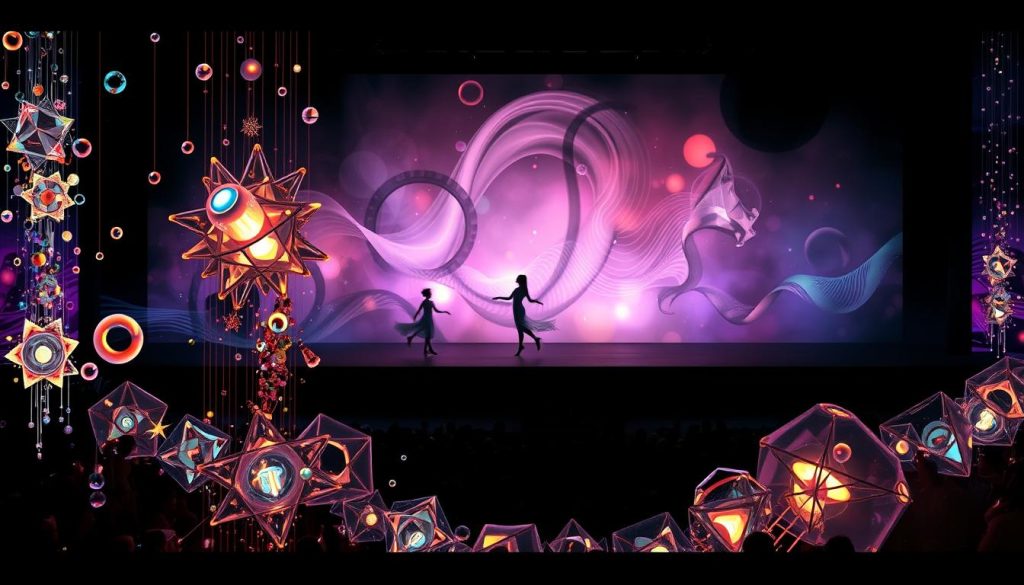
Think of Švankmajer’s Alice, where teacups grow teeth and drawers bleed. During COVID, theater turned to his surreal style. Actors became pixelated puppets in glitchy Brady Bunch grids. This was a new way to use visual spectacle.
But was it an evolution or a surrender? Czech surrealists used real textures. We used frozen screens and accidental cat cameos instead.
Now, let’s look at Peter Brook’s Marat/Sade. It was set in an asylum, where inmates staged a revolution. Their fights felt real, unlike today’s Instagram AR filters. These filters turn users into glitter-covered AI hallucinations.
- TikTok dance challenges as decentralized phantasmagoria
- Zoom theater’s “Brady Bunch” grids mimicking Švankmajer’s chessboard compositions
- AR filters vs. Brook’s visceral actor-audience collisions
Bruno Schulz once said,
“Reality shapes itself to the form of our neglect.”
Our 15-second TikTok surrealism and Zoom meeting Dadaism show what we’ve lost. We’ve lost shared physical space. But we’ve gained something new: democratized strangeness.
Sport/Festival Parallels
When did stadiums become our top art galleries? The Performa 13 festival showed us America loves innovative staging everywhere, not just in theaters. Super Bowl halftime shows and tailgate parties are now our avant-garde art spaces. Imagine Robertson’s ghost parades with drones instead of gaslights, and you get Katy Perry on a mechanical lion, watched by 120 million.
Coachella’s “immersive experiences” are just a start. Neon flower walls and VR sandboxes are small compared to Abrons Arts Center’s light shows. True surreal theater happens in unexpected moments, like when a Roman gladiator show meets TikTok influencers at Caesar’s Palace.
“We’re not selling tickets—we’re staging collective psychosis,” said a Performa director about their laser-grid Colosseum show.
Think of a modern tailgate party as a surreal carnival. It’s filled with grill smoke, beer-can art, and people debating politics in cheese hats. This isn’t just pre-game—it’s surreal theater made of ketchup and propane. When 70,000 fans unite in chant, it’s truly magical.
- Super Bowl LX’s floating cityscape vs. 1820s Parisian magic lantern shows
- Coachella’s corporate “wonderlands” vs. Performa’s destabilizing light mazes
- Gladiator crowds roaring for blood vs. avant-garde audiences gasping at shadow puppets
America’s stadiums are our new places of wonder. Where else can you see Travis Kelce become a Greek chorus while Elon Musk’s tweets light up a Jumbotron? The innovative staging we love isn’t just in theaters. It’s in the chaos of parking lots and the pixelated madness of halftime shows.
Why It Resonates Now
We’re living in a time of great change, where spectacle and substance mix in new ways. Walter Benjamin’s commodity fetishism theory, written when gramophones were new, helps us understand why we spend big on digital art. Just like people used to look at panoramic paintings to escape the city, today we turn to TikTok to forget the stress of online meetings.
NFTs are like the ultimate example of neoliberal phantasmagoria. Just as Robertson’s magic lantern showed ghosts, crypto fans share blockchain dreams on Discord. Both use group magic to create value, one with old lamps, the other with digital fees. The real imaginative design here? It’s making us believe that saving digital images is stealing in a world full of copies.
“The phantasmagoria of capitalist culture achieves its most triumphant expression in the marketplace of attention.”
Our time is filled with conspiracy theories that blend reality and fantasy. QAnon’s stories are like bad theater, with green screens and fake actors. This is different from Bruno Schulz’s puppet shows, which showed the fragility of humans in a poetic way. One spreads chaos with simple tricks, the other finds truth in distortion.
Zuckerberg’s metaverse is another example of this mix. When your VR headset breaks, think: Is this just Robertson’s magic lantern for VC pitch decks? Our desire for wonder hasn’t changed, even with new technology. Today’s challenge is creating digital experiences that feel as real as a campfire, making us look up from our screens.
Audience Takeaways
Leaving a surreal theater show feels like stepping out of a cryptocurrency exchange. Both experiences make you wonder about reality. At Lincoln Center, Wall Street experts held their playbills like they were financial doom. The avant-garde visuals confused their spreadsheet minds. It’s not just a show – it’s a brain reboot.
Director Arlo Lester’s emotional sound design shows we’ve been underestimating our ears. His show used deep bass that made people think there was an earthquake. A hedge fund manager said it was more intense than his 2022 crypto losses.
“A dream you remember is life’s director’s commentary.”
Here’s how to grow from visual spectacle:
- See disorientation as a chance to invest – buy in early
- Use crypto apps and dream journals together (both track different worlds)
- Look at audience gasps like market trends – they show what we all feel
Why is this important today? We’re surrounded by AI sameness but crave real weirdness. People who manage NFTs by day pay big to see shows that mess with their minds at night. It’s not just fun – it’s mental exercise.
Where to Experience It
Surreal theater pops up in unexpected places. Imagine guerrilla shows in old malls, with flickering lights and dead Orange Julians. Or, for those who love the traditional, Lincoln Center now offers more avant-garde shows than ever before.
Vinegar Syndrome brings lost stage experiments to your home in stunning 4K. Their work includes 1970s Polish mime and Tokyo Butoh riots. It’s like a trip without the hangover, paired perfectly with coffee and a dash of existential fear.
The Performa Biennial is the top spot for live surrealism. In 2023, they had a show where actors shed costumes while reading Trump depositions. It’s not your usual dinner theater; it’s a cultural shock with great lighting.
Steer clear of corporate “immersive experiences” with VR and overpriced drinks. True surrealism should unsettle CEOs, not boost their profits. Look for shows that use creativity to challenge, not sell. As Beckett said, try again, but with more lobster phones floating around.
