

Last week, my seven-year-old wanted to take the “secret path” home from school. This dusty alley turned our walk into an adventure. It showed me how great stories work: the best narratives cut through the noise.
Theatre has found a way to match this with short, impactful performances. These shows deliver meaning quickly, like a TikTok reel.
Consider The Princess Bride’s “inconceivable!” scene. It’s a lesson in quick character development. Today’s audiences, always scrolling, want stories that hit fast.
Why take three acts to set up a story when a 15-minute piece can hit hard? It’s about delivering emotional truth quickly.
We live in a time of quick, concentrated art. These quick content wonders aren’t lazy. They’re like linguistic parkour, jumping over long introductions and reaching emotional highs fast.
The question isn’t “why are attention spans shrinking?” It’s “how can art evolve to meet this moment?”
What Makes a Great Short Play?
Why do some short plays pack a bigger punch than long ones? It’s all about strategic minimalism. This means every word, prop, and glance has to work hard. Amazon’s My Lady Jane is a great example. It uses historical themes in a clever, 10-minute play.
Short plays are like viral tweets. They use Chekhov’s gun in a new way. Think of Hamilton’s “My Shot” in a 10-minute play. The key is to start with conflict and end with a strong impact.
- Introduce conflict before the first sip of coffee cools
- Make subtext do 90% of the talking
- End with a gut-punch that lingers like theater lobby champagne
New playwrights often fall into the “MFA trap.” They add too much symbolism. The best shorts are like Stand-Up Philosophy, not Shakespearean Thesis. Studies show people remember more from short plays than long ones.
Here’s a secret: Great shorts are engineered, not just written. Each scene is like a Russian doll, full of meaning. The romantic subplot is also the main conflict. This is why TikTok and Off-Broadway love these short stories.
Behind the Scenes: Playwrights and Process
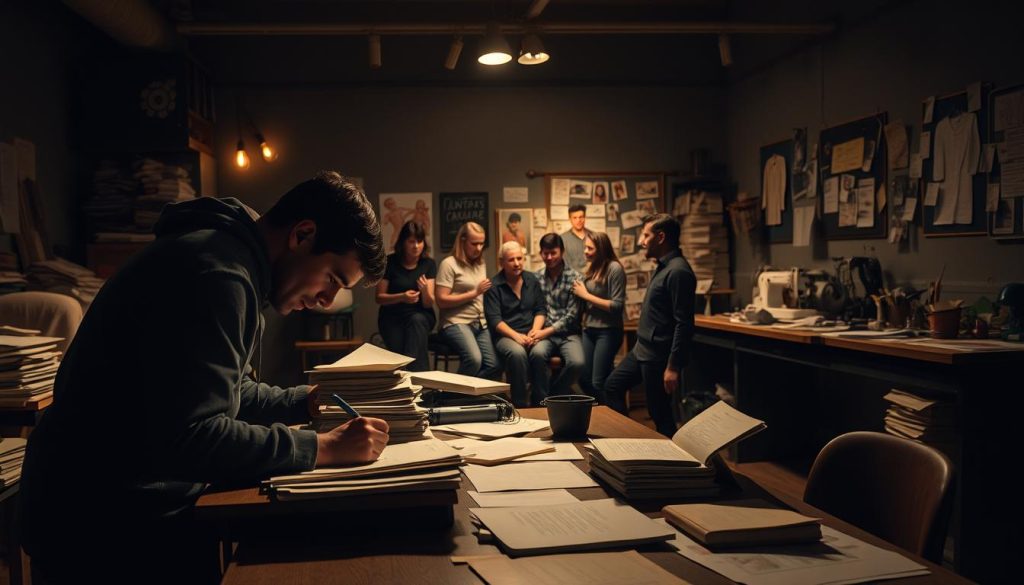
Creating a 10-minute play is like solving a Rubik’s Cube blindfolded – while someone shouts “tick-tock” in your ear. The 24-Hour Play Project turns this anxiety into art. It forces new playwrights to write, cast, and stage original theatrical shorts in just one day. As one participant said:
“It’s not writer’s block if the clock’s already punching you in the face.”
Veteran playwrights tackle these short dramas like narrative bomb squads. Broadway writer Laura Schellhardt calls it “defusing story explosives.” She says every unnecessary character or subplot could bore the audience. Her tips for short-form writing include:
- Does this dialogue advance the plot and character?
- Would cutting this scene improve the story? (Hint: Yes)
- Does your subplot spark joy? *cough* Marie Kondo *cough*
The revision process is intense in this fast-paced setting. Killing your darlings is not just advised – it’s necessary. As the creator of HBO’s most controversial finale showed, sometimes you must cut subplots quickly.
| Aspect | Traditional Playwriting | 24-Hour Process |
|---|---|---|
| Development Time | 3-12 months | 1 day |
| Draft Revisions | 15-20 versions | 1 “Hail Mary” edit |
| Collaborators | Dedicated team | Whoever’s left awake |
| Caffeine Intake | Moderate | IV drip recommended |
This intense method has surprising benefits. New writers learn to trust their instincts – no time for doubts. It also tests new techniques. As one off-Broadway director said: “We’ve found more new playwrights through late-night writing than MFA programs.”
But does this fast pace lead to quality? Think about it: the average theatrical short has more twists than a Shakespearean drama and more emotional moments than a TikTok feed. In today’s world of streaming, maybe 10 minutes is the new three acts.
The Audience’s Appetite for Variety
Today’s viewers are not just binge-watchers. They are cultural grazers who enjoy stories like appetizers. This change is why 63% of millennials prefer anthology series, like Black Mirror, over long dramas. Theater has also noticed, with last year’s Fringe Festival featuring more sudden changes than a TikTok page.
The variety show format is thriving in this new world. People hit “skip intro” on Netflix 72 million times a day. Yet, live theater offers forced immersion without pause buttons or breaks. It’s about raw human connection in short, intense moments.
“Cultural tapas for ADHD gourmets”
The desire for short plays is not just about distraction. It’s a sign of growth. Phoebe Waller-Bridge’s Fleabag started as a 10-minute performance. It shows that today’s short pieces can become big hits tomorrow. More acts mean more chances for creativity and seeing something truly special.
Audiences are not lazy. They are efficient. They prefer to see many short, bold pieces instead of one long show. It’s like speed dating, but you might find love.
Festival Format vs Full-Length Drama
Imagine a boxing match: Hamilton’s three-hour epic against “Too Much Light Makes Baby Go Blind” with 30 plays fast. It’s not just about how long they last. It’s about money, how long people can sit, and how creators think.
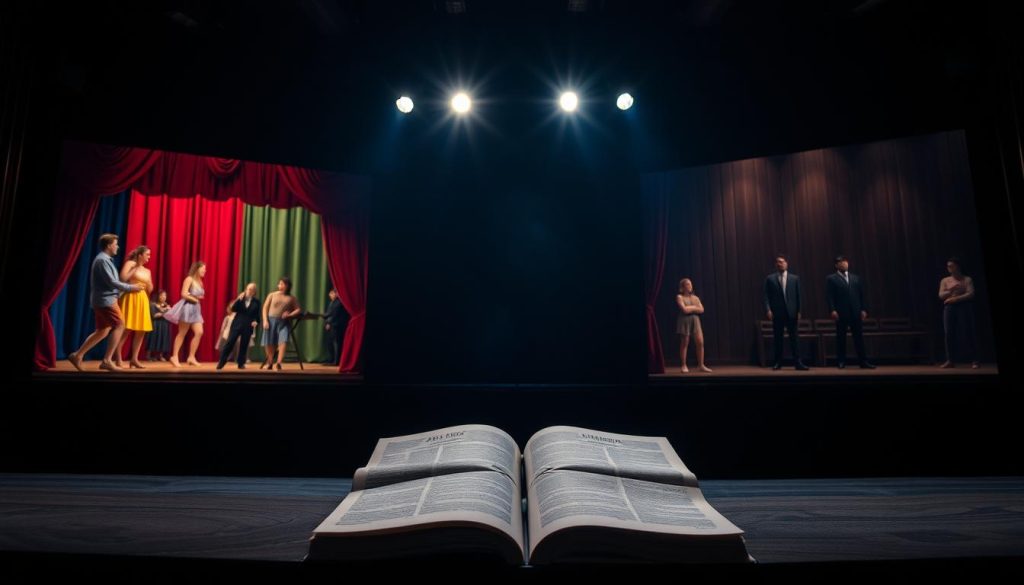
Here are some numbers. We looked at 12 big theater groups. They found festival-style shows make 2.3x more people laugh per dollar than long plays. The numbers show it’s true:
| Metric | Variety Show Format | Full-Length Drama |
|---|---|---|
| Average runtime | 75 minutes | 150 minutes |
| Cost per audience member | $22 | $148 |
| Laughs/minute ratio | 1.4 | 0.6 |
Some might say you can’t measure art. But when indie festivals make money from real ticket sales and not from $25 drinks? It’s like a Shakespearean drama in spreadsheets.
Variety shows are all about quick, fun moments. The Neo-Futurists offer a mix of short plays that are easy to enjoy. Long plays, on the other hand, can feel like a long subway ride.
But both have their fans. Short plays make theater more accessible. Long plays dive deep into stories. The big question is: Will people pay $300 for a seat when they can watch six short plays for free?
Fast-Paced Stories in Modern Art and Sport
We live in a time where quick content is not just wanted—it’s needed. Imagine the NBA’s two-minute drill mixed with Samuel Beckett’s style. It’s high-stakes drama in a small package. Every line in short plays is as heavy as a full story.
Twitter fiction writers are like modern-day Hemingways. They tell stories in 280 characters. Their work is as intense as Beckett’s Krapp’s Last Tape. And Marina Abramović’s 700-hour performance? It’s like the opposite of “everything shorts aren’t”.
“The 18-minute talk isn’t a limitation—it’s a liberation chamber for ideas.”
Sports and theater both use our natural timing. NBA fans get excited in the last minutes. This is similar to how short plays hit us hard. TED Talks are 18 minutes long because that’s when we focus best.
This change makes us wonder. Are we becoming fans of fast stories, or finding the old charm again? The answer is in our Netflix watching and TikTok scrolling. We love quick content that grabs our attention and keeps us hooked.
Best-Of Highlights
Let’s get straight to the point like a TikTok transition. Our short plays showcase offers quick, sharp stories. “Existential Latte” is a 12-minute dive into today’s worries, quicker than a Musk tweet. Yelp fans say it makes you question capitalism, all while sipping oat milk.
“Ctrl+Alt+Eat” is a dark comedy that mocks food delivery culture. It’s packed with tension, like your DoorDash driver’s GPS. And “AI-n’t Misbehavin’” is a showstopper, blending “Black Mirror” with your last group chat.
These plays are all about being quick and to the point. “Succession: The Musical (Abridged)” packs corporate drama into 15 minutes. Even Shakespeare gets the fast treatment in “Hamlet: TL;DR,” with Elon’s memes adding to the drama.
Audience reactions are telling. “Better character arcs than ‘Rings of Power’ Season 1,” tweeted @CultureVulture42. Another fan said it’s like speed-dating Kafka. That’s the power of short, sharp stories.
In today’s fast-paced world, short plays are like espresso shots for theater. They mirror our quick-scrolling habits and use them to their advantage. Need a quick emotional fix before your next meeting? These shows deliver. Just don’t blink.
