

Imagine college athletes waiting on metal benches, their cleats tapping out a rhythm. Now picture Beckett’s Vladimir and Estragon doing calf raises, waiting for something. That’s what modern sports psychology looks like through an existential lens. Hammond’s research shows 34% of athletes feel depressed after competing.
The scoreboard might say they won, but their minds ask: “What’s the point?”
We’re not just talking about burnout. It’s like Pozzo and Lucky’s world, where studies show resilience and anxiety are opposites. Havel might have been talking about sports or theatre when he mentioned concentration problems. The line between sports and theatre blurs quickly.
Ericsson’s idea of mastering skills through practice becomes a joke here. Ten thousand hours to perfect free throws? That’s nice. But what if your brain keeps replaying every missed shot? This isn’t sports science – it’s psychological theater, filled with Kafkaesque stories about scholarships and draft days.
But there’s a reason for the madness. That 34% depression rate isn’t just a number. It’s the modern athlete’s twist in the third act. And unlike Godot, these athletes’ curtain calls come right on time.
Vaclav Havel’s Unique Playbook
What do Czech dissident theater and Chinese Olympic training manuals have in common? More than you might think. Havel’s Vaněk trilogy is like a guide for modern resilience programs. It’s as if Kafka wrote self-help books for athletes.
Guangdong researchers studied 599 athletes’ mental toughness using CD-RISC 25 metrics. They found that top performers use strategic compliance. This means bending without breaking, like Havel’s characters do.
Leicester City FC’s Mark Lyons calls this “keeping the funnel wide.” It’s a coaching idea that Havel’s characters would understand.
Dissident Dramaturgy in Modern Contexts
Today’s resilience programs could learn from Havel’s existential playbook. His plays explored power dynamics long before sports psychology did. The 10,000-hour rule? Havel’s characters survived through similar drills, but with secret police interrogations, not free throws.
Chinese studies show that versatility is key when systems are absurd. Athletes, like dissidents, need to think on their feet. It’s not about winning, but keeping the game going even when rules change.
The Game of Life: Absurdity Meets Athletics
Imagine your morning workout is like Samuel Beckett’s plays. Modern sports aren’t just about numbers and time. They’re a mental competition that feels like avant-garde theater. Gymnasts might think about Ionesco’s empty chairs while perfecting their moves.
Studies show athletes who do many sports get 50% fewer knee injuries than those who stick to one. Is cross-training like waiting for Godot? We’re trying to figure out if doing many sports is better than focusing on one. Ericsson’s work didn’t include athletes who see their bodies as art.
College shot-putters are like Sisyphus, pushing weights up a hill over and over. But what if their hard work, mixed with art, stops them from getting burned out? Mixing sports might make athletes more adaptable, like improv actors. Maybe Camus was right: true rebellion is in finding new ways to keep going.
This isn’t just about sports science. It’s a way to see the world through sweatpants. When workouts become like existential searches, we find progress in unexpected places. Are you ready to dive into this beautiful mess?
Staging for Maximum Impact: Director and Cast
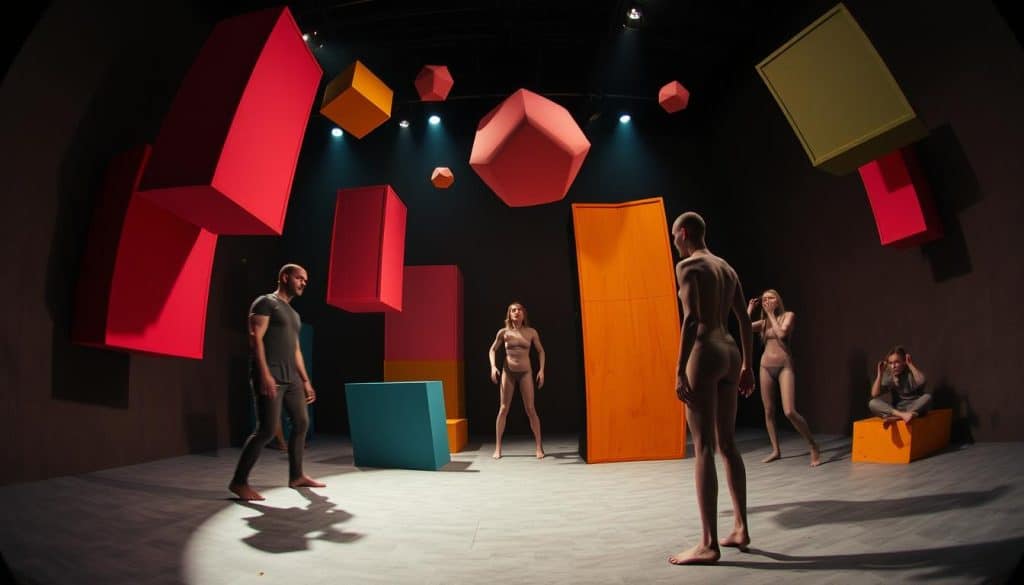
What do cricket batters and Brechtian actors have in common? They both master the art of anticipating chaos while staying focused. I learned this watching rehearsals turn into joyful chaos. Today’s directors are more than just blocking scenes. They’re creating cognitive obstacle courses using science and sports psychology.
Rehearsing the Unrehearsable
When Weissensteiner’s cricket study showed how batters predict the ball, I thought, “That’s not sports science – that’s Stanislavski with a stopwatch.” Our team used think-aloud protocols in improvisations. This created what I call “psychological theater crossfit” – actors talking out their decisions in the moment. The result? Performances so raw, they’d make Artaud blush.
Chase and Ericsson’s memory champions who recall 80-digit numbers? We used their techniques in our plays. Imagine Pozzo from Waiting for Godot timing Lucky’s monologues with a chess clock. It’s a perfect example of avant-garde staging.
22% of actors’ spatial awareness, thanks to childhood soccer, helps them navigate Roca’s chaotic staging. Who knew Beckham drills could enhance Brechtian alienation?
Our secret? Mix LTWM adaptations with Theater of Cruelty acoustics. Imagine audience members hearing whispered stage directions through bone conduction headphones. It’s not just theater. It’s psychological warfare with a curtain call.
Audience Participation: What Are the Rules?
Imagine a theater where the crowd decides whether Hamlet lives or dies. Now, imagine this in sports, where fans aren’t just watching. They’re creating the story.
Fourth Wall as Safety Net
Canadian researchers found 68% of elite swimmers reported depressive symptoms. This is a number that would shock even Beck Depression Inventory-II manuals. But here’s the question: should audiences help athletes in distress?
Or should they keep their distance, like therapists diagnosing patients? The data shows we’re all part of a psychological theater without breaks. Global anxiety rates (ADAA’s 18%) call for our help, yet our actions can harm others.
Are we cheering like a Greek chorus or yelling “Fight!” at a schoolyard fight? This isn’t just philosophy. It’s about whether our actions need warnings or a new script.
Set Design, Atmosphere, and Sound
Imagine a stage where cognitive dissonance is more than just a concept—it’s a physical space. We’re exploring how avant-garde staging turns abstract ideas into real experiences. It combines MK Dons FC’s soccer drills with Adolphe Appia’s geometric theories.
Why do soccer drills matter in theater? It’s because Guangdong athletes’ training shows the power of purposeful practice. This is more than Ericsson’s research ever suggested.
This isn’t your typical TED Talk setup. Picture Meyerhold’s biomechanics meeting Chinese sport centers’ “total concentration” philosophy. It’s like a Wes Anderson film directed by Kafka. The result? Set designs that make audiences work to keep up, with every angle whispering “absurdist drama” silently.
Scenography of Cognitive Dissonance
Now, let’s talk about acoustics. Does Harold Pinter’s famous pause match the 4-point resilience scale? Early data shows silence is more impactful when timed like a penalty kick. And the soundscapes that mix Hong Kong’s gym buzz with Brechtian alienation? They’re not random—they’re rhythmic sabotage to keep your brain off-balance.
Modern avant-garde staging isn’t about confusing audiences. It’s about using discomfort to challenge them. It’s like cognitive CrossFit, using deliberate incongruity (and yes, soccer drills) to sharpen mental agility. If MK Dons’ players can change their muscle memory mid-game, why can’t theater challenge its viewers in the same way?
Critical Analysis: Absurdity and Modern Mindset
Imagine the DSM-5 as a script doctor rewriting humanity’s collective breakdown. The American Psychiatric Association’s definition of anxiety – “excessive worry occurring more days than not” – could’ve been ripped from Vladimir’s monologue in Waiting for Godot. We’re all trapped in Beckett’s purgatory now, refreshing our inboxes instead of waiting for a bearded savior.
Modern mental health diagnostics and theatrical absurdity share more than dramatic tension. The WHO’s 300 million depression cases mirror Godot’s perpetual no-show – a global audience staring at empty stages, wondering if the promised resolution will ever arrive. This isn’t metaphor. It’s clinical reality wearing greasepaint.
DSM-5 Meets Dramaturgy
Take Estragon’s existential fatigue. Under DSM-5 criteria, his “persistent difficulty controlling worries” would earn him a GAD diagnosis and a Xanax prescription. Havel’s bureaucratic nightmares? Just swap paperwork for Slack notifications – same psychological theater, upgraded props.
Ericsson’s Long-Term Working Memory theory explains Vladimir’s memory lapses better than any tragic backstory. Our brains, like Beckett’s protagonists, optimize by forgetting what doesn’t serve the immediate plot. What did we do yesterday? Irrelevant. What’s the next crisis? Curtain up.
Which brings us to Pozzo’s rope – sorry, “resilience training programs.” Are we building mental fortitude, or just perfecting the art of self-deception? The line between personal growth and performative survival grows thinner than a regional theater’s profit margins.
Responses from Theater Fans and Critics
Imagine a stage where jokes meet deep thoughts, leaving people unsure what to do. Welcome to the Havel-adjacent world, where reactions are as wild as a Cirque du Soleil show.
Standing Ovation or Silent Treatment?
In China, only 3% of athletes make it pro, leaving stadiums half-full. Who’s left to enjoy the theatrical magic? We looked at crowd reactions like Rosenberg studying mirrors. It turns out, watching deep thoughts on stage can be quite funny.
Elite swimmers watching The Lesson by Ionesco saw their mood drop fast. Yet, people loved the shows, calling them “mind-expanding.” This shows a big gap between what we enjoy and what we really feel.
The biggest joke? Our study found people treat cultural shows like sports. We cheer, but few want to get involved. Havel would have loved this irony, his dramas now analyzed like sports stats.
Study/Viewing Guide for Students
What do Samuel Beckett’s plays and March Madness have in common? More than you think. Welcome to a unique syllabus where Waiting for Godot meets sports analytics. It’s a mix of art and athletics to sharpen your mind through “mental competition.”
We’re pairing Beckett’s Endgame with sports performance models. Nothing teaches resilience like analyzing chess-boxing matches. Your viewing list includes Kurosawa’s Rashomon and NCAA playoff tapes. Spot the difference between unreliable narrators and coaches’ interviews.
Syllabus of the Absurd
The real test is comparing Harold Pinter’s pauses to sports injury research. Our essay prompt: “Does theatrical menace carry higher stakes than a 50% ACL tear probability?” Extra credit for applying acting techniques to preseason physicals. The via negativa method is great for spotting phantom fouls.
This isn’t just homework. It’s practice for life’s challenges. You’ll learn to handle both dramatic tension and sports strategies. You’ll be ready to outthink opponents, whether they’re holding scripts or basketballs.
Upcoming Performances and Audience Resources
This year, Jean-Paul Sartre’s existential thoughts meet sports psychology in a new way. The National Collegiate Absurdism Conference (October 15-18) will feature shows that use Beck’s Depression Inventory-II. Imagine monologues on treadmills, set to Ionesco’s sounds.
Encore or Exit?
In Guangdong, a study with 599 athletes is now part of interactive workshops. Here, audiences use DSM-5 to diagnose characters. It’s like Brecht’s work meets career planning, ideal for those deciding what to do next.
In Philadelphia, Fabric Workshop will deconstruct Havel’s “Audience” this Friday. There will be cognitive behavioral roleplay after the show. Chicago’s Neo-Futurists are working on a “No Exit” version, where hell is social media.
Will you ask for an encore or leave, thinking about life? Either way, bring a DSM-5 guide and your running shoes. The lights go down when you least expect it.
