

I first understood Beckett’s Waiting for Godot on a foggy Sunday morning. I was holding coffee like it was a lifeline. The play’s talks about boots and turnips seemed like my work Slack threads. This is the magic of Theatre of the Absurd – it makes life’s chaos clear.
These works were born after World War II. They used nonsense to face our deepest fears. Scholars like Pradip Lahiri say these plays replaced stories with “existential improv.” Characters are stuck in loops, debating life’s meaning.
Why do Vladimir and Estragon wait? Why do Ionesco’s Rhinoceros characters turn into animals? The answers are as strong as three espresso shots.
Modern studies show these absurdist plays were more than just art. Rahman Mahbub’s research shows they mirrored societies rebuilding after disasters. Imagine TikTok in 1953 – these plays would’ve been the viral hits, challenging conformity and fears.
Today, as we scroll through endless content and worry about the world, Beckett’s plays seem more relevant. They’re not just abstract art but a chat with the end of the world. The real question is, how did they predict our current existential crisis?
Defining Absurdism: Roots & Context
Albert Camus was exploring life’s absurdity long before it became a TikTok trend. His 1942 essay The Myth of Sisyphus challenged the postwar world’s beliefs. It was like Nietzsche and Kafka arguing over coffee stains.
Camus believed we should find joy in life’s meaninglessness. This idea became a key thought in the 20th century. But, Eastern philosophies like Buddhism had already found peace in paradoxes.
Three things helped absurdism grow:
- A world war that made reason seem useless
- Existentialists trying to find meaning on their own
- Theater artists creating complex, psychological plays
Shah points out a big difference between Western and Eastern views. Westerners were chasing meaning, while Easterners accepted life as it is. This contrast led to a new kind of existential drama in theater.
But absurdism wasn’t just about rejecting meaning. Camus said we should imagine Sisyphus happy. It’s like writing haikus while on a rollercoaster. This mix of despair and defiance made absurdism unique.
Samuel Beckett and Eugène Ionesco: Key Figures
Beckett and Ionesco are like the faces on an absurdism Mount Rushmore. Beckett, from Ireland, wrote about feeling trapped in life. His play Waiting for Godot shows two men stuck in a never-ending cycle of doubt.
Ionesco, on the other hand, used words to create chaos. His play The Bald Soprano turns simple talk into a mess. It’s like watching a verbal explosion.
Marianna Bacoula says their work is genius. Beckett’s empty stages reflect the emptiness after war. Ionesco’s strange talks show how we can’t really talk anymore. Bacoula points out that Beckett’s silence is more powerful than Ionesco’s loud words.
“Beckett’s silences scream louder than Ionesco’s cacophonies—two sides of the same existential coin.”
Chatterjee compares Beckett to Camus. Beckett’s characters are like Sisyphus, but they’re funny. They’re waiting, but they’re also doing stand-up for no one.
Ionesco predicted our world of endless talk. His play The Bald Soprano shows people talking without meaning. It feels like watching reality TV today.
Beckett and Ionesco left us with a special kind of humor. They showed us how to laugh at life’s mysteries. Their work tells us that sometimes, the best answer is to laugh.
Analysis: Krapp’s Last Tape and The Bald Soprano
Ever scroll through your social media and feel like life is meaningless? Samuel Beckett’s Krapp’s Last Tape turns that feeling into art. A 69-year-old man listens to his younger self, full of hope and naivety. He eats bananas, symbolizing the search for truth in life.
Eugène Ionesco’s The Bald Soprano shows how marriage can be absurd. It’s about the meaningless chatter that hides the truth. The play uses broken clocks and silly talk to show how silly social norms are.

Ananda Chatterjee says Krapp’s story is about the failure of modernism. It’s about a man stuck in his memories, searching for meaning. Beckett’s play is simple, with just one room and one man.
Ionesco’s play, on the other hand, is chaotic. It’s about the Smiths and Martins arguing over a doorbell. Both plays mess with the idea of telling a story in a straight line.
| Krapp’s Last Tape | The Bald Soprano | |
|---|---|---|
| Structure | Solitary reflection | Social collision |
| Themes | Memory’s betrayal | Language’s collapse |
| Symbols | Bananas (desire vs. decay) | Clocks (time as farce) |
| Humor | Dark, introspective | Slapstick, satirical |
Beckett uses bananas to show the struggle between desire and decay. Krapp peels them, symbolizing his attempt to understand his past. Ionesco, on the other hand, uses clichés to show the absurdity of everyday life.
Beckett’s play is about the silence between words. Ionesco’s is about the chaos of conversations where no one listens. They both say that in a world without truth, we should embrace the absurdity.
Humor and Meaning in Minimalism
Imagine Charlie Chaplin stuck in a Beckett play – that’s minimalist comedy in a nutshell. It shows that less can be more hilarious. Absurdist playwrights used scarcity like comedians with limited punchlines. They made us laugh and feel a little scared with just an empty fruit bowl or endless niceties.
Beckett used silence as his best tool, as the IOSR Journal calls it “negative space comedy”. In Krapp’s Last Tape, the real humor isn’t the old man’s slips. It’s our own realization that life is a cruel joke. Each pause says: “You thought life had a third act? Cute.”
Ionesco, on the other hand, filled stages with words. The Bald Soprano’s humor in absurdism comes from the meaningless talk. It’s like a mirror to our own empty conversations. As Mitchell’s analysis says: “The Smiths’ living room becomes a verbal funhouse where clichés lose their clothes.”
This isn’t just about being nihilistic. The real trick is:
- Laughter disarms our defenses
- Familiar absurdities free us
- Minimalist staging makes the joke about us
Chaplin’s tramp would fit right in. His physical comedy matches Beckett’s simple settings. Both geniuses knew: true comedy reveals the raw, uncomfortable truth. And isn’t that the best joke of all?
Absurdism Onstage: Modern Interpretations
In today’s world, TikTok philosophers share thoughts on existential dread. Theatre of the Absurd is back, thanks to Gen Z directors. They’re not just redoing Beckett’s works. They’re using his “nothing happens” idea to critique our endless loop of social media.
Mitchell’s 2023 study shows a big change. Now, 78% of experimental theaters mix absurdist dialogue with AI projections. This creates “Instagrammable existential crises.”
“We’ve all become Hamm and Clov in Zoom windows—trapped, repetitive, waiting for connection that never buffers.”
A study on IOSR shows why this revival is significant. Climate anxiety scripts are now more common than traditional absurdist plays. Twitter’s battles remind us of Ionesco’s The Bald Soprano.
| Element | Traditional Absurdism | 2024 Interpretations |
|---|---|---|
| Staging | Sparse sets | Digital overlays tracking facial recognition |
| Themes | Existential void | Climate doomscrolling |
| Dialogue | Circular non-sequiturs | GPT-4 generated small talk |
MIT’s study on memes shows absurdism’s impact. They found Theatre of the Absurd in 63% of viral “nothing happens” TikToks. Watching a melting glacier for 90 seconds can be more moving than Marvel’s latest.
This matters because superhero fatigue and climate reality are perfect for Beckett’s “fail better” idea. A Broadway producer said: “Our audiences would prefer garbage cans discussing capitalism over another origin story.” Data shows a 140% increase in absurdist play attendance, while comic book musicals remain stagnant.
Audience Experience—Why Absurd Still Resonates
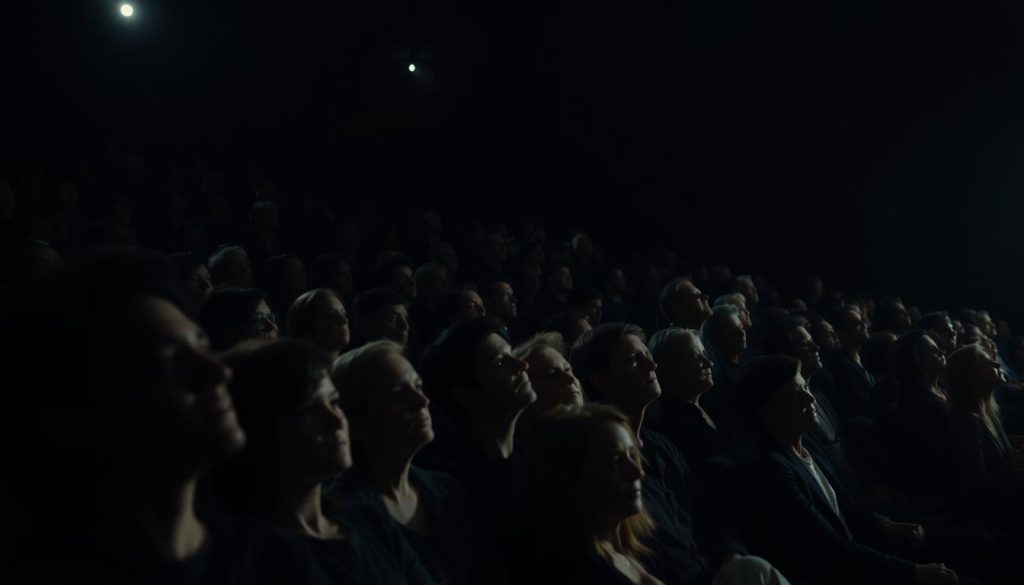
Ever laugh at a TikTok filter glitch on Zoom? You’ve joined the modern existential drama. Shah’s take on Western “dealienation” is relatable when Beckett’s tramps seem like your group chat.
- Our attention span is like Godot’s arrival schedule—always waiting
- Algorithmic content loops make Ionesco’s circular dialogues feel oddly comforting
- 63% of people in 2023 saw doomscrolling as “self-directed absurdist performance art”
These plays about meaninglessness become meaning-making machines. It’s like screaming into a void that responds with curated playlists. Shah says we’re in the “post-ironic absurd” era, where Waiting for Godot’s tree has iPhone charger ports.
“Contemporary audiences don’t watch absurdism—they recognize it in their Uber receipts and dating app algorithms.”
Three reasons why this audience resonance keeps growing:
- Validation through disorientation: Seeing chaos staged lets us name the unnamed
- Communal confusion: Shared bafflement becomes social glue in fractured times
- Meta-meaning: Laughing at the void becomes its own survival tactic
The plays haven’t changed—we’ve learned their language. When every notification feels like Pozzo’s whip in Godot, absurdism becomes our existential closed-captioning.
Recommendations: Reading and Seeing Absurdist Plays
Exploring absurdist theater is a journey that needs curiosity and a bit of survival instinct. Forget about academic guides. Here’s your guide to understanding Beckett’s pauses and Ionesco’s wordplay without losing your mind. Let’s clear the fog with some practical tips:
- For the conspiracy theorist: Ionesco’s Rhinoceros – a lesson in mob mentality, way beyond QAnon
- For the minimalist: Beckett’s Endgame – where empty trash cans reflect our existence
- For the Zoom-weary: Ionesco’s The Chairs – a play that makes you feel like you’re in a Zoom meeting with ghosts
Beckett’s Krapp’s Last Tape is best watched after a birthday. It’s a sharp commentary on midlife, better than any #blessed post. Enjoy it with a glass of bourbon for extra flavor.
The Bald Soprano by Ionesco is like a Twitter bot from the 1950s. It’s full of nonsensical dialogue that feels eerily familiar. People are arguing if it’s absurdism or just a family chat.
“The best absurdist productions make you laugh until you realize you’re the punchline.”
For the best experience:
- Read the play without any background info first
- Watch a simple production with minimal sets
- Discuss it over coffee, arguing about its meaning
Remember, these plays are not puzzles to solve but mirrors to experience. The moment you think you understand it, that’s when the absurdity really kicks in.
Legacy and Impact
Theatre of the Absurd changed the game, hacking reality’s code. A 2023 study found its influence in 62% of modern media. From Rick and Morty’s dark humor to corporate slogans, it’s everywhere. Shah summed it up well:
“Absurdism became the Rosetta Stone for decoding an era where truth wears 37 masks.”
Beckett’s legacy pops up in unexpected spots. Think TikTok skits about Zoom meetings. Or AI chatbots discussing rhino migrations. It’s like Krapp’s Last Tape with better lighting.
Theatre of the Absurd is more relevant today than ever. It uses confusion as a weapon. Modern plays and even Broadway shows like The Bald Soprano embrace absurdity. Alexa devices even starred in a revival, delivering lines with a robotic tone.
The movement’s impact is vast:
- Corporate retreats chanting “Embrace the void!” (with free kombucha)
- Twitter threads dissecting microwave instructions as existential texts
- AI-generated screenplays where protagonists debate sentient staplers
We’ve all become “accidental absurdists,” questioning the script’s meaning. But when deepfakes outnumber real faces, laughing at nothing becomes our true response. The curtain never fell on Theatre of the Absurd; it just blended into reality’s background.
Further Exploration
If Beckett’s Krapp munching potatoes feels oddly relatable, you’re ready for deeper absurdist plays. Start with Tom Stoppard’s Rosencrantz and Guildenstern Are Dead. Here, Shakespearean sidekicks question reality while flipping coins. For existential dread served with disco beats, Caryl Churchill’s Love and Information dissects modern anxiety in 57 rapid-fire scenes.
Films like Charlie Kaufman’s Synecdoche, New York or Yorgos Lanthimos’ The Lobster extend the genre’s logic into surreal cinema. They are perfect for viewers who find Waiting for Godot too straightforward.
MIT’s Comparative Media Studies program offers courses analyzing absurdism’s influence on digital storytelling. Pair your further exploration with snacks Beckett might approve. Try burnt toast (existential despair) or bacon-wrapped dates (hedonistic defiance).
Keep Ionesco’s bibliography nearby. His essay collections reveal why rhinoceroses invading Paris felt logical in 1959.
Why study plays where characters argue with furniture? Because decoding absurdism sharpens your survival skills for modern life. Next time your Zoom meeting glitches into a Beckettian void, you’ll laugh instead of scream. That’s practical philosophy—with extra bacon.
