

Imagine a world where courtroom dramas are as exciting as the Super Bowl. That’s what The Wasps, a 422 BCE comedy by Aristophanes, brings to life. It turns legal battles into a spectator sport, much like today’s sports events.
Meet Philocleon, the ultimate fan. He’s obsessed with jury duty, not sports. He wears wasp costumes and leads chants against politicians, much like soccer fans today.
The play is full of sharp satire. Aristophanes mocks leaders like Cleon, who made courts political playgrounds. A scene where a dog is tried for stealing cheese is more than just funny. It’s a commentary on a justice system that entertains more than it serves justice.
What makes this ancient play feel so modern? Team spirit. The play’s energy is similar to today’s culture wars. Whether we’re debating in theaters or online, our passion and loyalty are just as strong.
Aristophanes: The Coach of Political Satire
Jon Stewart, Saturday Night Live, and a 2,400-year-old playwright share a common trait. They all loved to poke fun at those in power. But Aristophanes did it in a way that’s both timeless and unique.
Imagine the courthouse as WWE SmackDown. That’s what Aristophanes did in The Wasps. He turned legal battles into a show. He made real-life politician Cleon the main target of his jokes.
Aristophanes had a few tricks up his sleeve:
| Satire Technique | Ancient Execution | Modern Equivalent |
|---|---|---|
| Caricature Warfare | Portraying Cleon as a barking dog | SNL’s political impressions |
| Absurdist Framing | Lawsuits as addictive games | John Oliver’s metaphor-heavy segments |
| Audience Participation | Breaking the fourth wall | Trevor Noah’s crowd work |
Aristophanes knew when to strike. He performed his plays during the Lenaea festival. It was like a Super Bowl for democracy criticism.
Today’s comedians could learn from his approach. Aristophanes didn’t just tell jokes. He used humor to teach important lessons about power and responsibility.
Plot, Players, and Public Arena: The Wasps in Performance
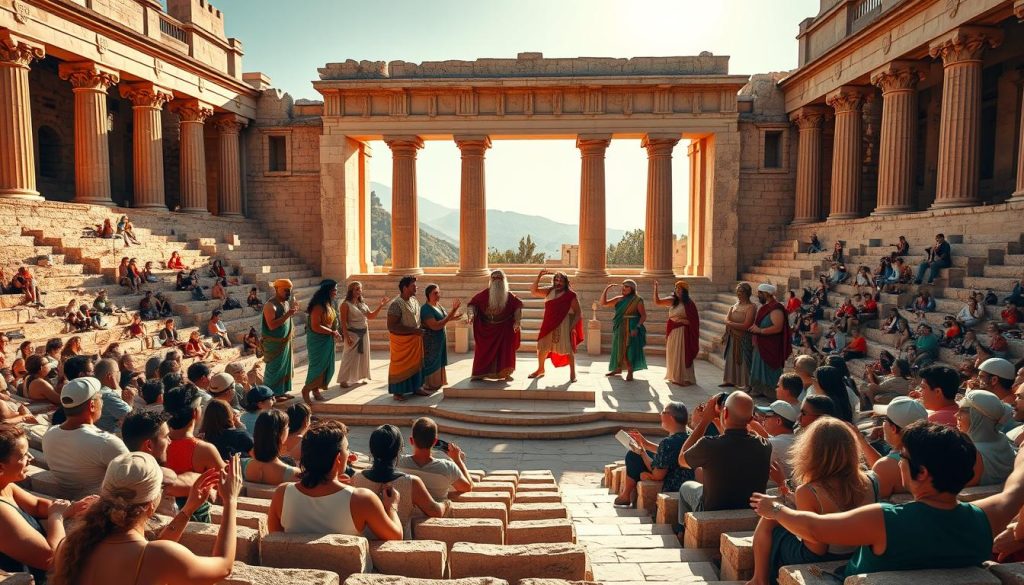
Imagine a legal drama where courtroom antics meet slapstick comedy. That’s The Wasps in action. Aristophanes turns Athenian law into a show, full of over-the-top lawsuits and silly verdicts.
Stinging Social Commentary: The Mock Trial Breakdown
The play’s famous dog trial scene is like a 5th-century BCE TikTok trend. It’s viral, silly, and spot-on. When Philocleon judges a case about stolen cheese, Aristophanes shows how silly law can be.
Today’s reality court shows have roots in these scenes. The playwright uses laughter to show how courts often focus on show, not justice. Bdelycleon tries to stop his dad’s addiction to court, like today’s debates on media.
Chorus as Hive Mind: Collective Madness in Action
The 24-member chorus of elderly jurors is like a groupthink gone wild. They wear wasp costumes and show the power of:
- Mob mentality’s addictive buzz
- Political polarization’s sting
- Society’s craving for conflict-as-entertainment
Their synchronized actions and chants are like ancient protests. They defend their right to unfair verdicts, showing the power of choruses in comedy. Aristophanes shows that choruses aren’t just singers – they’re society’s id in comedy.
This theatrical device feels modern, like today’s social media. The chorus’s madness is like our outrage cycles. Their show is a mirror to us then and now.
Ancient Games: Athletics and Satirical Competitions
Before stadiums were filled with cheers for touchdowns, Athenian crowds cheered for comedy. These events mixed the strength of Olympic wrestling with quick thinking. It was like Hamilton meets WWE SmackDown, but with metaphorical body slams and laurel leaf belts.
Lenaea Festival: Where Comedy Meets Competitive Spirit
Every January, Athens became a comedy battle arena like Comedy Central’s roast battles. Playwrights competed for votes, like presidential candidates. Five comedies went head-to-head, with citizens voting using clay tablets.
- State-funded production costs (the original “creator fund”)
- A civic crown symbolizing cultural dominance
- Bragging rights that could sway political alliances
Choruses trained hard, perfecting dance routines that would make Broadway ensembles work hard. The best jokes were like precision airstrikes, critiquing generals and politicians. Aristophanes’ The Wasps premiered here, changing public views on Athens’ legal system.
Modern parallels? Imagine John Oliver’s writers room training with the New York Knicks. The festival showed that mixing physical and witty performances could sway voters long before attack ads. Civic engagement was scored like gymnastics, with extra points for clever jabs without exile.
Reimagining Greek Comedy for a Modern Audience
Two thousand years haven’t dulled Aristophanes’ edge – we’ve just swapped amphitheaters for algorithms. The real magic of theater adaptation lies in its chameleon-like ability to morph ancient jokes into viral moments. It turns out that a play about obsessive jurors and talking dogs stays relevant by becoming whatever each generation needs it to be.

From Orchestra to Streaming: Adapting Ancient Roasts
Shakespeare understood the assignment centuries ago. His Fool in King Lear channels Philocleon’s chaotic energy, turning royal critique into tragicomic performance art. Fast-forward to HBO’s Veep, where Selina Meyer’s political maneuvers make Cleon look like an amateur. Today, TikTok skits distill social commentary into 15-second bursts.
Modern productions are flipping The Wasps’ DNA like genetic engineers:
- The jury system becomes a Twitter mob dissecting celebrity scandals
- Philocleon’s obsession transforms into Reddit moderators policing niche forums
- Courtroom debates play out as viral Zoom trial reactions
| Ancient Element | Modern Parallel | Platform | Audience Reach |
|---|---|---|---|
| Chorus | TikTok duet chains | Social media | 2.3M views avg. |
| Public debates | Twitch political streams | Live streaming | 18-34 demographic |
| Masked actors | Verified parody accounts | Twitter/X | Virality within 2 hrs |
The British Museum’s latest exhibition on Greek comedy includes an interactive installation where visitors rewrite The Wasps’ ending via AI prompts. It’s not just preservation – it’s cultural remixing. When a 2023 Off-Broadway production turned the dog trial into a crypto scandal parody, critics called it “theater adaptation meets Succession.”
Here’s the twist: ancient satire works better in our content-saturated world. Viral outrage cycles? That’s just decentralized choruses roasting leaders in real-time. The algorithms favor conflict – Aristophanes would’ve dominated engagement metrics.
Sportsmanship, Spectatorship, and Social Commentary
Imagine if fantasy football drafts decided tax policies. That’s how Athenian democracy worked. It was a mix of strategy, spectacle, and civic excitement. The courtroom was like the ultimate endzone, where jurors risked their daily wages on verdicts.
Civic Engagement as Contact Sport
Ancient Athenians saw politics as a full-contact debate league. They drafted policies like playbooks, with speechwriters as their offensive coordinators. The stakes were higher than any Super Bowl ring. Lose a major trial, and you might get ostracized, like getting cut from the roster.
Modern politics has its own scoreboard:
| Era | Political Currency | Spectator Role | Win Conditions |
|---|---|---|---|
| Ancient Athens | Obol coins (jury pay) | Active participants | Public shaming decrees |
| Modern Democracy | Social media clout | Armchair analysts | Viral dunk moments |
Today, politics is like a sportsbook, with impeachment odds and debate KO predictions. Pundits score with approval ratings instead of yardage gains. But the core remains the same – we’re betting on ideological gladiators, with faster tweetstorms.
The real challenge is recognizing when spectatorship becomes complicity. Like fans cheering dangerous tackles, political audiences often prioritize entertainment over consequences. Our goal: stay engaged without getting caught up in partisan groupthink.
Final Whistle: What Today’s Theater Makers and Fans Can Learn from The Wasps
Aristophanes’ comedy is surprisingly relevant today, 2,400 years later. It views politics as a big show. It turns serious issues into comedy, making it hard to ignore.
Today, people from The Daily Show to TikTok use this trick. They hide serious messages in jokes that sneak past our defenses.
Overtime Lessons: Enduring Relevance of Satirical Playbooks
The key is mixing teamwork with individual talent. The Wasps combines sharp critiques with group worries. This mix is seen in Succession and John Oliver’s shows.
Aristophanes used humor to make politics fun. His plays made us see civic duty as exciting. Shows like Don’t Look Up prove this works today, engaging viewers more than politics.
This isn’t just about old plays. It’s about making us active, not just watching. The goal is to make important messages stick, without tricks. It’s a win-win for truth and laughter.
