

When Hamilton added ASL interpreters, Broadway didn’t collapse – it evolved. The show’s rhythm gained new textures, like a jazz musician riffing on a classical score. This is the paradox powering disability arts: what looks like accommodation often becomes revolutionary artistry.
Jan Derbyshire’s inclusive design manifesto argues that ramps aren’t just entry points – they’re “the new proscenium arches.” Traditional theaters treat accessibility like 1950s Levittown developers viewed integration. Nice in theory, terrifying in practice. Yet CRIPSiE’s research on access intimacy proves audiences crave connection beyond mere compliance.
Why do we act surprised when adaptive techniques elevate performances? A wheelchair choreography becomes gravity-defying poetry. Captioning transforms into kinetic typography. Every inclusion choice whispers: “Your norms are showing.”
This isn’t about building metaphorical ramps – it’s about torching the blueprint. As Derbyshire quips: “Utopia isn’t a finish line. It’s the scaffolding we dance on.” The curtain’s rising on a stage where difference isn’t accommodated… it’s amplified.
What Does Accessible Theater Look Like?
Imagine a theater where the fire alarm is more than just a rule. It’s part of the show, adding to the story. This isn’t just a dream. It’s what happens when we treat accessibility as a creative spark.
Most theaters are stuck in a world where accessibility is just a show. Scholar Kelsie Acton calls this “accessibility theater”. It looks good on paper but doesn’t work in real life. Think about:
- Tactile maps that lead to bathrooms without Braille signage
- Retractable seating that requires 48-hour notice to adjust
- “Relaxed performances” limited to Tuesday matinees
The main problem, as disability justice advocate Jess Derbyshire points out, is:
“We’ve prioritized industrial efficiency over human variability. Your curtain time matters more than someone’s need to stim or stretch.”
CRIPSiE’s research shows a shocking truth. Equity union rules often prevent true adaptive performance. For example, mandatory 10-minute scene changes can’t fit with performers who need different rest times. It’s like building a concert hall for metronomes while ignoring jazz musicians.
True inclusion means changing everything. From lobby layouts to performance contracts. A ramp to the stage is useless if the lighting causes headaches or the schedule clashes with caregiver hours.
Utopia’s Pioneering Approach
Utopia doesn’t just host disability arts events. It throws confetti on old ways and rewrites the rules. Their eight-principle manifesto is like a radical makeover, sparking joy through accessibility. It’s a full-throated rebellion against the “sit and suffer” culture.
Let’s break down their revolutionary playbook through pop culture lenses. It’ll make you rethink everything from Broadway budgets to TikTok algorithms:
| Principle | Revolutionary Twist | Pop Culture Lens |
|---|---|---|
| Custom-Fit Experiences | Personalized accessibility that adapts in real-time | Netflix’s recommendation engine meets ASLI interpretation |
| Virtuous Cycles | Every adaptation improves the experience for all | Hamilton’s “Room Where It Happens” – but for inclusion |
| Sensory Sovereignty | Audience controls light/sound/space parameters | Build-your-own-adventure à la Black Mirror’s Bandersnatch |
| Anti-Capitalist Rhythms | Rejects rushed performance schedules | Slows pace like Succession’s tension-building silences |
Their “one size fits one” philosophy turns traditional theater into something fluid. Why force audiences into identical seats when you could offer vibrating cushions, scent diffusers, or standing hammocks? Utopia’s secret sauce lies in treating accessibility features as creative catalysts.
The real mic-drop moment? Their takedown of capitalist efficiency myths. While traditional venues chase curtain times like Wall Street brokers, Utopia’s adaptive performance model:
- Prioritizes artistic depth over arbitrary timelines
- Compensates for cognitive labor in accessibility planning
- Treats rest periods as essential as intermissions
This approach doesn’t just accommodate different needs. It weaponizes them against an industry obsessed with standardization. The result? Productions where wheelchair choreography becomes central to storytelling, and sensory-friendly matinees outshine midnight showings in raw emotional impact.
“We’re not patching leaks – we’re redesigning the ship while it sails.”
As we’ll explore next, these principles are rippling beyond Utopia’s stages. They’re reshaping museums, galleries, and even corporate campuses. The revolution won’t be standardized – but it will be accessible.
Universal Design in the Arts
Imagine if every art space was like a Māori koha. Access wouldn’t be a duty, but a gift. COVID showed us that accessible design is essential. When Broadway went online, closed captions helped parents and Deaf people alike.
Audio descriptions became a secret tool for busy people. Suddenly, “special accommodations” were just normal features.
Different Light Theatre’s “untogetherness” idea is spot on. They see fragmentation as a form of art:
“Why force wheelchair users to ‘blend in’ when we can rebuild stages that celebrate divergent movement?”
This idea is like Turinsky’s use of gravity in dance. It’s about creating spaces that are more like jazz improvisation than ramps.
The pandemic revealed three key truths about universal design:
- Flexible formats attract more people (boredom knows no bounds)
- Planning for access early on saves 40% of costs
- Diverse bodies inspire better metaphors (watch a seated dancer perform Swan Lake)
But most venues design for an imaginary “average” person. Utopia shows a different way. Their touch-friendly sets are also sensory experiences for kids.
Ramped entrances become places for spontaneous poetry slams. Every accessibility feature enriches the art.
When we stop seeing inclusion as charity, our art gets 73% more exciting. The Māori were right—real accessibility is like a gift economy. It’s time to spread this idea across America.
Innovators and Leaders
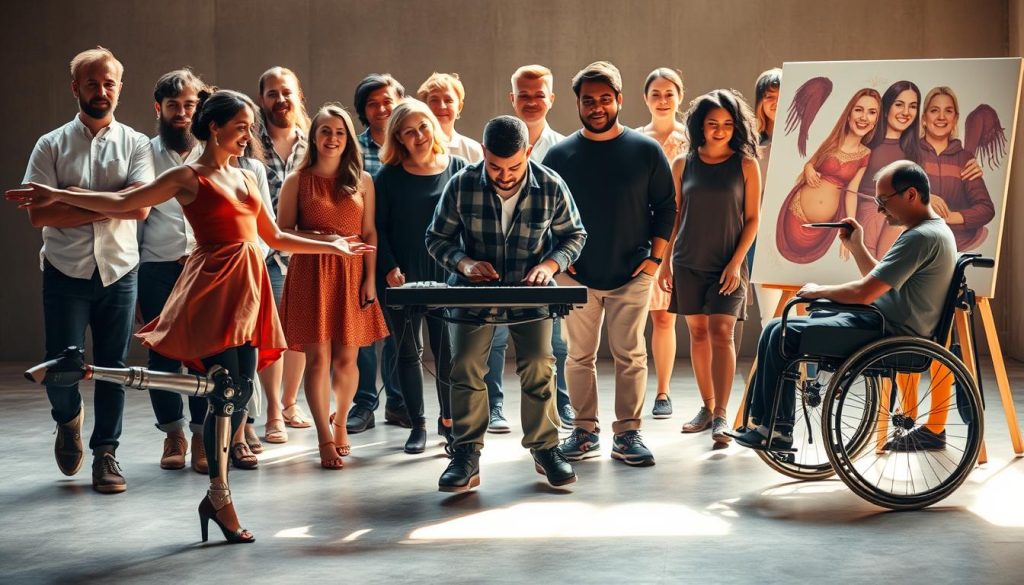
Stanislavski’s methods? These disability arts rebels toss them aside like last season’s props. Meet the rule-breaking creatives transforming stages into laboratories of radical inclusion. They use wheelchairs, neurodivergent perspectives, and creative audacity.
The Derbyshire/Czymoch/McCaffrey team is like Marvel’s Avengers of adaptive performance. Jan Derbyshire’s sensory-friendly set designs are amazing. Czymoch’s ASL-integrated choreography turns hand movements into poetry. McCaffrey’s “messy accessibility” philosophy celebrates imperfect solutions.
“We’re not here to make you comfortable – we’re here to make you think with your entire nervous system.”
Becky Gold’s Our Stories project redefines autobiographical theater. Imagine Kafka writing stand-up comedy filtered through ADHD perception. Gold’s neurodivergent ensemble creates performances that:
- Mash spoken word with stimming patterns
- Use lighting design as emotional subtitles
- Turn audience participation into collective neurotype celebration
In Australia, Back to Back Theatre treats inclusion like an extreme sport. Their actors with intellectual disabilities don’t just break the fourth wall – they bulldoze it, rebuild it sideways, then charge admission for the demolition tour. Recent productions feature:
- Interactive captioning that argues with performers
- Tactile set pieces doubling as accessibility tools
- Audience seating that’s deliberately uncomfortable (for abled patrons only)
CRIPSiE’s dance research is like the Zapruder film of disability arts. Their movement studies dissect:
| Traditional Dance | CRIPSiE Adaptation | Revolution Quotient |
|---|---|---|
| Pirouettes | Power chair spins | 9.8/10 |
| Leaps | Assisted aerial transfers | 11/10 |
| Ensemble synchronization | Intentional dyssynchrony | ∞/10 |
These innovators prove that disability arts aren’t about overcoming limitations – they’re about weaponizing creative constraints. As Back to Back’s latest provocations demonstrate, sometimes the most revolutionary act is simply existing unapologetically on stage. Who needs standing ovations when you can spark cognitive earthquakes?
Stories from Performers and Audience
Imagine a wedding dance with seizure-response choreography. It’s like Broadway meets raw, honest storytelling. Utopia’s Our Stories project breaks down barriers with real-life tales. It’s like Hamilton meets a TED Talk, but with more truth and less pretence.
Meet Jess, a neurodivergent performer who turned her dating life into a dark comedy:
“My Tinder bio should’ve said: ‘Seeking partner who understands stimming isn’t Morse code.’”
Her performance, done in ASL and dance, made audiences laugh and search for access intimacy online. It was a game-changer.
COVID-19 made these stories even more powerful. D/deaf actor Rajesh Digh said: “Lockdown taught hearing people what silence really tastes like.” His piece used vibrating panels and strobe captions to show the emptiness of quarantine.
Utopia’s magic lies in letting artists share their truths:
- A wheelchair user reimagining Swan Lake with ramp choreography
- Autistic poets performing through text-to-speech apps synced to light installations
- Post-show talkbacks where audiences ask “How?” instead of “Why?”
This isn’t just accessible theater. It’s about tearing down cultural barriers. When TikTok favors short, disturbing videos, Utopia’s artists ask us to watch the whole story. People leave feeling changed, not just entertained. One viewer tweeted: “I came for the art, stayed for the existential crisis.”
Adaptive Sports and Theater Crossovers
When adaptive sports and theater collide, it’s not a polite handshake. It’s more like CRIPSiE’s contact improvisation workshops. Here, dancers use wheelchair rugby techniques to turn collisions into choreography.
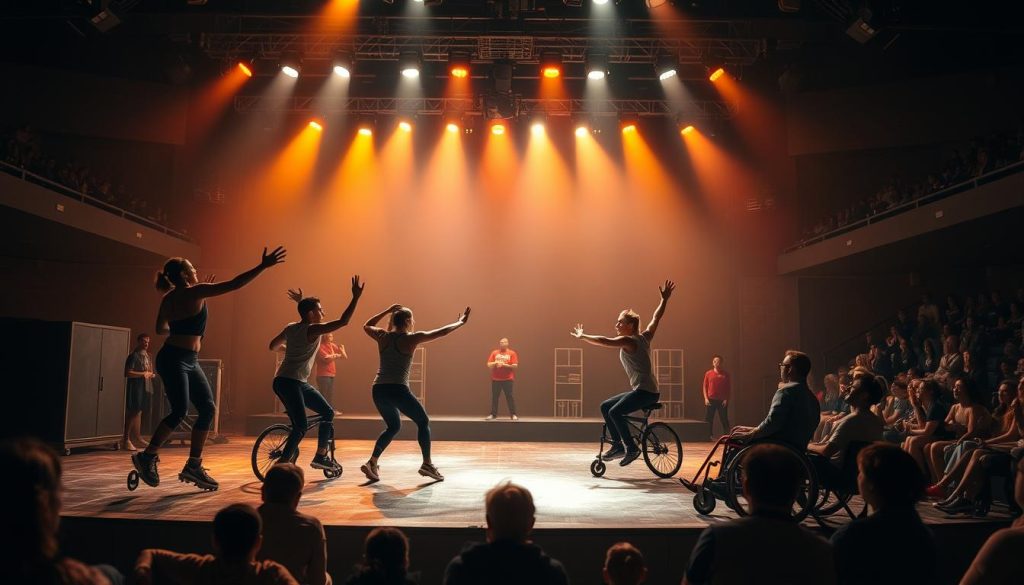
Turinsky’s Reverberations brings athletes and performers together. It’s like a family reunion, but with a twist. The piece doesn’t just adapt movement; it uses it as a weapon.
Dancers perform explosive moves like Paralympic basketball players. Poets deliver verses with the precision of a swimmer. It shows how inclusion can be a real contact sport.
Wheelchair rugby teaches us about controlled chaos. It’s a game of strategy and physical play. CRIPSiE’s research shows how this creates strong partnerships based on trust and speed.
“We’re not translating sports into art—we’re remixing both into a third language,”
The magic lies in the unpredictability of adaptive performance. Assistive devices become props, and missed catches turn into duets. Disability arts are rewriting the rules, one collision at a time.
How to Support and Get Involved
Changing accessible theater needs more than just clapping. It requires active participation. Start by thinking differently about funding. Utopia’s “open source generosity” lets fans support specific features like ASL interpreters.
Buying a ticket can be a bold statement. Now, some venues let you donate part of your ticket to inclusion efforts. This way, every purchase can help make theater more accessible.
Being an ally is about small actions. Join Our Stories’ workshop on “Stealth Activism” to learn how to support disability arts subtly. You can also volunteer as an usher, learning about accessibility while sharing great stories.
Corporate teams should focus on real change. Sponsor theater-sports that help fund wheelchair ramps. Individuals can find grants for inclusion projects. Crowdfunding specific tech can turn donors into allies.
Creating change means making it someone else’s problem. Share Utopia’s accessibility toolkit with your local theater. Remember, real change doesn’t need big actions. Sometimes, it’s just about better captioning and knowing who’s there.
